

From an 86-day dash toward the Sun to Voyager 2’s 12-year trip to Neptune, real launch and arrival dates show that the route and the arrival plan matter more than the distance.
Getting to the planets has taken robotic spacecraft anywhere from about three months to twelve years. Venus has been reached in 94 to 463 days, Mars in about 7 to 10 months, Jupiter in 1.1 to 6.1 years, Saturn in 3.2 to 6.7 years, Uranus in 8.4 years and Neptune in 12.0 years. New Horizons reached Pluto in 9.5 years, and Parker Solar Probe made its first close pass of the Sun just 86 days after launch.
The spread within each planet comes down to one choice: fly past, or stop. A flyby can arrive fast. An orbiter has to arrive slowly enough to be captured, which usually means a longer, looping route with gravity assists along the way. That is why MESSENGER needed 6.6 years to enter orbit around Mercury, a planet Mariner 10 flew past only 146 days after launch.
Explain it like I’m busy:
- Inner planets: months for a flyby, years for an orbiter. Outer planets: years either way, up to 12 for Neptune.
- Spacecraft follow curved paths around the Sun, so travel time depends on the route, not the straight-line distance.
- The Sun and Mercury are hard to reach because a spacecraft must shed most of Earth’s 29.8 km/s orbital speed.
Key facts
- Fastest arrival in our table: Parker Solar Probe’s first close pass of the Sun, 86 days after its August 2018 launch.
- Longest: Voyager 2 to Neptune, 4,388 days (12.0 years), still the only visit to Uranus or Neptune by any spacecraft.
- The calculated minimum-energy (Hohmann) trip to Neptune is about 30.8 years. Voyager 2 took 12 because Jupiter, Saturn and Uranus each added speed through gravity assists.
- Reaching the Sun’s surface would take a calculated change in speed of about 26.9 km/s, more than twice the 12.3 km/s needed to escape the Solar System from Earth’s orbit.
- Radio signals take between 2.1 minutes (Venus at its closest) and about 7 hours (Pluto at its farthest) to cross the gap, based on NASA’s minimum and maximum Earth distances.
How long did real missions take to reach each planet?
| Destination | Mission | Type | Launch | Arrival event | Travel time |
|---|---|---|---|---|---|
| Sun | Parker Solar Probe | Close pass | 12 Aug 2018 | 6 Nov 2018 (first perihelion, 24 million km from the surface) | 86 days |
| Sun | Parker Solar Probe | Close pass | 12 Aug 2018 | 24 Dec 2024 (record pass, 6.1 million km from the surface) | 2,326 days (6.4 years) |
| Mercury | Mariner 10 | Flyby | 3 Nov 1973 | 29 Mar 1974 (first Mercury flyby) | 146 days |
| Mercury | MESSENGER | Orbiter | 3 Aug 2004 | 18 Mar 2011 (orbit insertion) | 2,418 days (6.6 years) |
| Mercury | BepiColombo (ESA/JAXA) | Orbiters | 20 Oct 2018 | 21 Nov 2026 (planned orbit insertion) | 2,954 days (8.1 years), if on schedule |
| Venus | Mariner 10 | Flyby | 3 Nov 1973 | 5 Feb 1974 (closest approach) | 94 days |
| Venus | Venus Express (ESA) | Orbiter | 9 Nov 2005 | 11 Apr 2006 (arrival) | 153 days |
| Venus | Magellan | Orbiter | 4 May 1989 | 10 Aug 1990 (orbit) | 463 days |
| Mars | Six NASA missions, from Mariner 4 to Perseverance: see how long it takes to get to Mars | 203–307 days | |||
| Jupiter | New Horizons | Flyby | 19 Jan 2006 | 28 Feb 2007 (closest approach) | 405 days |
| Jupiter | Voyager 1 | Flyby | 5 Sep 1977 | 5 Mar 1979 (closest approach) | 546 days |
| Jupiter | Juno | Orbiter | 5 Aug 2011 | 4 Jul 2016 (orbit insertion, US time) | 1,795 days (4.9 years) |
| Jupiter | Galileo | Orbiter | 18 Oct 1989 | 7 Dec 1995 (arrival and orbit insertion) | 2,241 days (6.1 years) |
| Saturn | Voyager 1 | Flyby | 5 Sep 1977 | 12 Nov 1980 (closest approach) | 1,164 days (3.2 years) |
| Saturn | Voyager 2 | Flyby | 20 Aug 1977 | 26 Aug 1981 (closest approach, UT) | 1,467 days (4.0 years) |
| Saturn | Cassini | Orbiter | 15 Oct 1997 | 1 Jul 2004 (orbit insertion, UT) | 2,451 days (6.7 years) |
| Uranus | Voyager 2 | Flyby | 20 Aug 1977 | 24 Jan 1986 (closest approach) | 3,079 days (8.4 years) |
| Neptune | Voyager 2 | Flyby | 20 Aug 1977 | 25 Aug 1989 (closest approach) | 4,388 days (12.0 years) |
| Pluto | New Horizons | Flyby | 19 Jan 2006 | 14 Jul 2015 (closest approach) | 3,463 days (9.5 years) |
Source: dates from each linked NASA or ESA mission page, the NASA Parker Solar Probe blog and closest-pass release, and NASA’s Cassini FAQ, checked 14 October 2026. Travel days are SciQuest calculations (arrival date minus launch date) and can shift by one day with time zone; Voyager 2’s Saturn pass and Cassini’s orbit insertion fell on the previous evening in US time. Parker distances are converted from NASA’s 15 million and 3.8 million miles. BepiColombo has not yet arrived; its date is ESA’s plan as of 6 October 2026.
Read the table by type, not by year. Every flyby on the list beat every orbiter heading to the same planet. Jupiter makes the point twice: New Horizons and Voyager 1 swept past in 405 and 546 days, while Juno and Galileo, which had to stay, took 4.9 and 6.1 years.
What it means: passing a planet versus stopping at it
Think of a planet as a bus on a ring road and your spacecraft as a cyclist on an inner lane. To wave at the passengers, you only need to be at the right spot when the bus goes by, at whatever speed you like. To climb aboard, you must match the bus’s speed as well as its position. Orbiters are trying to climb aboard.
The analogy breaks down in one place. A bus does not pull on you, but a planet does: its gravity speeds a spacecraft up as it falls in. An orbiter must fire its engine hard enough to cancel that extra speed, or it will swing past and leave again. JPL’s arrival press kit planned a main-engine burn of about 96 minutes for Cassini to be captured by Saturn, and NASA’s Cassini FAQ says the spacecraft was moving at 68,771 mph (about 110,700 km/h) relative to Saturn during the manoeuvre.
How scientists calculate the trip: the Hohmann transfer
The cheapest route in fuel between two circular orbits is a Hohmann transfer. NASA’s Basics of Space Flight describes it as an orbit around the Sun whose closest point lies on Earth’s orbit and whose farthest point lies on the target planet’s orbit. The spacecraft rides half of this ellipse, so the trip lasts half of one orbital period. Kepler’s third law gives that time directly.
Worked calculation for Jupiter and Neptune
- Orbit sizes (measured): mean distance from the Sun is 149.6 million km for Earth, 778.5 million km for Jupiter and 4,515.0 million km for Neptune (NASA Planetary Fact Sheet).
- Transfer orbit size: the semi-major axis a is the average of the two distances. Jupiter: (149.6 + 778.5) ÷ 2 = 464.05 million km. Neptune: (149.6 + 4,515.0) ÷ 2 = 2,332.3 million km.
- The Sun’s pull: the Sun’s gravitational parameter, GM, is 1.32712 × 10¹¹ km3/s2 (NASA Sun Fact Sheet).
- Half an orbit: t = π√(a3 ÷ GM).
Jupiter: a3 = 9.993 × 1025 km3; divided by GM gives 7.530 × 10¹⁴ s2; the square root is 2.744 × 10⁷ s; times π is 8.62 × 10⁷ s, or about 998 days (2.7 years).
Neptune: a3 = 1.2687 × 1028 km3; divided by GM gives 9.560 × 10¹⁶ s2; the square root is 3.092 × 10⁸ s; times π is 9.71 × 10⁸ s, or about 11,242 days (30.8 years).
These are calculated, idealised figures. They assume circular orbits in one plane and ignore the planets’ own gravity, and they apply only when the target sits in the right place at launch.
| Destination | Mean distance from Sun (million km) | Hohmann transfer time (calculated) | Fastest arrival in our table |
|---|---|---|---|
| Mercury | 57.9 | 105 days | 146 days (Mariner 10, via Venus) |
| Venus | 108.2 | 146 days | 94 days (Mariner 10 flyby) |
| Mars | 228.0 | 259 days | 203 days (Perseverance) |
| Jupiter | 778.5 | 998 days (2.7 years) | 405 days (New Horizons) |
| Saturn | 1,432.0 | 2,220 days (6.1 years) | 1,164 days (Voyager 1) |
| Uranus | 2,867.0 | 5,847 days (16.0 years) | 3,079 days (Voyager 2) |
| Neptune | 4,515.0 | 11,242 days (30.8 years) | 4,388 days (Voyager 2) |
| Pluto | 5,906.4 | 16,631 days (45.5 years) | 3,463 days (New Horizons) |
Source: distances from the NASA Planetary Fact Sheet; GM from the NASA Sun Fact Sheet. Transfer times are SciQuest calculations using t = π√(a³/GM) with circular, coplanar orbits. Pluto’s orbit is strongly elliptical (4,436.8 to 7,375.9 million km from the Sun), so its row is the roughest approximation.
Beyond Mars, every fast mission beat the Hohmann time, some by more than half. A Hohmann transfer is the slowest sensible route because it uses the least energy; spacecraft launched with more energy, or picked up speed from planets on the way, can cut across sooner. The catch is arrival speed. A fast flyby arrives too quickly to stop.
Why gravity assists change the clock
In a gravity assist, a spacecraft flies close to a planet and trades momentum with it. NASA’s Basics of Space Flight explains that the planet’s orbital angular momentum is shared with the spacecraft, and that a flyby can also be aimed to slow a craft down. The planet’s own change is far too small to notice.
For outer-planet flybys, assists save years. NASA says Jupiter added about 9,000 mph (roughly 14,500 km/h) to New Horizons and shortened its trip to Pluto by three years. Voyager 2 picked up speed at Jupiter, Saturn and Uranus on the way to Neptune.
For heavy orbiters, assists are what make the trip possible at all, at the cost of time. JPL’s Cassini arrival press kit says Cassini was too massive for any available rocket to send directly to Saturn, so it flew past Venus twice, Earth once and Jupiter once. Galileo’s planned direct trip of about 3.5 years became a six-year route via Venus and Earth after its upper-stage rocket was changed, according to NASA’s Galileo mission page. Juno came back past Earth 26 months after launch for a boost of about 7.3 km/s.
Why getting to the Sun and Mercury is so hard
Everything launched from Earth starts out moving with Earth, about 29.8 km/s around the Sun (NASA Planetary Fact Sheet). To fall inward, a spacecraft has to cancel much of that sideways speed. NASA’s spaceflight primer describes it as firing against the direction of Earth’s motion so the craft keeps circling the Sun, only more slowly.
The numbers are lopsided. Starting from Earth’s orbit and ignoring Earth’s own gravity, we calculate that dropping onto the Sun’s surface needs a change in speed of about 26.9 km/s, while escaping the Solar System altogether needs about 12.3 km/s. Even Parker Solar Probe’s record pass, 6.1 million km above the surface, would take roughly 21 km/s by the same idealised calculation. No rocket provides that directly, so Parker made seven Venus flybys to lower its orbit step by step, NASA says. Its first close pass came after 86 days; its record one, after more than six years.
Mercury has the same problem, plus a second one. It moves at 47.4 km/s, the fastest of any planet, so an orbiter must match a target that is both deep in the Sun’s gravity and racing. MESSENGER used one Earth, two Venus and three Mercury flybys before it could enter orbit. BepiColombo has used nine planetary flybys, six of them at Mercury, and is due to enter orbit on 21 November 2026, ESA says.
How long does light take to reach each planet?
Light, and radio, travel at 299,792 km/s and need no route planning, which makes signal delay the honest lower limit on any trip. Because Earth and the planets move, the delay changes through the year.
| Destination | Closest to Earth (million km) | Farthest from Earth (million km) | Light time (closest to farthest) |
|---|---|---|---|
| Sun | 149.6 (mean) | 8.3 minutes | |
| Mercury | 77.3 | 221.9 | 4.3 to 12.3 minutes |
| Venus | 38.2 | 261.0 | 2.1 to 14.5 minutes |
| Mars | 54.6 | 401.4 | 3.0 to 22.3 minutes |
| Jupiter | 588.5 | 968.5 | 33 to 54 minutes |
| Saturn | 1,205.5 | 1,658.6 | 1.1 to 1.5 hours |
| Uranus | 2,580.6 | 3,153.5 | 2.4 to 2.9 hours |
| Neptune | 4,319.0 | 4,711.0 | 4.0 to 4.4 hours |
| Pluto | 4,284.7 | 7,528.0 | 4.0 to 7.0 hours |
Source: minimum and maximum Earth distances from each NASA planetary fact sheet (Sun: NASA Sun Fact Sheet mean distance). Light times are SciQuest calculations using 299,792.458 km/s.
Pluto’s closest distance is slightly smaller than Neptune’s because Pluto’s eccentric orbit sometimes carries it inside Neptune’s. For the jump from planets to stars, see how long it takes to travel one light-year.
What changes the answer
- Flyby or orbit: the biggest single factor in the table, often a difference of years.
- Launch window: planets must be in the right places. Each mission’s route is designed around a specific window, and missing it can mean waiting months or years.
- Spacecraft mass and rocket: heavier craft need more help from gravity assists, as Cassini and Galileo did.
- Which assists are available: Voyager 2’s chain of Jupiter, Saturn, Uranus and Neptune depended on the planets’ positions in the late 1970s.
- What “arrival” means: first flyby, orbit insertion and landing can be months apart. Our table states the event for every row.
How it compares
Online travel-time lists often divide the closest Earth–planet distance by a fixed speed. That gives a straight-line floor, and it can mislead in two ways: spacecraft lose speed as they climb away from the Sun, and they cannot fly a straight line between moving planets. Mixing up events causes errors too. Mariner 10 reached Venus in 94 days; the 146-day figure sometimes given for Venus is actually its arrival at Mercury.
For a sense of scale only, here is the straight-line arithmetic for a familiar speed. Driving at a constant 100 km/h, the 4,319 million km to Neptune at its closest would take about 4,900 years. Voyager 2 did the real, curved trip in 12, and light does it in about 4 hours. For the speed side of the story, see how fast we can travel in space with current technology.
Why it matters to you
These times decide what we can learn and when. A mission to the outer planets is a career-length commitment: Voyager 2 launched in 1977 and reached Neptune in 1989, and NASA says it is still the only spacecraft to visit Uranus or Neptune. Any new orbiter for those planets would add years more for braking. On the near side, a 3- to 22-minute radio delay at Mars, and hours at Neptune, is why spacecraft there have to manage much of their work on their own.
“But wait…” why not just fly straight there, faster?
Going faster costs fuel, and the fuel needed climbs steeply with speed. The bigger obstacle is arrival: the faster you go, the more speed you have to shed to stay. New Horizons shows the trade-off. It left Earth at about 58,500 km/h relative to Earth, according to NASA, and reached Pluto in 9.5 years, but it could only fly past at a closest distance of about 7,800 km above the surface, with no way to stop.
Related questions
How long does it take to get to Mars? NASA missions have taken 203 to 307 days; the full breakdown, with launch windows, is in our guide to Mars travel time.
How long does it take to get to the Sun? Parker Solar Probe made its first close pass 86 days after launch, at about 24 million km from the surface. Reaching its record distance of 6.1 million km took 2,326 days and seven Venus flybys. Nothing can land on the Sun.
How long would Earth take to fall into the Sun if it stopped orbiting? About 65 days, by our calculation using the free-fall time (π/2)√(r³ ÷ 2GM) from 1 AU. It is a thought experiment, not a risk: nothing could stop Earth’s orbital motion.
Does gravity feel different when you get there? Yes, and by a lot: see gravity on other planets for NASA values for each world.
In one sentence
Spacecraft have reached Venus in about three months and Neptune in twelve years, and the biggest factor in each trip is whether the craft flies past or stops, which determines the route, the gravity assists and the braking needed.
Quick check: did it click?
- Why did MESSENGER take 6.6 years to reach Mercury when Mariner 10 took 146 days? MESSENGER had to slow down enough to enter orbit, using six planetary flybys; Mariner 10 only flew past.
- Why is the calculated Hohmann trip to Neptune (30.8 years) longer than Voyager 2’s 12? A Hohmann transfer uses the least energy; Voyager 2 gained speed from gravity assists at Jupiter, Saturn and Uranus.
- Why is the Sun harder to reach than the edge of the Solar System? A spacecraft must cancel most of Earth’s 29.8 km/s orbital speed to fall inward: about 26.9 km/s to hit the surface versus 12.3 km/s to escape.
Read next
- How long does it take to get to Mars? Mission times and the math
- How fast can we travel in space? Speed records and real limits
- How long does it take to travel one light-year?
Sources
- NASA Science, Parker Solar Probe mission page (launch 12 Aug 2018).
- NASA Parker Solar Probe blog, Parker Solar Probe reports first telemetry since perihelion (20 Nov 2018; first perihelion 6 Nov, 15 million miles from the surface).
- NASA Science, NASA’s Parker Solar Probe makes history with closest pass to Sun (24 Dec 2024 pass, 3.8 million miles, 430,000 mph, seven Venus flybys).
- NASA Science, Mariner 10; MESSENGER; Magellan; Galileo; Juno; New Horizons; Voyager 1; Voyager 2 mission pages.
- NASA Science, Cassini FAQ (arrival 1 Jul 2004 UT), and JPL, Cassini-Huygens Saturn Arrival press kit (PDF; gravity assists, planned 96-minute burn).
- ESA, BepiColombo and Latest updates: BepiColombo’s arrival at Mercury (planned orbit insertion 21 Nov 2026).
- ESA, Venus Express (launch 9 Nov 2005, arrival 11 Apr 2006).
- NASA Goddard (NSSDCA), Planetary Fact Sheet, individual planet fact sheets and Sun Fact Sheet (distances, orbital speeds, GM).
- NASA, Basics of Space Flight, Chapter 4: Trajectories (Hohmann transfers, gravity assists, inward travel).
- NASA History, 35 years ago: STS-30 launches Magellan to Venus (route 1.5 times around the Sun).
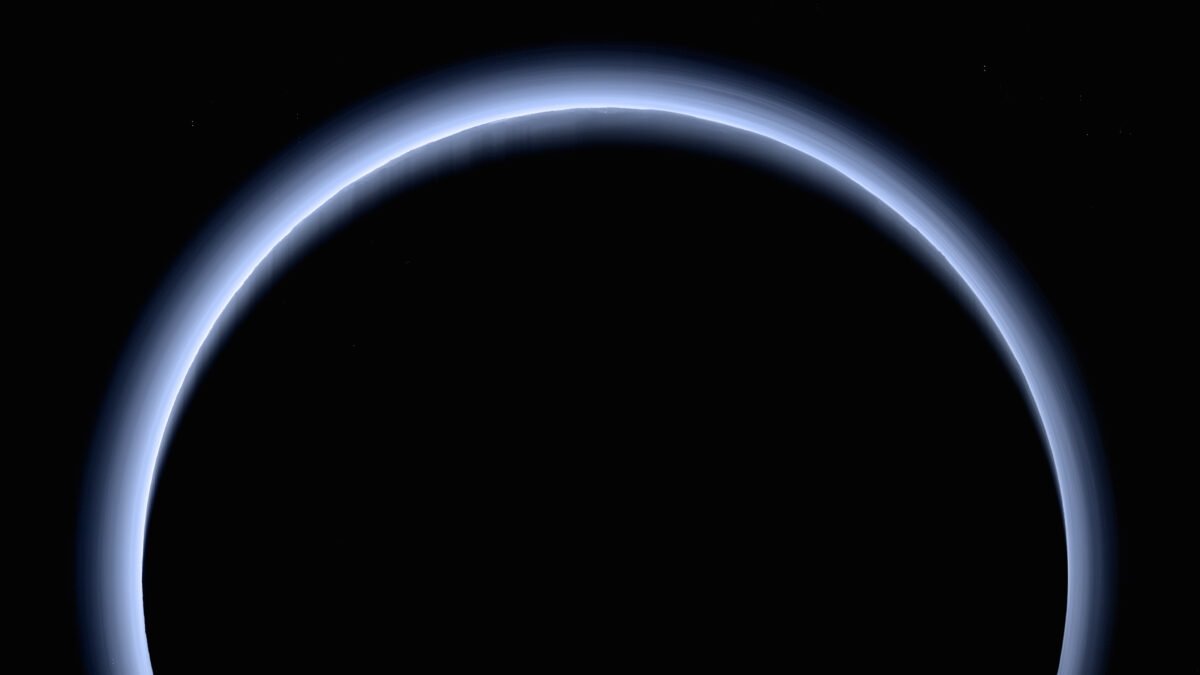
Disclosure: This article was drafted with AI assistance and checked against the sources above. Travel days, Hohmann transfer times, changes in speed and light times are SciQuest calculations from the cited NASA and ESA values; the chart is a SciQuest original graphic built from the same data. The featured image of Pluto’s haze is a NASA/JHUAPL/SwRI photograph from New Horizons. Spotted an error? See our corrections policy.
Discover more from SciQuest
Subscribe to get the latest posts sent to your email.
Leave a comment