

NASA robotic spacecraft have reached Mars in 203 to 307 days, and the reason is less about rocket speed than about catching a planet that circles the Sun at about 24 kilometres per second.
It takes about seven to ten months to get to Mars. NASA’s Perseverance rover made the trip in 203 days in 2020–21, Curiosity took 254 days, and Viking 1 needed 304 days to reach Mars orbit in 1976. The idealised minimum-energy route, called a Hohmann transfer orbit, works out to about 259 days, or roughly 8.5 months.
That time is set by orbital mechanics, not by a straight-line distance. A spacecraft cannot simply aim at Mars; it coasts on a curved path around the Sun and must arrive where Mars will be months later. Those efficient departures open only about once every 26 months.
Explain it like I’m busy:
- NASA missions in the table below took 203–307 days to reach Mars.
- The textbook minimum-energy trip is about 259 days, because a spacecraft travels half an orbit around the Sun.
- Launch windows recur about every 26 months; NASA plans a crewed round trip at roughly two years, possibly more than three.
Key facts
- Typical one-way time for NASA robotic missions: about 7 to 10 months (203–307 days in our sample of six).
- Calculated Hohmann transfer time: about 259 days, assuming circular orbits in the same plane.
- Earth and Mars return to the same alignment once per synodic period of 779.94 days, about 25.6 months (NASA Mars Fact Sheet). NASA’s Basics of Space Flight rounds this to “about every 25 months”; many sources round to 26.
- The curved transfer path is roughly 587 million km long, more than ten times the closest Earth–Mars distance of 54.6 million km.
- NASA describes a crewed round trip as about two years, and potentially more than three years if the crew must wait at Mars for the return window.
How long did past missions take to reach Mars?
| Mission | Type | Launch | Arrival at Mars | Travel time (days) |
|---|---|---|---|---|
| Mariner 4 | Flyby | 28 Nov 1964 | 14 Jul 1965 (closest approach) | 228 |
| Viking 1 | Orbiter and lander | 20 Aug 1975 | 19 Jun 1976 (orbit insertion) | 304 |
| Mars Pathfinder | Lander and rover | 4 Dec 1996 | 4 Jul 1997 (landing) | 212 |
| Curiosity | Rover | 26 Nov 2011 | 6 Aug 2012 (landing) | 254 |
| MAVEN | Orbiter | 18 Nov 2013 | 21 Sep 2014 (orbit insertion) | 307 |
| Perseverance | Rover | 30 Jul 2020 | 18 Feb 2021 (landing) | 203 |
Source: dates from each linked NASA mission page, checked 12 October 2026. Travel days are SciQuest calculations (arrival date minus launch date) and can shift by one day with time zone; NASA lists Mariner 4’s closest approach and MAVEN’s orbit insertion in US Eastern time. Viking 1 landed a month after orbit insertion, on 20 July 1976.
Two patterns stand out. First, there is no steady speed-up over 60 years: Mariner 4 in 1964 arrived faster than MAVEN in 2013. Second, the spread of about 100 days reflects where the planets sit in each launch window, how heavy the spacecraft is and how it needs to arrive, rather than better engines. For the wider picture on speed, see our guide to how fast we can travel in space with current technology.
What it means: you are aiming at a moving target
Think of throwing a ball to a friend running on an outer lane of a track while you jog on an inner lane. You do not throw at where they are; you throw to where they will be. NASA’s own spaceflight primer describes Mars launches in the same terms, as leading a moving target.
The analogy breaks down in one important way. The spacecraft is not thrown in a straight line. Once its engine shuts off, it falls around the Sun on its own orbit, curving outward until it meets Mars’s path.
How scientists calculate the trip: the Hohmann transfer
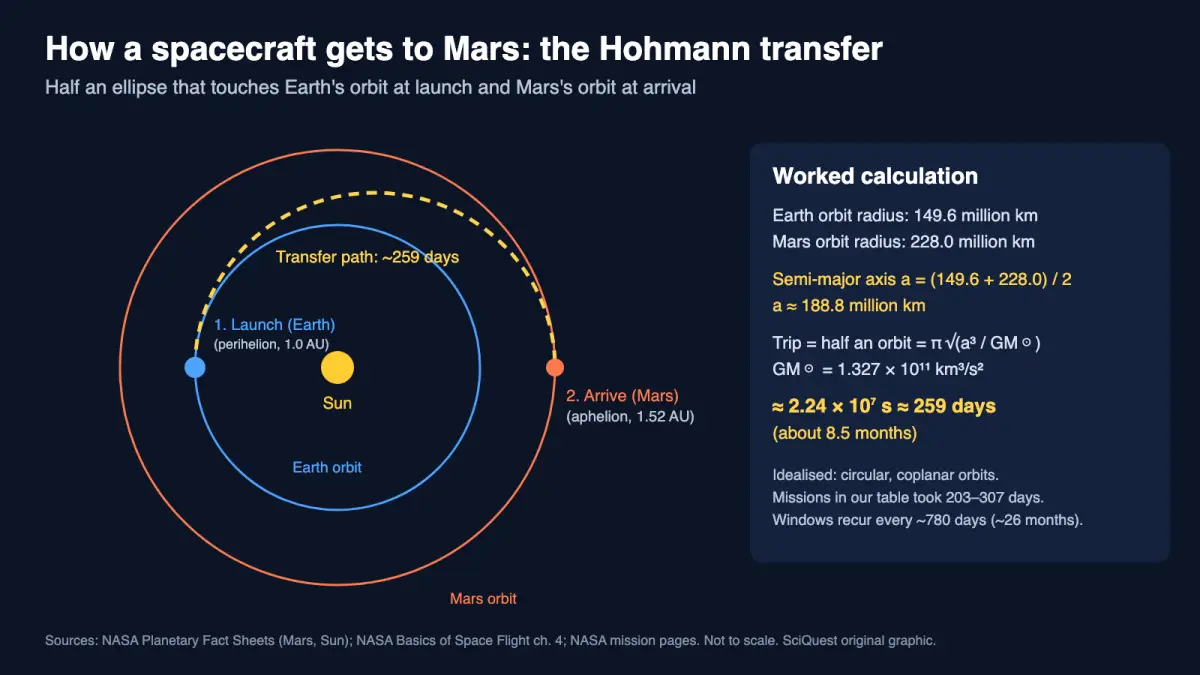
The route that uses the least energy is a Hohmann transfer orbit. NASA describes it as an ellipse whose point closest to the Sun (perihelion) lies on Earth’s orbit and whose farthest point (aphelion) lies on Mars’s orbit. The spacecraft rides only half of this ellipse, from one end to the other.
Worked calculation
- Orbit sizes (measured): the average distance of Earth from the Sun is 149.598 million km, and of Mars 227.956 million km (NASA Mars Fact Sheet).
- Semi-major axis of the transfer ellipse: a = (149.598 + 227.956) ÷ 2 = 188.777 million km = 1.88777 × 10⁸ km.
- Kepler’s third law: one full orbit takes T = 2π √(a³ ÷ GM), where GM for the Sun is 1.32712 × 10¹¹ km³/s² (NASA Sun Fact Sheet).
- Half an orbit: t = π √((1.88777 × 10⁸)³ ÷ (1.32712 × 10¹¹)) ≈ 2.237 × 10⁷ s.
- Convert: 2.237 × 10⁷ s ÷ 86,400 s per day ≈ 259 days, or about 8.5 months.
This is a calculated value for a simplified solar system with circular orbits in one plane. Real orbits are slightly elliptical and tilted, so mission designers plan actual trajectories with detailed software, and those can be shorter or longer.
What changes the answer
- The launch window. Earth and Mars return to the same relative positions once every 779.94 days (NASA Mars Fact Sheet), about 25.6 months. Miss a window and the efficient route closes until the next one.
- Mars’s elliptical orbit. Mars’s distance from the Sun varies, so some windows require more energy than others for the same trip.
- Extra speed. Leaving Earth faster than the Hohmann minimum shortens the trip, as Perseverance’s 203 days show, but it costs propellant and makes slowing down at Mars harder.
- What counts as “arrival”. A flyby (Mariner 4), orbit insertion (MAVEN) and landing (Perseverance) are different end points. Viking 1 reached orbit on 19 June 1976 but did not land until 20 July.
How long would a crewed trip to Mars take?
No human has yet travelled to Mars, so every crewed figure is a planning estimate, not a record. NASA’s technology overview says the round trip, including time in transit, “will take about two years.” NASA has also noted that waiting at Mars for the planets to realign could stretch the mission “to more than three years,” and says its goal is to keep crew travel time as close to two years as practical.
Faster options, such as nuclear propulsion, are being studied, but NASA says it is too soon to know which system will carry the first astronauts. Our article on how strong gravity is on Mars explains what those astronauts would feel after landing.
How it compares
At its closest, Mars is 54.6 million km from Earth, and at its farthest 401.4 million km (NASA Mars Fact Sheet). Yet the Hohmann path is about 587 million km long (a SciQuest estimate of half the ellipse’s perimeter), more than ten times the closest distance. That is the cost of travelling efficiently: the spacecraft swings around the Sun rather than crossing the gap directly. For how the gap itself changes, see how far away Mars is from Earth.
Why it matters to you
Travel time shapes almost everything about a Mars mission: how much food, water and air a crew needs, how long they are exposed to deep-space radiation, and how long they would wait for help. It also explains why Mars launches cluster together; when several spacecraft leave Earth in the same summer, they are sharing the same window.
“But wait…”
Why not launch when Mars is closest and fly straight there? Because both planets keep moving during the months of flight. If you launched at closest approach on a Hohmann path, Mars would have moved far ahead by the time you reached its orbit. On this route, the spacecraft must leave while Mars is still ahead of Earth in its orbit, before the planets are at their closest, so that the two meet on the far side of the Sun.
Related questions
Could we get to Mars in three months? Not with any spacecraft flown so far; the fastest trip in our table took 203 days. Much shorter trips would need far more energy or new propulsion that is still being studied.
How long does a radio signal take to reach Mars? Light covers 54.6 million km in about 3 minutes and 401.4 million km in about 22 minutes, so the one-way delay ranges between those values (SciQuest calculation). Our Mars distance guide explains why the distance changes.
Why don’t Mars missions launch every year? Because the efficient alignment repeats only once every 779.94 days, about every 26 months.
In one sentence
Getting to Mars takes about seven to ten months, because spacecraft must coast half an orbit around the Sun and can depart efficiently only about once every 26 months.
Quick check: did it click?
- Why can’t a spacecraft fly straight to Mars? It follows an orbit around the Sun and must arrive where Mars will be, not where it was at launch.
- About how long does the idealised Hohmann transfer take? About 259 days, or 8.5 months.
- How often do efficient launch windows open? About every 26 months (779.94 days).
Read next
- How far away is Mars from Earth?
- How fast can we travel in space with current technology?
- Can humans survive on Mars?
Sources
- NASA Science, Mariner 4 mission page.
- NASA Science, Viking mission page.
- NASA Science, Mars Pathfinder mission page.
- NASA Science, Mars Science Laboratory: Curiosity mission page.
- NASA Science, MAVEN mission page.
- NASA Science, Mars 2020: Perseverance mission page.
- NASA Science, Basics of Space Flight, Chapter 4: Trajectories.
- NASA NSSDCA, Mars Fact Sheet.
- NASA NSSDCA, Sun Fact Sheet.
- NASA, 6 Technologies NASA is Advancing to Send Humans to Mars.
- NASA, Nuclear Propulsion Could Help Get Humans to Mars Faster.
Disclosure: This article was drafted with AI assistance and checked against the sources above. Travel days, the Hohmann transfer time, path length and signal delays are SciQuest calculations from NASA-published dates and constants; the diagram is a SciQuest original graphic and is not to scale. Spotted an error? See our corrections policy.
Discover more from SciQuest
Subscribe to get the latest posts sent to your email.
Leave a comment