

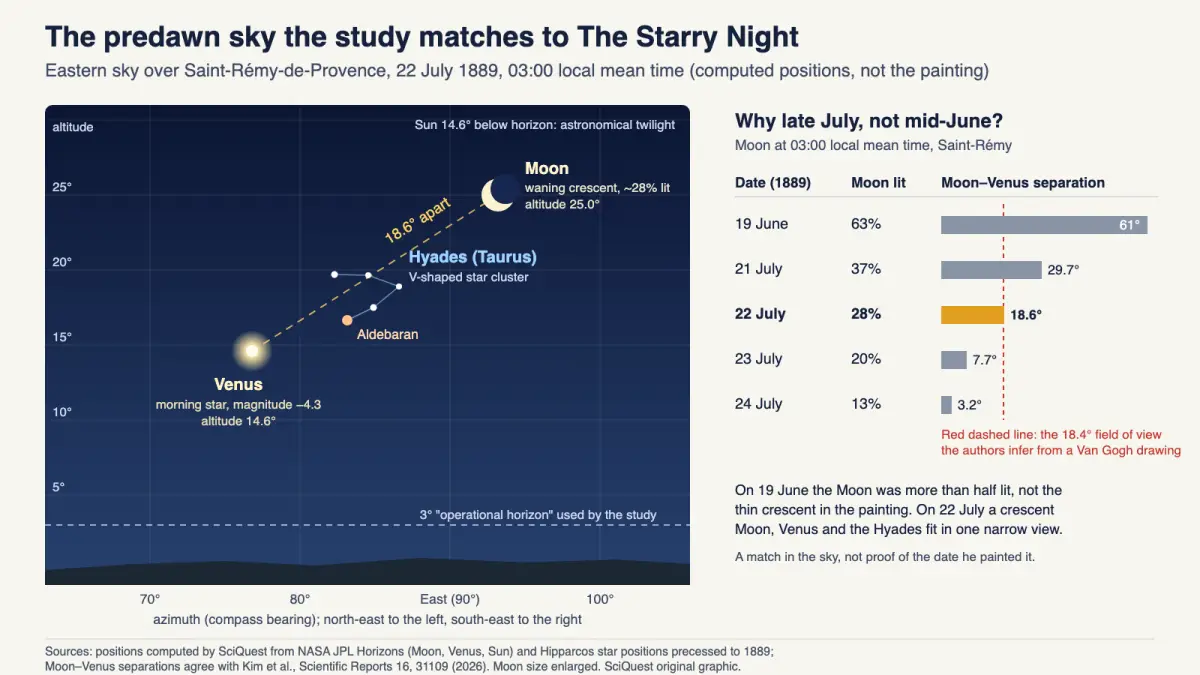
A new reconstruction finds that a waning crescent Moon, Venus and the Hyades star cluster fitted inside one narrow view of the eastern sky before dawn on about 22 July 1889, while on the usual mid-June date the Moon was more than half lit.
Peer reviewed · Interpretive/modelling study · Evidence strength: limited
Vincent van Gogh’s The Starry Night may record a real predawn sky from about 22 July 1889, roughly a month after the June date art historians usually give it. Elijah Jeong-hyun Kim of Kyung Hee University and the company SLLAB, with three co-authors, makes the case in Scientific Reports using sky simulations, star-pattern geometry, 1889 weather records and the painter’s letters. If it holds, the sky was observed, not invented. The catch: this is a best-fit reconstruction, and Van Gogh worked the sky up in his studio, possibly blending several nights.
What you need to know
- Finding: Before dawn on about 22 July 1889, a 28% lit crescent Moon and Venus sat 18.6° apart in the eastern sky over Saint-Rémy-de-Provence, with the Hyades cluster in Taurus between them.
- Method: The team simulated the 1889 sky, took an 18.4° field of view from a Van Gogh drawing of the same terrain, and fitted the painting’s central stars to the Hyades with a shape statistic.
- Source: Kim, Kang, Song and Jin, Scientific Reports 16, 31109, published 22 October 2026 (open access).
- Why it matters: It turns an old argument, imagination or observation, into something that can be tested.
- Limitation: A good geometric fit is not proof: other star patterns fit almost as well and are ruled out only by extra assumptions.
Evidence at a glance
| Item | Assessment |
|---|---|
| Evidence status | Peer reviewed; interpretive reconstruction from astronomical modelling, shape statistics, historical weather and letters. Not a measurement of what Van Gogh saw. |
| Primary source | “The actual sky of Van Gogh’s Starry Night: a multidisciplinary reconstruction”, Scientific Reports 16, 31109, published online 22 October 2026, doi:10.1038/s41598-026-73025-5. Code and coordinates on Zenodo. |
| Evidence strength | Limited. The sky positions are solid (SciQuest reproduced them), but tying them to the canvas rests on an assumed field of view, five painted stars and indirect clues. |
| Principal limitation | The study shows the July sky fits the painting well; it cannot show Van Gogh painted that sky on that date, or that the canvas was not reworked. |
| Coverage at a glance | 3 distinct credible publishers with their own articles (Associated Press, Space.com, Popular Science) as of 23 October 2026, 12:30 UTC. Not counted: AP reposts (Phys.org, Yahoo, ABC News, France 24) and the EurekAlert news release. |
Sources: the full open-access paper; SciQuest’s own reading of the coverage listed under “How other headlines framed it”.
Is this a big deal?
A careful step, not a settled redating. The crescent-Moon problem with the June date is real, and the July case is quantitative. But every link in the chain carries an assumption, and the authors’ company may profit from the work, as the paper discloses.
What scientists found
The painting shows a sharp waning crescent, a bright “star” usually read as Venus, and a cluster of stars near the centre. On 19 June 1889, the dawn an earlier researcher proposed, the Moon was 63.10% lit, between full and last quarter: no crescent.
Of the June and July dawns with the Moon above Venus, as painted, only 23 June and 22 and 23 July put both inside the team’s reconstructed field of view. Only the July dates add the bright star Aldebaran. On 22 July the Hyades sat near the centre and the Moon was 28.44% lit.
How they found it
Kim, SLLAB’s founder, and co-author Suna Kang surveyed the terrain at Saint-Rémy in June and July 2019. The team first tested the method on night paintings with known settings, including Van Gogh’s Starry Night over the Rhône and Café Terrace at Night from 1888.
Matching a drawing of the same view (catalogued F1541v) to field photographs gave a narrow frame, about what a 134 mm telephoto lens sees. They laid that frame over the simulated 1889 sky.
Then the stars. Procrustes analysis shifts, rotates and scales one point pattern onto another and measures what is left over. Fitting five points in the painting’s central group to the Hyades V left an average mismatch of 8.17% of the pattern’s size. Of 120 possible pairings, the anatomically correct one fitted best. The painted V also tilts 33.13°, inside the real cluster’s 32.6° to 35.1° that morning.
Think of dating a holiday photo by the Moon in the background. That works for a camera; a painter can work from memory and merge nights.
SciQuest’s check: NASA JPL Horizons, queried for Saint-Rémy at 03:00 local mean time, gave Moon–Venus separations of 29.7°, 18.6°, 7.66° and 3.19° for 21 to 24 July, against the paper’s 29.7°, 18.6°, 7.66° and 3.20°. We got 62.8% lit for 19 June (the paper’s 63.10% is for 02:27) and 28.1% for 22 July (paper: 28.44%), a gap too small to change the crescent. Venus was a morning star of magnitude −4.3.
Why it matters to you
Nothing changes in daily life. What changes is how a hugely familiar picture can be read: as a real sky, exaggerated, rather than an invented one.
What the evidence does not show
The paper is candid. A low mismatch score does not identify a pattern: a fit to stars in Auriga came within 0.6 percentage points of the Hyades, and three-star fits to Aries or Andromeda scored better. Those rivals are rejected on other grounds, such as one point actually being Venus.
The field of view comes from a drawing, not the painting. The 1889 weather records are patchy. Moving Van Gogh’s summer seizure from mid-July to late July, which July painting requires, rests on letters, not a clinical record. And the study does not say when the canvas was begun or whether it was reworked.
How this fits what we already knew
The letter of about 18 June 1889 to his brother Theo mentions “a new study of a starry sky”, the basis of the June dating. Two to three weeks earlier, in letter 777, he described seeing the dawn from his window “with nothing but the morning star, which looked very big”. The authors argue the June letter records a start, not a finish.
Albert Boime proposed the dawn of 19 June 1889 in 1984; Charles Whitney called the sky a composite in 1986. Kim first proposed 22 July in a 2025 Korean-language book; the paper adds the shape statistics and weather analysis.
Independent perspective
Physicist José Luis Aragón of the National Autonomous University of Mexico, who has studied the painting and was not involved, told the Associated Press: “Still, I would see the July date as an intriguing hypothesis rather than a settled answer.” He also said that because Van Gogh worked in a studio from sketches and memory, the sky is probably a composite of many nights, a point the authors accept. SciQuest has not yet interviewed an art historian.
How other headlines framed it
- The Associated Press (via Phys.org) said the study traces the painting to a real 1889 sky and gave Aragón’s caution prominent space.
- Space.com‘s headline stated the 22 July date as a finding, with no hedge.
- Popular Science hedged in its subheading but its headline put the date in July outright; it quoted only the lead author.
The paper itself frames 22 July as the best fit to several nights, not the night of painting, so SciQuest does too.
What happens next
The code and star coordinates are public, so others can rerun the fits. The real test is whether astronomers and art historians outside the team accept the field-of-view step and the later seizure date.
In one sentence
The sky over Saint-Rémy around 22 July 1889 fits The Starry Night better than mid-June does, which argues for an observed sky, but it does not fix the night Van Gogh painted.
Quick check: did it click?
- Why does the Moon cause trouble for the June date? On 19 June 1889 it was about 63% lit, not a thin crescent like the one painted.
- Does a close shape match prove the identification? No. Other patterns fit about as well and are excluded only by extra constraints.
Read next
- A 6,500-year-old Czech enclosure may have tracked the Sun and Moon
- Why Venus, the painting’s “morning star”, has no moons
- The stages of a star’s life cycle
Sources and disclosure
- Kim EJH, Kang S, Song J, Jin H. “The actual sky of Van Gogh’s Starry Night: a multidisciplinary reconstruction.” Scientific Reports 16, 31109, published 22 October 2026. doi:10.1038/s41598-026-73025-5. CC BY-NC-ND 4.0.
- Van Gogh Museum and Huygens ING, Vincent van Gogh: The Letters: letter 782 (about 18 June 1889) and letter 777 (about 31 May to 6 June 1889).
- NASA JPL, Horizons ephemeris system, queried by SciQuest on 23 October 2026.
- Marcia Dunn, Associated Press, “New study traces van Gogh’s famed ‘Starry Night’ to an actual night sky from 1889”, 22 October 2026, via Phys.org.
Disclosure: This article was drafted with AI assistance and checked against the sources above, including the full open-access paper. The authors declare competing interests: three work for SLLAB, Inc. (its founder and chief executive, a director and a manager), which may benefit commercially from the work; the paper reports no external funding. SciQuest computed the Moon, Venus and Sun positions with NASA JPL Horizons and placed the Hyades stars from Hipparcos coordinates precessed to 1889; that method reproduced Horizons’ Venus position to within 0.01°. The graphic is a SciQuest original; it does not reproduce the painting. Spotted an error? See our corrections policy.
Discover more from SciQuest
Subscribe to get the latest posts sent to your email.
Leave a comment