
Mercury and Venus are the only two of the Sun’s eight planets with no natural satellite, and a quick calculation from NASA data shows why the Sun’s gravity and planetary tides leave them almost nowhere to keep one.
Venus has zero moons, and so does Mercury. NASA lists no natural satellite for either planet, making them the only moonless planets in the solar system [1][2][3]. Every other planet has at least one: Earth has 1, Mars 2, and the giant planets have dozens to hundreds.
Why they have none is less settled. The leading explanation is physical rather than historical: so close to the Sun, each planet’s gravitational “zone of control” is small, and the planets spin so slowly that tides would drag any moon inward. A separate, untested proposal suggests Venus may once have had a moon that it later lost.
Explain it like I’m busy:
- Mercury: 0 moons. Venus: 0 moons. They are the only moonless planets.
- Close to the Sun, a planet’s gravity controls only a limited space, and slow rotation means tides pull a moon inward rather than pushing it out.
- Venus does have a small “quasi-satellite” called Zoozve, but it orbits the Sun, not Venus, so it is not a moon.
Key facts
- Observed: no natural moons have been found around Mercury or Venus; NASA’s fact pages state this directly [2][3].
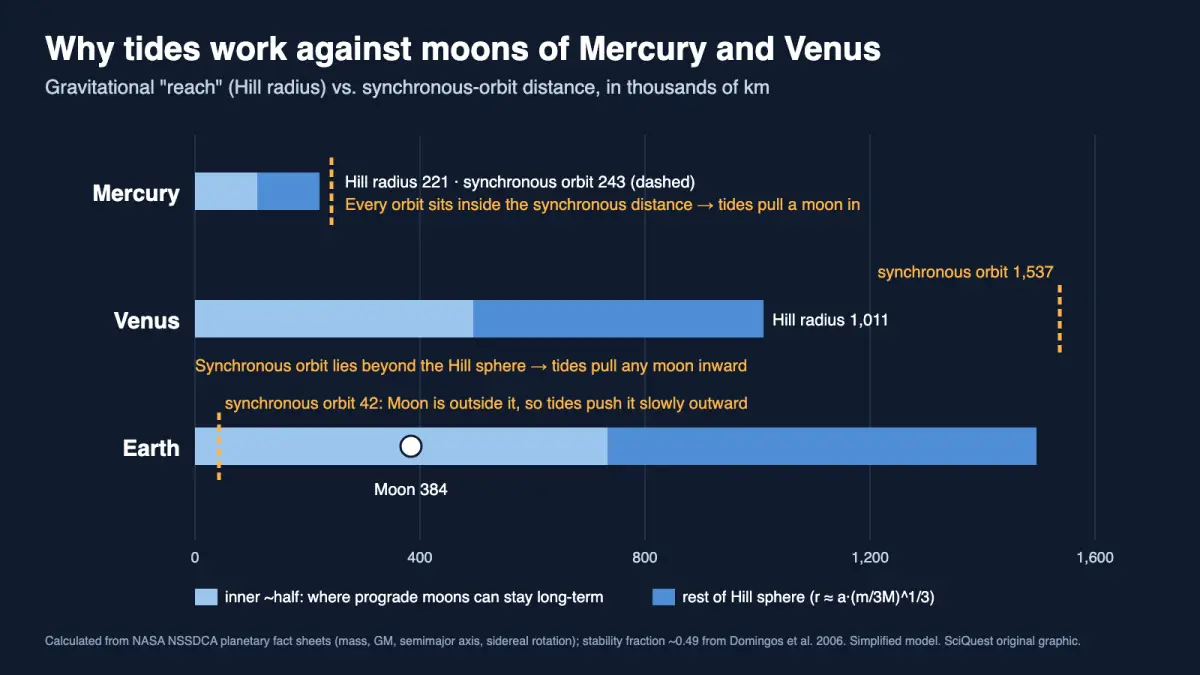
- Calculated: Mercury’s Hill radius, the rough limit of its gravitational control against the Sun, is about 221,000 km; Venus’s is about 1.01 million km; Earth’s is about 1.50 million km (worked below).
- Calculated: both planets spin so slowly that their synchronous-orbit distance lies beyond their Hill radius, so tides would tend to shrink the orbit of any moon they captured or formed.
- Proposed, not confirmed: a 2006 conference presentation suggested Venus once had a moon that spiralled back into it after giant impacts changed its spin [6].
- Not a moon: Zoozve (2002 VE68), roughly 200–500 m across, is a quasi-satellite of Venus; NASA notes it was the first quasi-satellite of a major planet to be identified [2].
How many moons does each planet have?
| Planet | JPL Solar System Dynamics count | NASA NSSDCA fact sheet count |
|---|---|---|
| Mercury | 0 | 0 |
| Venus | 0 | 0 |
| Earth | 1 (not listed by JPL; the Moon) | 1 |
| Mars | 2 | 2 |
| Jupiter | 115 | 95 |
| Saturn | 293 | 274 |
| Uranus | 29 | 28 |
| Neptune | 16 | 16 |
Sources: NASA/JPL Solar System Dynamics, “Planetary Satellite Discovery Circumstances” [4], and NASA NSSDCA Planetary Fact Sheet [1], both accessed 12 October 2026. The two NASA pages are updated on different schedules; the higher JPL figures include more recently confirmed small moons. Only Mercury and Venus are zero in every count.
The disagreement for the giant planets is a useful reminder that “how many moons” is a moving number. Small, faint moons of Jupiter and Saturn keep being confirmed, and different catalogues catch up at different times. For Mercury and Venus there is nothing to reconcile: both lists say zero.
What “no moons” means
Think of each planet as a ranch in the middle of a much larger estate owned by the Sun. The planet’s own fence, its gravitational territory, is a sphere around it. Anything inside that fence can circle the planet; anything outside belongs to the Sun. Mercury’s fence is small, and Venus’s is moderate, but both have another problem: the planet’s slow spin turns tides into a slow leak that drains a moon’s orbit.
The analogy breaks down in one important way. A fence is a sharp line; real gravitational boundaries are fuzzy, and whether an orbit is stable also depends on its shape and direction.
How scientists know: the Hill-sphere calculation
The Hill radius is an approximate distance within which a planet’s gravity dominates over the Sun’s tidal pull. For a planet of mass m orbiting at distance a from a star of mass M, it is about r ≈ a·(m/3M)1/3.
Worked example for Venus, using NASA NSSDCA values [5]: m = 4.8673 × 1024 kg, a = 108.21 million km, M (Sun) = 1.9884 × 1030 kg.
- m/3M = 4.8673 × 1024 ÷ 5.9652 × 1030 ≈ 8.16 × 10⁻⁷
- Cube root: (8.16 × 10⁻⁷)1/3 ≈ 0.00934
- r ≈ 108.21 million km × 0.00934 ≈ 1.01 million km
The same steps for Mercury (m = 0.33010 × 1024 kg, a = 57.909 million km) give about 221,000 km. Earth’s Hill radius works out to about 1.50 million km.
Not all of that space is usable. Numerical studies of planet–moon–star systems find that moons orbiting in the same direction as the planet stay stable only out to roughly 0.49 of the Hill radius (Domingos and colleagues, 2006) [7]. For Venus that is roughly 500,000 km; for Mercury, about 110,000 km.
Why slow spin matters: the tidal leak
A moon raises tides on its planet, and those tides tug back on the moon. If the planet spins faster than the moon orbits, the tidal bulge runs ahead and pushes the moon outward. That is why our Moon, about 384,400 km away, is slowly receding, by about 3.8 cm per year: Earth’s day is much shorter than a month [8].
If the moon orbits faster than the planet spins, the opposite happens and the moon spirals inward. The dividing line is the synchronous orbit, where one orbit takes exactly one planetary rotation. We calculated it from NASA’s GM and sidereal rotation values [5] using a = (GM·P²/4π²)1/3:
- Venus: rotation 5,832.6 hours (about 243 days, retrograde) → synchronous orbit about 1.54 million km, beyond its 1.01 million km Hill radius.
- Mercury: rotation 1,407.6 hours (about 58.6 days) → synchronous orbit about 243,000 km, beyond its 221,000 km Hill radius.
- Earth: about 42,000 km, far inside the Moon’s orbit.
Show the maths: Venus’s synchronous orbit
- GM (Venus) = 0.32486 × 10⁶ km³/s²; P = 5,832.6 h × 3,600 s/h ≈ 2.0997 × 10⁷ s [5]
- GM·P² ≈ 3.2486 × 105 × 4.4089 × 1014 ≈ 1.4323 × 10²⁰ km³
- Divide by 4π² (≈ 39.478): ≈ 3.628 × 10¹⁸ km³
- Cube root: ≈ 1.54 million km, about 1.5 times Venus’s Hill radius of 1.01 million km.
So for both inner planets, every orbit a moon could hold sits inside the synchronous distance. Because Venus spins backwards, a moon orbiting in either direction would lose orbital energy to tides. This is our own illustration of standard tidal physics, not a published result; studies of planets close to their stars describe the same mechanism stripping moons over time [9]. How fast a hypothetical moon would fall depends on its mass and on the planet’s interior, which this simple calculation does not include.
Did Venus ever have a moon?
Possibly, but the evidence is thin. In 2006, Caltech’s Alex Alemi and David Stevenson presented models at the American Astronomical Society’s Division for Planetary Sciences meeting suggesting that a giant impact gave early Venus a moon, and a later impact reversed the planet’s spin so that tides pulled the moon back into Venus [6]. This was a conference presentation, not a peer-reviewed paper, and no direct geological evidence for it has been found. The reported test would be isotopic signatures in Venusian rock, which no mission has yet sampled.
The alternative is simpler: Mercury and Venus never formed or captured a lasting moon at all. Current evidence cannot decide between “never had one” and “had one and lost it” for Venus.
What about Zoozve, Venus’s “moon”?
Zoozve, provisionally named 2002 VE68, was discovered on 11 November 2002 by Brian Skiff, and its name was approved in February 2024 [2]. It is a quasi-satellite: an asteroid that orbits the Sun on a path that keeps it near Venus, so from Venus it appears to loop around the planet. NASA notes it is roughly 200 to 500 m across, based on JPL estimates [2]. It is not bound to Venus’s gravity, so it does not count as a moon.
What changes the answer
- New discoveries: a tiny moon below current detection limits cannot be ruled out entirely, but searches have found none, and the tidal argument above suggests none would survive for long.
- Definitions: counting quasi-satellites or temporary captures as “moons” would change headlines, not the physics. Astronomers do not count them.
- Model details: the Hill radius is an approximation; real stability depends on orbit shape, direction and the planet’s eccentric orbit, which matters especially for Mercury.
How it compares
Size of the Hill sphere is not the whole story. Mars, which has two moons, has a Hill radius of about 1.08 million km, similar to Venus’s. The difference is spin: Mars rotates about once every 24.6 hours, so its synchronous orbit is only about 20,400 km out (our calculation from NSSDCA data), and its outer moon Deimos, at 23,459 km, orbits beyond it. For how Earth’s Moon measures up against the moons that do exist, see how big the Moon is compared with other moons in the solar system.
Why it matters to you
This won’t change anything in daily life, but it explains why Earth’s large Moon is unusual among the rocky planets. That same Moon raises the ocean tides and has been drifting away for billions of years; Venus and Mercury show what a planet looks like without one.
“But wait…”
If Venus’s gravity is almost as strong as Earth’s, why can’t it hold a moon? Surface gravity is not the issue. Venus’s pull at its surface is about 90% of Earth’s (see gravity on Venus), and its Hill sphere is large enough to hold an orbit like our Moon’s. The barrier is its very slow rotation, which turns tides against any moon, combined with the Sun’s limit on how far out a moon could orbit.
Related questions
Which planets have no moons? Only Mercury and Venus.
Which planet has the most moons? Saturn, with 293 in JPL’s current count [4].
Is gravity on Mercury and Venus similar to Earth’s? Venus’s is close to Earth’s; Mercury’s is much weaker. Compare them in our guide to gravity on other planets.
In one sentence
Mercury and Venus have no moons, most likely because they sit deep in the Sun’s gravity and spin so slowly that tides would drag any moon down, though whether Venus once had a moon remains an open question.
Quick check: did it click?
- How many moons do Venus and Mercury have? None.
- Is Zoozve a moon of Venus? No. It is a quasi-satellite that orbits the Sun.
- Why does Venus’s slow spin matter? Its synchronous orbit lies beyond its Hill sphere, so tides would pull any moon inward.
Read next
- Gravity on Venus: how strong it is and why
- How big is the Moon compared to other moons?
- Gravity on other planets and major moons
Sources
- NASA NSSDCA, Planetary Fact Sheet (metric), accessed 12 Oct 2026.
- NASA Science, Venus: Facts, accessed 12 Oct 2026.
- NASA Science, Mercury: Facts, accessed 12 Oct 2026.
- NASA/JPL Solar System Dynamics, Planetary Satellite Discovery Circumstances, accessed 12 Oct 2026.
- NASA NSSDCA fact sheets for Venus, Mars, Mercury and the Sun.
- G. Musser, “Double Impact May Explain Why Venus Has No Moon”, Scientific American, 10 Oct 2006 (report on the Alemi and Stevenson presentation at the 2006 AAS Division for Planetary Sciences meeting).
- R. C. Domingos, O. C. Winter and T. Yokoyama (2006), Monthly Notices of the Royal Astronomical Society 373, 1227–1234, doi:10.1111/j.1365-2966.2006.11104.x.
- NASA NSSDCA, Moon Fact Sheet.
- J. W. Barnes and D. P. O’Brien (2002), “Stability of Satellites Around Close-in Extrasolar Giant Planets,” The Astrophysical Journal 575, 1087–1093, arXiv:astro-ph/0205035.
Disclosure: This article was drafted with AI assistance and checked against the sources above. The Hill-radius and synchronous-orbit figures and the graphic are SciQuest calculations from NASA NSSDCA data, using a simplified model. Spotted an error? See our corrections policy.
Discover more from SciQuest
Subscribe to get the latest posts sent to your email.
Leave a comment