

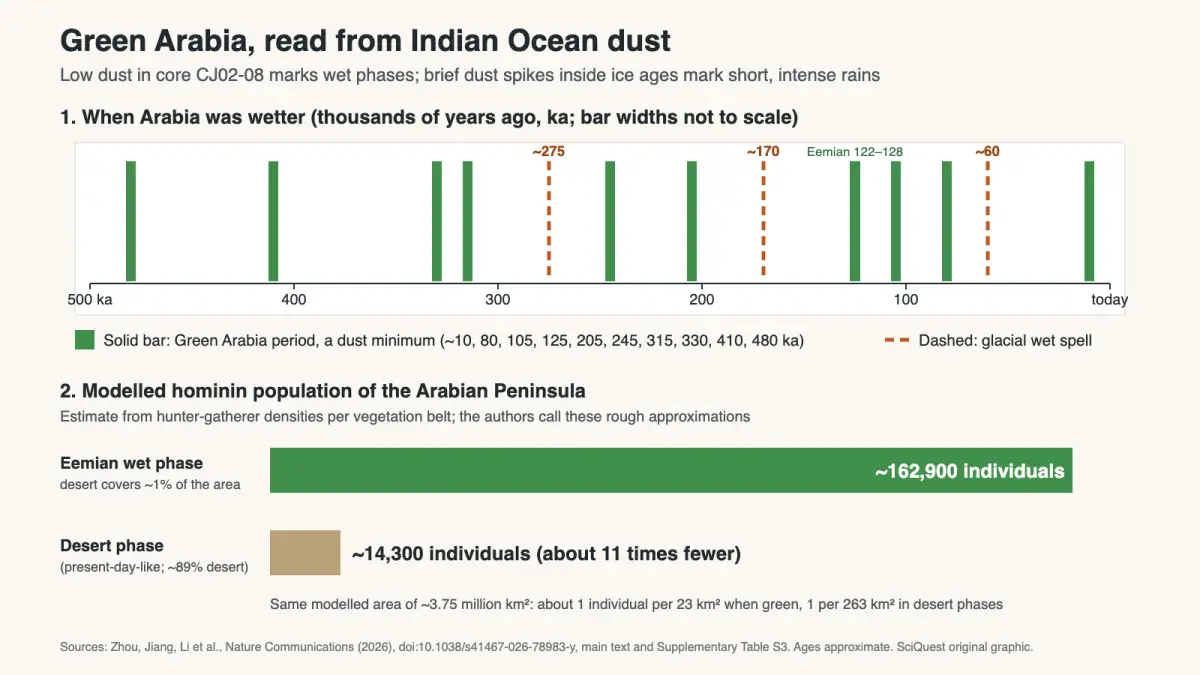
Dust in a 5.4-metre sediment core from the Indian Ocean marks ten wet “Green Arabia” phases in 500,000 years, and a rough model suggests the peninsula held about 11 times more hominins in a green phase than in a desert one.
Peer reviewed (accepted manuscript) · One marine sediment core · Model-based population estimate
Arabia’s deserts turned green at least ten times in the past 500,000 years, and hominin numbers there appear to have risen when they did, according to a dust record from the floor of the Indian Ocean. Liang Zhou, Zhaoxia Jiang and colleagues at the Ocean University of China, with co-authors in Spain, Australia and the United States, report it in Nature Communications. The record also picks out short, intense rains inside three ice ages that may have let hominins in. The population numbers are modelled, and the authors call them rough approximations.
What you need to know
- Finding: Dust lows mark ten Green Arabia periods, from about 480,000 to 10,000 years ago; dust spikes near 275,000, 170,000 and 60,000 years ago point to brief glacial wet spells.
- Method: Magnetic, optical and chemical tracers of Arabian dust in core CJ02-08, set against 115 age estimates from 50 archaeological and fossil sites.
- Source: Zhou, Jiang, Li and 10 co-authors, Nature Communications, published 25 October 2026 (open access).
- Why it matters: Arabia has a rich Stone Age record but few long climate records to set it against; this one runs unbroken for half a million years.
- Limitation: One core, population figures borrowed from recent hunter-gatherer densities, and an ice-age link resting on a handful of dated sites.
Evidence at a glance
| Item | Assessment |
|---|---|
| Evidence status | Peer reviewed; accepted manuscript (“Article in Press”). One marine core, compiled site ages, and a modelled population estimate. |
| Primary source | “Arabian hydroclimate and hominin population dynamics over the last 500,000 years”, Nature Communications, 25 October 2026, doi:10.1038/s41467-026-78983-y. |
| Evidence strength | Moderate for wet-phase timing, because four dust tracers agree and match cave records. Limited for population numbers and the ice-age link, which rest on analogy and few sites. |
| Principal limitation | The population contrast is an illustration from present-day forager densities, modelled for one wet phase only. |
| Coverage at a glance | 0 distinct news publishers found as of 25 October 2026, 11:15 UTC (web searches for title, DOI and key terms; press releases and aggregators excluded). |
Sources: accepted manuscript and Supplementary Information on nature.com; SciQuest web searches.
Is this a big deal?
For the climate record, it’s a solid step: a continuous, dated archive where land records are short and patchy. The ice-age idea is new and testable, but thin. Read the population figures as orders of magnitude, not head counts.
What scientists found
Dust fell to low levels during ten Green Arabia periods, each lasting roughly 4,000 to 10,000 years and each matching a peak in northern summer sunshine. Those peaks strengthened the African and Indian monsoons, rain reached the peninsula, and plants held the soil down. Compiled site ages show at least eight pulses of hominin occupation, each in a less arid phase, often with a different stone-tool tradition.
The surprise is in the cold periods. Near 275,000, 170,000 and 60,000 years ago, dust jumped in the middle of glacial times. More dust usually means drier land, but the authors argue the reverse here: a desert that stays dry runs out of loose fine grains, while short, heavy storms wash fresh silt onto fans and riverbeds for the wind to lift. Sites from these windows suggest hominins were present, probably in small areas.
How they found it
Core CJ02-08 was raised in 2020 to 2021 from 3,710 metres down on the Central Indian Ridge (1.64°S, 65.64°E), slightly deeper than the average ocean depth of about 3,682 m. It is 542 cm long and grew about 1 cm per 1,000 years, so each centimetre holds roughly a millennium.
Think of that seabed as a windowsill under a dusty road: the thicker the film, the drier the source. Isotopes in the grains fit an Arabian origin. The team tracked two desert iron oxides, hematite by its magnetism and goethite by how it reflects light, and checked them against element ratios. The analogy has a limit: wind and soil supply also change the film, which is what the ice-age spikes reveal.
How the population numbers were built
The authors mapped vegetation belts for the Eemian wet phase, 122,000 to 128,000 years ago, from an existing climate simulation, and for desert conditions like today’s. Each belt got a density from studies of subtropical hunter-gatherers, with Homo sapiens standing in for every hominin. SciQuest rechecked every row.
| Belt | Individuals per km² | Eemian wet phase | Desert phase |
|---|---|---|---|
| Mediterranean | 0.1 | 12,836 | 10,787 |
| Grassland | 0.01 | 10,838 | 2,933 |
| Dry wooded grassland | 0.056 | 139,198 | 566 |
| Desert | 0 | 0 | 0 |
| Total | 162,872 | 14,286 |
Source: Zhou et al. (2026), Supplementary Table S3; population = habitable area × density. Desert covers 1.4% of the modelled area in the Eemian and 89% in the desert phase.
The ratio is 162,872 ÷ 14,286 ≈ 11.4. Spread evenly, that is one individual per 23 km² when green and one per 263 km² in desert: a square about 5 km on a side, against one about 16 km on a side.
Why it matters to you
Nothing changes in daily life. This is about where we came from: Arabia sits on the land route between Africa and Eurasia, so when it was green, hominin groups could pass through and meet. Today the interior is hyper-arid, which is why this history must be read from lake beds, caves and the seafloor.
What the evidence does not show
One core records dust blown off Arabia as a whole; it cannot map where rain fell. Its ages were tuned to a global ocean record. Dust lows and site ages line up in time, which fits climate driving occupation but does not prove it.
The population model applies recent foragers’ densities to Neanderthals and earlier hominins and covers one wet phase, likely the wettest of the last 250,000 years. The authors call the results “rough approximations”. Their ice-age crossing idea is “largely untested”, since sites from low sea-level times may lie under the Red Sea.
How this fits what we already knew
The paper checks its wet phases against stalagmites from southern Arabian caves dated by Samuel Nicholson and colleagues in 2020. In 2021, Huw Groucutt’s team reported at least five hominin expansions into the Nefud Desert, between about 400,000 and 55,000 years ago, each with its own Stone Age tool style. New here: a continuous marine record set beside the sites, and the case for occupation during short glacial rains.
Outside views
No outside comment had been published when SciQuest checked on publication day, and we did not interview an independent researcher. The journal names Eduardo Méndez-Quintas as a peer reviewer; his assessment is not public. A separate group’s 2016 model, by Axel Timmermann and Tobias Friedrich, also produced migration waves across Arabia and the Levant during glacial times, between about 106,000 and 29,000 years ago. Co-author Michael Petraglia worked on the 2021 study, so it is not an independent check.
How other headlines framed it
SciQuest found no news coverage of this paper at the time of writing. Earlier stories, such as Phys.org’s 2025 report on an 8-million-year cave record, framed Arabia as a crossroads opened by wet phases; this study adds brief openings in the cold.
What happens next
An edited final version will replace this manuscript, and SciQuest will check it for changes. The real tests are more dated sites from the windows near 275,000, 170,000 and 60,000 years ago, and surveys of the drowned Red Sea shelves. The core data are public on Figshare.
In one sentence
Indian Ocean dust shows Arabia greening in sunshine-paced pulses that drew hominins in, with short ice-age rains as a possible extra opening, while the population figures remain a rough model.
Quick check: did it click?
- Why does low dust mean a wetter Arabia? Rain grew plants that held soil in place, so less dust blew out to sea.
- Were the population numbers counted from fossils? No. They are modelled from vegetation belts and hunter-gatherer densities: about 162,900 in the Eemian wet phase versus 14,300 in desert conditions.
Read next
- What tools were made in the Stone Age?
- Neanderthal wooden spears survive as moulds in Spain
- Monkey feet complicate a key assumption about human evolution
Sources and disclosure
- Zhou L, Jiang Z, Li S, Larrasoaña JC, Roberts AP, Yang S, Liu Q, Chen L, Yin Z, Liu W, Guan Y, Zhang Y, Petraglia MD. “Arabian hydroclimate and hominin population dynamics over the last 500,000 years.” Nature Communications, published 25 October 2026 (accepted manuscript), with Supplementary Information. doi:10.1038/s41467-026-78983-y. Data: doi:10.6084/m9.figshare.32051127.
- Nicholson SL et al. “Pluvial periods in Southern Arabia over the last 1.1 million-years.” Quaternary Science Reviews 229, 106112 (2020). doi:10.1016/j.quascirev.2019.106112.
- Groucutt HS et al. “Multiple hominin dispersals into Southwest Asia over the past 400,000 years.” Nature 597, 376–380 (2021). doi:10.1038/s41586-021-03863-y.
- Timmermann A, Friedrich T. “Late Pleistocene climate drivers of early human migration.” Nature 538, 92–95 (2016). doi:10.1038/nature19365.
- Markowska M et al. “Recurrent humid phases in Arabia over the past 8 million years.” Nature 640, 954–961 (2025). doi:10.1038/s41586-025-08859-6. Coverage read for framing: Phys.org (2025).
Disclosure: This article was drafted with AI assistance and checked against the sources above, including the full accepted manuscript and Supplementary Table S3. The authors declare no competing interests. SciQuest recomputed each population row (habitable area × density), the 11.4 ratio and area per individual (3,753,531 km² ÷ population); the graphic is a SciQuest original built from the paper’s values. Spotted an error? See our corrections policy and editorial standards.
Discover more from SciQuest
Subscribe to get the latest posts sent to your email.
Leave a comment