

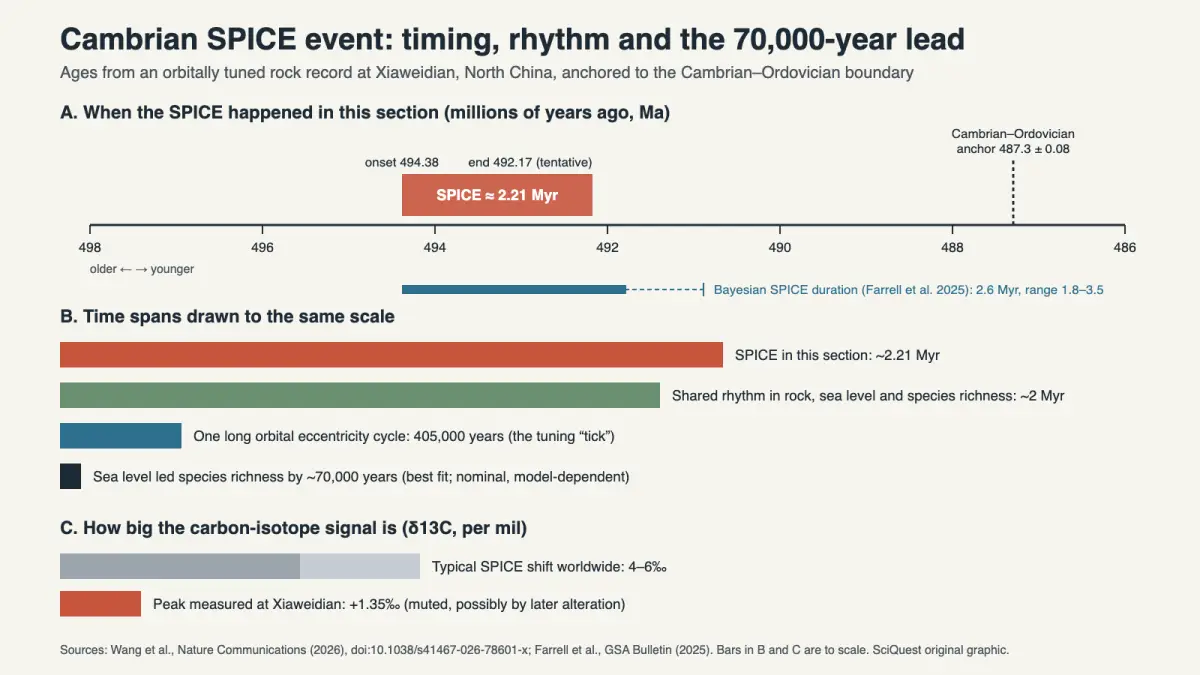
A 181-metre rock section near Beijing dates the late Cambrian SPICE carbon-cycle upheaval to about 2.2 million years and finds sea-level swings running roughly 70,000 years ahead of changes in seafloor species richness, a lag the authors call nominal and model-dependent.
Peer reviewed (accepted manuscript) · One rock section plus a regional fossil compilation · Statistical association, not proven cause
About 494 million years ago, Earth’s carbon cycle lurched in an episode geologists call the Steptoean Positive Carbon Isotope Excursion, or SPICE. In Nature Communications, a team led by Meng Wang of the Nanjing Institute of Geology and Palaeontology and Mingsong Li of Peking University reports that sea level in North China rose and fell on a roughly 2-million-year rhythm through this interval. Seafloor species richness kept the same beat, about 70,000 years behind. The match comes from aligning separately dated records, so it shows sequence, not proof of cause.
What you need to know
- Finding: Rock chemistry, reconstructed sea level and North China’s seafloor (benthic) species richness share a ~2-million-year cycle; the best fit has sea level leading richness by ~70,000 years.
- Method: Field gamma-ray and aluminium readings every 0.1 m (median) plus 130 carbon-isotope samples, tuned to Earth’s 405,000-year orbital eccentricity cycle.
- Source: Wang, Shi, Yang and eight co-authors, Nature Communications, 24 October 2026 (open access).
- Why it matters: The SPICE coincided with low-oxygen seas and losses of trilobites and brachiopods; ordering sea level, oxygen and extinction is the first step to explaining it.
- Limitation: The sea-level and fossil records have independent age models, and the carbon signal here is weak: +1.35‰ against a typical 4–6‰ shift.
Evidence at a glance
| Item | Assessment |
|---|---|
| Evidence status | Peer reviewed; accepted manuscript. Field data from one section, compared with a published regional fossil compilation. |
| Primary source | “Coupled sea-level and biodiversity dynamics during the Cambrian SPICE event”, Nature Communications, 24 October 2026, CC BY-NC-ND 4.0. Code on Zenodo. |
| Evidence strength | Moderate for the SPICE timing, which agrees with independent uranium-lead and Bayesian ages. Limited for the 70,000-year lead, which depends on how two records are lined up. |
| Principal limitation | The authors write that the lag “should be treated as a nominal, model-dependent offset”, with its size and sign uncertain. |
| Coverage at a glance | 0 distinct credible publishers as of 26 October 2026, 07:00 UTC (outlets with their own article, found by searching the title and topic terms). No press release found. |
Sources: the accepted manuscript, Supplementary Information and peer review file, read in full; SciQuest coverage search.
Is this a big deal?
A solid dating step with a provisional twist. The SPICE timing here matches the newest independent estimates. The claim that sea level moved first is testable but rests on one statistical fit.
What scientists found
The SPICE is a jump in the ratio of carbon-13 to carbon-12 in seawater carbonate, long read as a sign that more organic carbon was being buried. At Xiaweidian the rise starts 47.3 m up the section, 494.38 million years ago, peaks at +1.346‰ just 2 m higher, and by the authors’ tentative placement ends at 86.8 m, 492.17 million years ago.
That is about 2.21 million years, or 2.18 to 2.32 depending on where boundaries fall between samples. Pick an earlier statistical break as the end and it shrinks to about 1.06 million.
The same ~2-million-year cycle shows up in gamma rays, aluminium, sea level and benthic richness. Two sharp richness drops, one within the Guzhangian Stage and one at the SPICE onset, each line up with a rapid sea-level fall.
How they found it
The Xiaweidian outcrop on Beijing’s outskirts is exposed end to end, cut by a river and a railway. The team measured about 181 m of limestone and marlstone with handheld instruments, two minutes per reading.
Gamma rays and aluminium both track clay washed in from land, which varies with rainfall and weathering. Think of the 405,000-year orbital cycle as tick marks on a tape: count them and metres of rock become years. The tape stretches where sediment piled up faster, and parts of the section lack clear cycles, so the clock is less certain there.
Sea level came from “sedimentary noise”, variation the orbital cycles don’t explain, which grows when shallow water reworks sediment. Richness came from the group’s earlier compilation of 2,152 species in 307 North China sections, ordered into one sequence averaging 22.2 thousand years per step.
Why it matters to you
Nothing changes in your daily life. This is about where we came from: how early seafloor animals fared when shallow seas drained and oxygen fell. The paper does not model present-day sea level, and SciQuest draws no lesson from it about modern change.
What the evidence does not show
It does not show that falling seas killed species. The proposed chain, from shrinking shelf habitat to spreading low-oxygen water to benthic losses, relies on oxygen evidence from other North China sections; this study measured no direct oxygen proxies.
The 70,000-year lead is only about three steps of the fossil sequence, or roughly 1.4 m of rock at the mean rate of 2 cm per thousand years, so small timing shifts could move it. Iron and manganese spikes at the SPICE onset also point to later chemical alteration of the carbon signal.
Show the maths: how big is a 70,000-year lead?
- Fossil sequence: 70,000 ÷ 22,200 years per step ≈ 3.2 steps.
- Rock: 70,000 years × 2 cm per 1,000 years ≈ 140 cm, about 1.4 m (0.7 to 1.5 m across the paper’s 1 to 2.2 cm per 1,000 years range).
- SPICE: 70,000 ÷ 2,210,000 ≈ 3% of the event; squeezed into one 24-hour day, the lead would last about 46 minutes.
How this fits what we already knew
Matthew Saltzman and colleagues linked the SPICE to trilobite extinctions, organic burial and sea level in 2000. In 2011 Benjamin Gill’s team found a matching sulphur-isotope shift in six sections worldwide, evidence of widespread oxygen-free, sulphide-rich water. The new study adds an orbital clock. Compare how fossil pollen tied plant turnovers to ancient warmth.
| Source | Onset (million years ago) | Duration (million years) |
|---|---|---|
| Farrell et al. 2025, Bayesian model (Utah, Idaho, Sweden, Wales) | Not dated directly | 2.6 (+0.9/−0.8) |
| Uranium-lead zircon ages, western North America | No earlier than 494.4 ± 0.5 | n/a |
| Wang et al. 2026, Xiaweidian | 494.38 | ~2.21 (2.18–2.32); ~1.06 with an earlier end |
| Older summaries (e.g. Wikipedia) | 497–494 range | About 3 |
Sources: Farrell et al. 2025 abstract; Wang et al. 2026 main text (which cites the uranium-lead ages) and Supplementary Text 2; Wikipedia, accessed 26 October 2026.
Outside views
SciQuest found no comment from an outside researcher as of 26 October 2026, 07:00 UTC. The published peer review file shows named reviewers probing the weak points. Damien Pas, who signed the final-round report, noted SPICE peaks of about +4‰ in Australia, Nevada and South China against close to +1‰ here, and asked for stronger evidence. Christian Zeeden asked the authors to state that not the whole record is cyclic. After revision, Pas called the study “more robust and scientifically compelling.”
How other headlines framed it
No other outlet had covered the paper by 26 October 2026, 07:00 UTC.
What happens next
The data and model code are public, so other groups can rerun the lag test. The authors suggest compound-specific isotope work to see past the alteration. They link the ~2-million-year rhythm to a slow Earth–Mars orbital interaction (about 2.4 million years today), which could help test models of the solar system’s long-term behaviour.
In one sentence
An orbital clock in Beijing-area limestone puts the SPICE at about 2.2 million years and suggests seafloor life tracked sea level with a short lag, but that lag is a statistical estimate, not a measured delay.
Quick check: did it click?
- What “clock” turned metres of rock into years? Earth’s 405,000-year orbital eccentricity cycle, recorded as repeating clay-rich layers.
- Why treat the 70,000-year lead with caution? It comes from aligning two independently dated records and spans only about three steps of the fossil sequence.
Read next
- The Grand Canyon’s missing billion years: what rock records leave out.
- Fossil pollen and extreme ancient warmth: another environment–extinction link.
- How deep is the ocean? Shelves like North China’s Cambrian sea are its shallow rim.
Sources and disclosure
- Wang M, Shi Y, Yang A, Zhang H, Zhang X, Wu Y, Shi Y, Liu J, Wei R, Jin Z, Li M. “Coupled sea-level and biodiversity dynamics during the Cambrian SPICE event.” Nature Communications (2026), published 24 October 2026. doi:10.1038/s41467-026-78601-x. Accepted manuscript, Supplementary Information and peer review file read in full. Fossil data: OneStratigraphy Database.
- Farrell TP et al. “Revising the late Cambrian time scale and the duration of the SPICE event using a novel Bayesian age modeling approach.” GSA Bulletin 137: 3093–3118 (2025). doi:10.1130/b37919.1.
- Gill BC et al. “Geochemical evidence for widespread euxinia in the Later Cambrian ocean.” Nature 469: 80–83 (2011). doi:10.1038/nature09700.
- Saltzman MR et al. “A global carbon isotope excursion (SPICE) during the Late Cambrian: relation to trilobite extinctions, organic-matter burial and sea level.” Palaeogeography, Palaeoclimatology, Palaeoecology 162: 211–223 (2000). doi:10.1016/S0031-0182(00)00128-0.
- Wikipedia, “Steptoean positive carbon isotope excursion“, accessed 26 October 2026 (older date range only).
Disclosure: This article was drafted with AI assistance and checked against the sources above, including the full accepted manuscript. The authors declare no competing interests. Calculations by SciQuest: 70,000 ÷ 22,200 ≈ 3.2 steps; 70,000 years × 2 cm per 1,000 years ≈ 1.4 m; 494.38 − 492.17 = 2.21 million years. The graphic is a SciQuest original drawn from reported values; no figures from the paper were reused. Spotted an error? See our corrections policy.
Discover more from SciQuest
Subscribe to get the latest posts sent to your email.
Leave a comment