

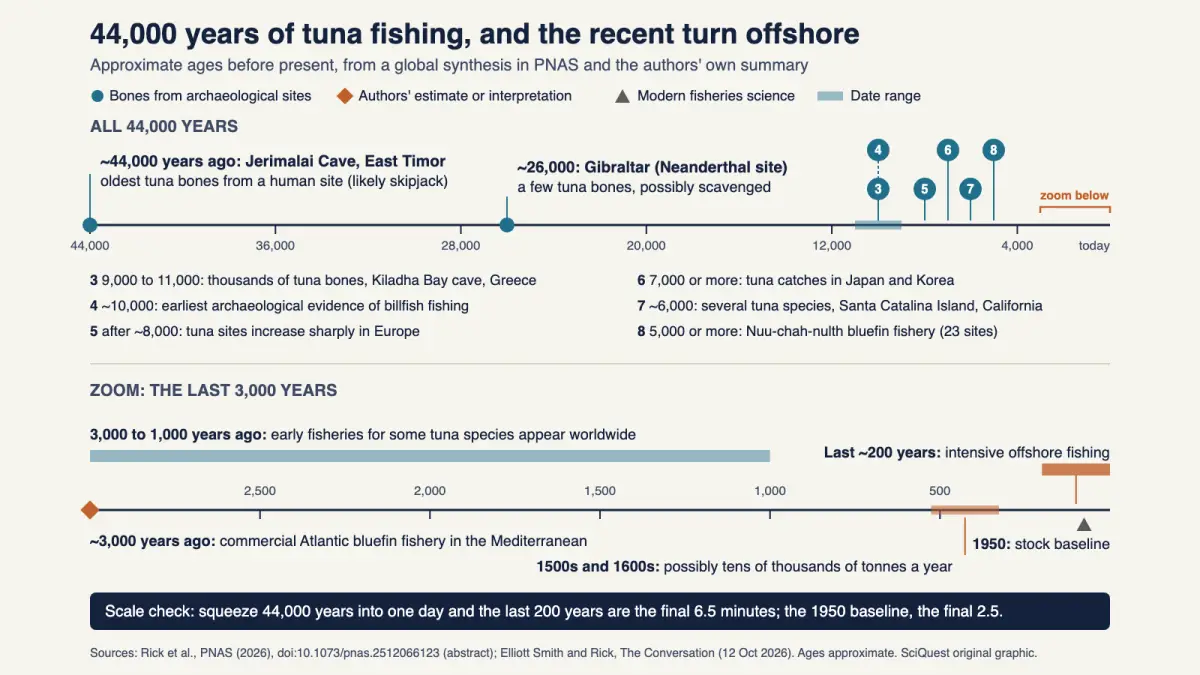
The oldest tuna bones from a human site are about 44,000 years old, yet a new global synthesis in PNAS concludes that sustained, intensive fishing of tuna and billfish far offshore mostly began in the last 200 years, a span equal to less than half of one percent of that record.
Peer-reviewed journal · Synthesis of published archaeological and historical records · Full text not read by SciQuest
Eighteen researchers led by Torben Rick of the Smithsonian’s National Museum of Natural History have pulled together evidence on when people first caught tuna and billfish. In PNAS, published online on 16 October 2026, they report tuna bones at a human site from about 44,000 years ago and billfish from about 10,000. Most early fisheries, they find, worked fish that came close to shore. Heavy offshore fishing came mostly in the last 200 years. This is a review of published sites and records, and SciQuest could read only its abstract and the authors’ own summary.
What you need to know
- Finding: Archaeological evidence of tuna fishing reaches back about 44,000 years and of billfish fishing about 10,000 years, with early fisheries for some tuna species in place around the world by 3,000 to 1,000 years ago.
- Method: A synthesis of fish bones from archaeological sites, rock art, frescoes and vases, written records and Indigenous ethnographic accounts, drawn from 18 specialists’ work and 115 cited references.
- Source: Rick et al., PNAS 123(43): e2512066123, online 16 October 2026 (open access, CC BY 4.0).
- Why it matters: Tuna stock assessments are usually measured against 1950, and the authors argue that a 44,000-year record shows how recent the move to large-scale open-ocean fishing really is.
- Limitation: The work compiles earlier finds rather than reporting a new excavation, the archaeological record is patchy, and SciQuest could not open the full text to check site-by-site detail.
Evidence at a glance
| Item | Assessment |
|---|---|
| Evidence status | Published in PNAS, a peer-reviewed journal. A synthesis of earlier archaeological, historical and ethnographic findings, not a new dig or dataset. |
| Primary source | “Global origins of tuna and billfish fisheries reveal the transition from coastal access to oceanic exploitation”, PNAS 123(43): e2512066123, online 16 October 2026 (Crossref), CC BY 4.0. The journal’s site blocked our access, so this article rests on the abstract (via Crossref) and on a summary by two of the authors in The Conversation. |
| Evidence strength | Moderate for the broad pattern, because it draws on many sites on several continents and 115 references. Limited for any single date or catch figure here, because we could not check the paper’s tables or the underlying site reports. |
| Principal limitation | Fish bones survive and get studied unevenly, so the oldest dates are the oldest found so far, and gaps on the map may reflect where archaeologists have looked. Ancient catch sizes are the authors’ estimates, not measurements. |
| Coverage at a glance | 1 distinct credible publisher as of 18 October 2026, 08:30 UTC: The Conversation, in an article written by two of the paper’s authors. Excluded as straight republications of that piece: Phys.org, Yahoo News, Mirage News and inkl. No independent news write-up of the paper was found. |
Sources: Crossref record and abstract for doi:10.1073/pnas.2512066123; Elliott Smith and Rick, The Conversation, 12 October 2026; SciQuest web searches on 18 October 2026. The count measures reach, not correctness.
Is this a big deal?
It is a useful synthesis, not a new discovery. The 44,000-year site in East Timor has been in the literature since 2011. What the paper adds is the global comparison: tuna and billfish fishing began in many places, at many times, and almost everywhere it stayed close to the coast for thousands of years. That timing gives fisheries scientists a much longer yardstick than the 1950 baseline they normally use.
What scientists found
The oldest evidence comes from Jerimalai Cave in East Timor, where bones of what were likely skipjack tuna date to about 44,000 years ago, according to the authors’ summary. A Neanderthal site in Gibraltar holds a few tuna bones from about 26,000 years ago, which the authors say may have come from scavenging rather than fishing. The earliest billfish evidence, a group that includes swordfish and marlins, is about 10,000 years old. The abstract does not name that site.
Fishing then appears region by region. A cave above Kiladha Bay in Greece holds thousands of tuna bones from 9,000 to 11,000 years ago, and tuna sites in Europe increase sharply after about 8,000 years ago. Fishers in Japan and Korea took tuna from at least 7,000 years ago. Around Santa Catalina Island off Southern California, Indigenous fishers caught several tuna species, including Pacific bluefin, yellowfin, albacore and skipjack, for about 6,000 years. On the northwest coast of North America, Nuu-chah-nulth fishers ran a Pacific bluefin fishery for more than 5,000 years; bluefin vertebrae turn up at 23 archaeological sites, from fish that could reach about 2 m and 290 kg.
By 3,000 to 1,000 years ago, early fisheries for some tuna species had appeared around the world. In the Mediterranean, the authors write that a commercial Atlantic bluefin fishery had formed by about 3,000 years ago.
How they found it
There was no single dig. The authors, based at museums, universities and research institutes in Europe, Asia, Australia and the Americas, combined several kinds of evidence. Each answers a different question, and they are not equally firm.
Fish bones from archaeological sites are the backbone. A tuna bone in a dated layer of a human site is direct evidence that people had the fish, though not always of how they got it. Rock art, paintings on frescoes and vases, and written records add when and how fish were caught. Ethnographic accounts from Indigenous communities describe methods and meaning. The authors’ summary lists hook and line, harpoons, and traps or nets, and describes Nuu-chah-nulth fishers setting fires in canoes to draw tuna close enough to harpoon.
Here is how the claims sort by kind of evidence, so you can see which are bones in the ground and which are inference.
| When | Where or what | Claim | Kind of evidence |
|---|---|---|---|
| ~44,000 | Jerimalai Cave, East Timor | Oldest tuna bones from a human site (likely skipjack) | Archaeological remains |
| ~26,000 | Neanderthal site, Gibraltar | A few tuna bones, possibly scavenged | Archaeological remains; how they got there is uncertain |
| ~10,000 | Site not named in abstract | Earliest billfish fishing | Archaeological remains |
| 9,000 to 11,000 | Kiladha Bay, Greece | Thousands of tuna bones in a cave | Archaeological remains |
| 5,000+ to 7,000+ | Japan and Korea; Santa Catalina Island; Nuu-chah-nulth territory | Regional tuna fisheries | Archaeological remains, with Indigenous accounts for the Nuu-chah-nulth |
| ~3,000 | Mediterranean | Commercial Atlantic bluefin fishery | Authors’ synthesis; the basis was not stated in the material we read |
| 1500s and 1600s | Mediterranean | Possibly tens of thousands of tonnes a year | Authors’ estimate |
| Over millennia | All ancient fisheries | Likely only thousands of tonnes removed in total | Authors’ estimate |
| Last ~200 years | Open ocean | Sustained, intensive offshore commercial fishing | Authors’ interpretation of the whole record |
Sources: Rick et al., PNAS (2026), abstract; Elliott Smith and Rick, The Conversation (12 October 2026). Evidence labels are SciQuest’s reading of those sources.
The authors’ main argument sits in one line of the abstract: sustained, intensive offshore exploitation is “a late development in the human past”. Most early fisheries, the abstract says, were in places where tuna and billfish could be reached fairly close to shore, such as above submarine canyons, or where the fish came inshore in some seasons or during warm ocean events. Many were tied to ceremony or ritual, alongside advances in boats and fishing gear.
Why it matters to you
If you eat canned tuna or sushi, this is the long history behind it. A day-long clock makes the timing concrete. Squeeze all 44,000 years into 24 hours and the era of heavy offshore fishing fills only the last 6.5 minutes. The 1950 baseline used to judge whether stocks are healthy covers the last 2.5. The clock compresses time evenly, which the evidence does not: we know far more about recent centuries than about any minute before midnight.
None of this changes what you should buy, and neither the abstract nor the authors’ summary offers shopping advice. The paper’s point is about what “normal” means when people say a tuna stock has recovered.
What the evidence does not show
A first find is a minimum date. Fish bone is fragile, sea levels have risen since the last ice age and drowned many old coastlines, and some regions have had little archaeological work. A blank on the map is not proof that nobody fished there.
The ancient catch figures are estimates. The authors write that ancient fisheries, even the Mediterranean ones, likely removed only thousands of tonnes over millennia, against millions of tonnes taken every year today. That comparison is plausible given the gear and the populations involved, but we could not see how it was calculated.
The 200-year line is also not absolute. The abstract says “with few exceptions” and “primarily”, and the Mediterranean bluefin trade is clearly older. Readers should take the 200-year figure as the authors’ summary of a global pattern, not a single start date.
How this fits what we already knew
Jerimalai first made headlines in 2011, when archaeologists Sue O’Connor, Rintaro Ono and Chris Clarkson reported in Science that pelagic fish there dated to 42,000 years ago, alongside the earliest known evidence of fishhook making. They took it as a sign that people were fishing in deep water. O’Connor, of the Australian National University, is a co-author of the new synthesis. The new work cites the site at about 44,000 years; we could not see in the material available to us why the figure changed.
There is a quiet tension between the two framings. The 2011 paper read the bones as evidence of deep-sea fishing, while the new synthesis stresses that most early fisheries reached fish near shore. The abstract does not say how it classifies Jerimalai.
The modern side connects to a 2022 Science study led by Maria José Juan-Jordá, also a co-author here. Tracking extinction risk for tunas, billfishes and sharks over 70 years, it found that after about 58 years of rising risk, fisheries management had bent the curve for tunas and billfishes, while sharks kept getting worse. The new paper adds the deep past to that 70-year view. Its authors note that southern bluefin, Pacific bluefin and bigeye tuna are still listed as endangered, vulnerable or near threatened. They expect stocks can be kept at sustainable levels “even if they’ll likely never again reach precommercial fishing levels of abundance.”
Independent perspective
SciQuest found no published comment from a researcher outside the author team by 18 October 2026, 08:30 UTC, and has not yet interviewed one. With 18 authors drawn from many regions, the synthesis already reflects several specialist views, but an independent check of its site list and catch estimates would help.
How other headlines framed it
Only one framing exists so far, and it comes from the authors. Emma Elliott Smith and Torben Rick wrote The Conversation article, which leads with the 44,000-year age and a tour of regional fisheries. Phys.org and Mirage News republished it. That piece covers tuna only. The paper’s title and abstract give equal weight to billfish and put the late shift offshore at the centre, a point the headline does not carry.
What happens next
The abstract leaves three questions we want answered from the full text: which site holds the 10,000-year billfish evidence, why the Jerimalai date moved from 42,000 to about 44,000 years, and which fisheries count as the “few exceptions” to the 200-year pattern. The paper is open access, and this article will be updated once SciQuest has read it in full. Further digs, especially on now-drowned coasts, could push the first dates earlier.
In one sentence
People have caught tuna for about 44,000 years and billfish for about 10,000, but for nearly all of that time they fished where these ocean predators came near the coast, and heavy fishing far out at sea is, by the authors’ reading, mostly a story of the last 200 years.
Quick check: did it click?
- Where is the oldest evidence of tuna fishing, and how old is it? Jerimalai Cave in East Timor, about 44,000 years ago, from bones of what were likely skipjack tuna.
- Is this a new excavation? No. It is a synthesis of earlier archaeological, historical and ethnographic evidence, published in PNAS.
- Which claims are estimates rather than finds? The ancient catch totals, the 1500s to 1600s Mediterranean catch and the 200-year timing of the offshore shift are the authors’ estimates and interpretations.
Read next
- What tools were made in the Stone Age? Harpoons and other early kit behind the first fisheries.
- Neanderthal wooden tools survive as rock moulds in Spain, another case of reading ancient life from a few fragile traces.
- An 11,000-year-old Karahantepe leopard sculpture, from roughly the time tuna bones were piling up in the Kiladha Bay cave.
Sources and disclosure
- Rick TC, Andrews AJ, Béarez P, Festa M, Fossile T, Hudson M, Janßen-Kim M, Juan-Jordá MJ, Lambrides ABJ, LeFebvre MJ, Luthra A, Newsom B, O’Connor S, Quintana Morales E, Spiess A, Zancan C, Zimmer C, Elliott Smith EA. “Global origins of tuna and billfish fisheries reveal the transition from coastal access to oceanic exploitation.” PNAS 123(43): e2512066123, 2026. doi:10.1073/pnas.2512066123. Abstract and metadata read via Crossref; full text not read.
- Elliott Smith E, Rick T. “Hooked on tuna: People have been harvesting these ocean predators for 44,000 years.” The Conversation, 12 October 2026.
- O’Connor S, Ono R, Clarkson C. “Pelagic fishing at 42,000 years before the present and the maritime skills of modern humans.” Science 334: 1117–1121, 2011. doi:10.1126/science.1207703.
- Juan-Jordá MJ, Murua H, Arrizabalaga H, Merino G, Pacoureau N, Dulvy NK. “Seventy years of tunas, billfishes, and sharks as sentinels of global ocean health.” Science 378(6620): eabj0211, 2022. doi:10.1126/science.abj0211.
Disclosure: This article was drafted with AI assistance and checked against the sources above. SciQuest could not open the full PNAS paper, so details come from its abstract and from the authors’ own summary in The Conversation; two of the authors work at the Smithsonian, which funds The Conversation US as a member. The authors use both “tons” and “tonnes”; at these orders of magnitude the difference does not matter. The graphic is a SciQuest original built from the ages in sources 1 and 2. The clock comparison is a SciQuest calculation (200 ÷ 44,000 × 1,440 minutes ≈ 6.5 minutes; 76 years since 1950 gives ≈ 2.5 minutes; 200 ÷ 44,000 ≈ 0.45%). Spotted an error? See our corrections policy.
Discover more from SciQuest
Subscribe to get the latest posts sent to your email.
Leave a comment