

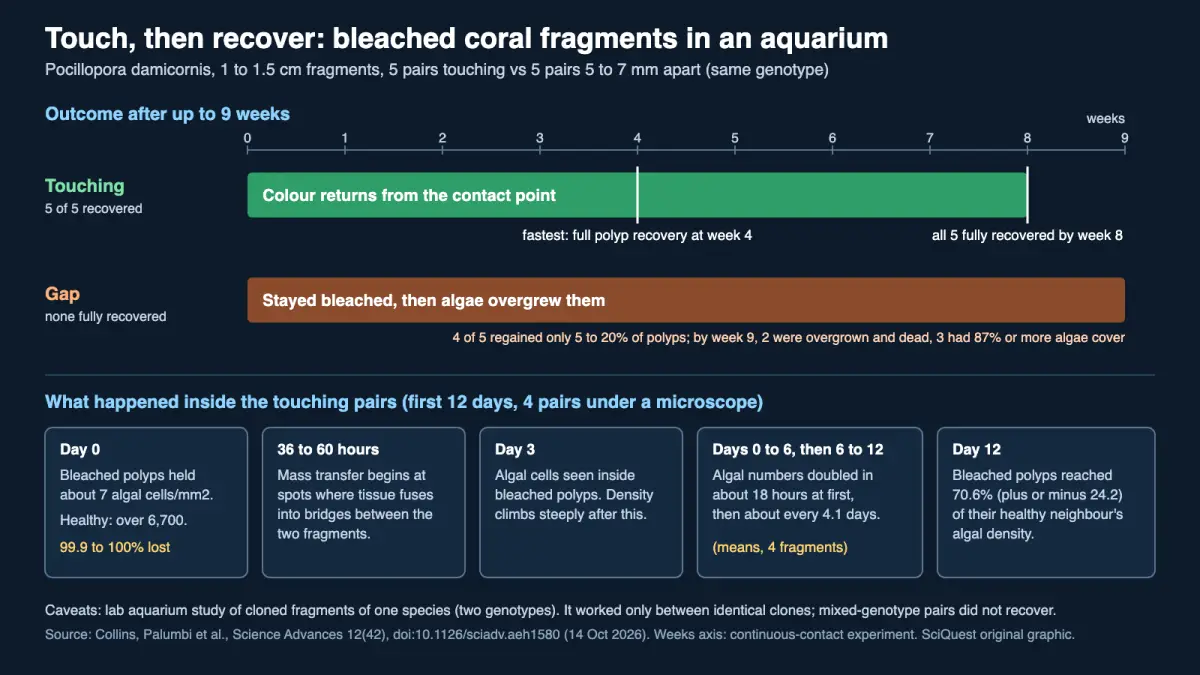
In aquarium tests on 1 to 1.5 cm fragments of one coral species, all five bleached fragments touching a healthy clone were fully recovered by week 8, while the five held 5 to 7 mm away stayed pale and were overgrown by algae.
Peer reviewed · Lab aquarium study · Small sample · One species
Bleached coral fragments regained their colour after touching healthy fragments cut from the same colony, a Stanford team reports in Science Advances. Algae that give corals their colour moved across fused tissue into the bleached pieces within days, then multiplied. The work was done in aquariums on tiny fragments of cauliflower coral, and it only worked between genetically identical corals, so it explains a mechanism. It is not a tested way to restore reefs.
What you need to know
- Finding: Bleached Pocillopora damicornis fragments touching a healthy same-genotype fragment all recovered (5 of 5, fully by week 8). Those held 5 to 7 mm apart did not (0 of 5).
- Method: Heat-bleached aquarium corals were cut into small fragments, paired with healthy ones, and tracked by photographs and confocal microscopy that counted algal cells.
- Source: Collins, Palumbi and seven co-authors, Science Advances 12(42), published 14 October 2026 (open access).
- Why it matters: It identifies a fast, natural way for bleached coral to get its algae back, which most known recovery routes cannot match for speed.
- Limitation: It requires direct contact between genetically identical corals, and it has not been tested on a reef or on other species.
Evidence at a glance
| Item | Assessment |
|---|---|
| Evidence status | Peer reviewed; controlled laboratory (aquarium) experiments on cloned coral fragments. Not a field study. |
| Primary source | “Rapid coral bleaching recovery via symbiont transfer from healthy corals”, Science Advances 12(42), eaeh1580, published online 14 October 2026, doi:10.1126/sciadv.aeh1580, CC BY-NC. Data are on Zenodo. |
| Evidence strength | Moderate for the mechanism in this species, limited for anything beyond it. The contact result repeated in a second genotype and with larger fragments, and the tissue-bridge evidence is direct. But each test used only a few pairs, and only two genotypes from one species were used. |
| Principal limitation | Recovery only occurred between genetically identical fragments in direct contact, in a tank fed more richly than a reef. Whether it happens on reefs, in larger colonies or in other corals is untested. |
| Coverage at a glance | 4 distinct credible publishers with their own reporting (Euronews, Gizmodo, ABC News/Good Morning America, and AFP) as of 20 October 2026, 08:40 UTC. Not counted: Stanford’s own release, its ScienceDaily repost, and outlets that republished AFP’s story. |
Sources: the paper and its Methods, and a SciQuest read of the coverage listed under “How other headlines framed it”.
Is this a big deal?
A tidy, well-controlled step in understanding how bleached coral gets its algae back, but not a restoration tool yet. Its value today is showing that a rescue route exists.
What scientists found
Bleaching is the loss of the microscopic algae (dinoflagellate symbionts) that live inside coral tissue and supply most of the coral’s food. Without them, coral can starve or be smothered by other algae. Natural recovery usually takes months.
In the main test, all five bleached fragments touching a healthy fragment of the same genotype had recovered all their polyps by week 8, and one did so at week 4. Five bleached fragments held 5 to 7 mm from a healthy one stayed bleached for weeks. Four regained 5 to 20% of their polyps near the tips. By week 9 two were overgrown and dead, and three had 87% or more of their surface covered in algae. At week 20, the recovered fragments had grown new branches.
How they found it
At Stanford’s Hopkins Marine Station in California, the team used aquarium-kept cauliflower coral (Pocillopora damicornis) of two genotypes, called R and G. Branches were bleached with a heat spike peaking at 34.5 °C for four hours, then held until all visible colour was gone, 12 to 16 days later.
Bleached fragments were glued to ceramic plugs next to healthy ones. Under a confocal microscope, the bleached polyps held a mean of about 7 algal cells per square millimetre on day 0, against more than 6,700 in healthy polyps, a loss of 99.9 to 100%. With almost none left, later algae had to come from the neighbour.
They saw where. Transfer began at a few contact points, about 36 to 60 hours after touching, then spread through the fragment. When pairs were pulled apart, matching torn patches of tissue appeared at the same spots on both fragments. The authors read these as tissue bridges that formed between clones. Fragments touching for one day showed no such tears (6 pairs). Think of it as a keycard: tissue from the same clone accepts the match and opens, while tissue from a stranger fires stinging defences. The analogy has a limit, since the paper does not identify the genes that do the recognising.
How fast was it, and is “ten times faster” fair?
In touching pairs, algal numbers in the bleached polyps doubled about every 18 hours in the first six days (mostly new algae arriving) and every 4.1 days (standard deviation 1.7 days) in the next six. By day 12 the bleached polyps had reached 70.6% of their healthy neighbours’ algal density (four fragments).
The paper calls this “up to an order of magnitude faster than most recovery times for corals in the field”, and press coverage compressed it to “10 times faster than wild corals”. The comparison needs care. It sets one aquarium measurement against other studies of different species. SciQuest’s arithmetic with the paper’s cited figures: Samoan Montipora doubled in 16 to 24 days (4 to 6 times slower than 4.1 days), while Great Barrier Reef Acropora took about three months, roughly 90 days, to double (more than 20 times slower). The authors say the cause is unresolved.
Why it matters to you
Nothing changes for you this year. Longer term it matters to reef managers, who have few ways to help coral that is already bleached. The paper counts four global bleaching events, in 1998, 2010, 2015-16 and 2023-25. For the basics, see why coral reefs are dying and why they matter.
What the evidence does not show
Several limits sit close together. The corals are clones from two aquarium colonies, kept for 3.5 years after purchase from suppliers, with no record of where they were collected. Feeding was likely higher than on a reef.
Sample sizes are small. The key contact test had five pairs per group, and the experiment on how long contact is needed used two pairs per duration. Brief contact is where the reports diverge. All six fragments that touched for a week or more recovered fully by week 7, as did one with five days. Fragments touching for three days showed transfer but were later covered by algae in the results text, even though the abstract says “as few as 3 days” can suffice in some cases. The three-day figure should be read as unsettled.
There is also a boundary on what counts as the same animal. Mixed-genotype pairs (6 pairs) triggered stinging defensive filaments and no recovery. All bleached fragments were extensively overgrown by the healthy coral, and four of six were fully covered by week 9. The authors add that contact area may limit recovery in large colonies.
How this fits what we already knew
Bleached coral can recover by regrowing a few remaining algae or by taking up algae from the water, but both are slow, and algae in reef water are several orders of magnitude scarcer than in coral tissue. Earlier work tested using healthy corals as donors through the water, and found that after 55 days only 5 of 45 recipient fragments held even low levels of the donor algae, according to the paper. Direct tissue contact is faster than that route in this experiment.
Independent perspective
SciQuest found no comment from an independent coral biologist outside the research team as of 20 October 2026, 08:40 UTC, and has not yet interviewed one. The paper itself lists open questions, including how consistently this works across species and colony shapes.
How other headlines framed it
- Euronews led on the reprieve, with bleached corals “not dead yet”, and clearly flagged that the work is a lab result.
- Gizmodo framed it as a possible restoration lever and stated the 8-week figure, matching the paper’s continuous-contact result.
- Good Morning America stressed hope for reefs under heat stress, with the researchers calling prevention the real solution.
- CP24, carrying AFP’s report, focused on the neighbour-helps-neighbour idea and on the lead author’s doubts about scaling to real reefs.
The outlets agree on the caveats. They differ on the headline number: some say seven weeks, Gizmodo says eight. The paper supports both, for different experiments.
| Experiment | Sample | Result |
|---|---|---|
| Continuous contact | 5 bleached fragments | All fully recovered within 8 weeks; fastest at 4 weeks |
| Contact for 1 week or more, then separated | 6 fragments (plus one with 5 days) | All fully recovered within 7 weeks |
| Contact for 3 days, then separated | 2 pairs | Transfer seen, but fragments later covered in algae |
Source: Collins, Palumbi et al., Science Advances (2026), Results and Fig. 2. Per-duration groups were very small.
What happens next
The authors list testing other species and field conditions, and delivering algae without a clone in contact. Whether different genotypes could be made to fuse is an open question. No reef-scale test has been done.
In one sentence
In a small aquarium study, bleached coral fragments recovered quickly by taking algae from a touching clone, which explains a fast route back from bleaching but is not yet a reef treatment.
Quick check: did it click?
- What did the algae need to cross to reach the bleached fragment? Tissue bridges that formed where genetically identical fragments touched.
- Why can’t this be used on a reef yet? It was shown only in aquarium fragments of one species, and it needs direct contact between identical clones.
- Why is “10 times faster than wild corals” loose? It compares one tank measurement with other species’ recovery times, and the paper says “up to”.
Read next
- Why are coral reefs dying? Heat, pollution and the other pressures behind the bleaching.
- How much oxygen do coral reefs produce? The algae inside coral, and what they produce.
- Why are coral reefs important? What reefs give us, and what is lost if recovery fails.
Sources and disclosure
- Collins DS, Sipkova J, Mollica NR, Rolander T, Klepac CN, Calistro GF, Barone V, Micheli F, Palumbi SR. “Rapid coral bleaching recovery via symbiont transfer from healthy corals.” Science Advances 12(42), eaeh1580, published 14 October 2026. doi:10.1126/sciadv.aeh1580 (full text read via PubMed Central).
- Collins DS et al. Dataset and 3D-print files. Zenodo (2026).
- Stanford Doerr School of Sustainability release, as reposted by ScienceDaily, 19 October 2026.
- Coverage read for framing: Euronews, Gizmodo, Good Morning America, CP24 (AFP).
Disclosure: This article was drafted with AI assistance and checked against the sources above, including the full open-access paper. The authors declare no competing interests; funding came from the US National Science Foundation, the Knight-Hennessy Scholars Program, Stanford University and a MAC3 Impact Philanthropies and Stanford Woods Institute seed grant. Calculations by SciQuest: 7 of more than 6,700 cells/mm² is about 0.1% (99.9% lost); 90 days divided by 4.1 days is about 22, and 16 to 24 days divided by 4.1 is about 4 to 6. The graphic is a SciQuest original built from the paper’s reported values. Spotted an error? See our corrections policy.
Discover more from SciQuest
Subscribe to get the latest posts sent to your email.
Leave a comment