

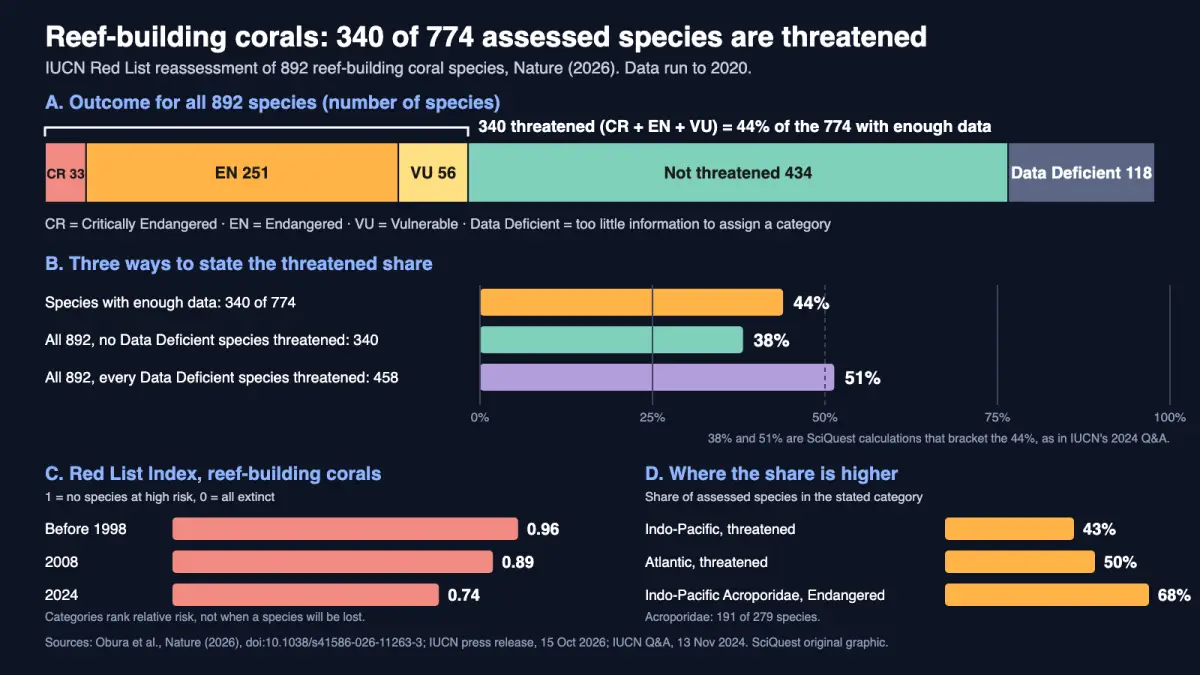
Of 774 reef-building coral species with enough data, 340 (44%) now sit in a threatened IUCN Red List category, up from about a third in 2008, but the data stop in 2020 and the declines were inferred from proxies rather than counted species by species.
Peer reviewed · Red List reassessment · Proxy-based projections
A global reassessment of reef-building corals, published in Nature on 15 October 2026, places 340 of the 774 species with enough data in a threatened Red List category: 33 Critically Endangered, 251 Endangered and 56 Vulnerable. David Obura of CORDIO East Africa and 65 co-authors report it, and the work was run by the IUCN Coral Specialist Group. The data end in 2020, so the authors say the share at risk today is probably higher. A Red List category ranks relative extinction risk. It does not say when, or whether, a species will be lost.
What you need to know
- Finding: 44% of the 774 data-sufficient species are threatened, against about a third in 2008, and the risk is uneven: 43% in the Indo-Pacific, 50% in the Atlantic.
- Method: Species-level population trends were missing for most corals, so the team inferred declines from global coral-cover trends and projected severe bleaching, then adjusted for each species’ traits.
- Source: Obura and 65 co-authors, Nature, 15 October 2026 (paywalled; early-share version).
- Why it matters: Corals are the fastest-worsening group among the comprehensively assessed groups, and the IUCN release says climate change decides the final status of over 90% of the species at highest risk.
- Limitation: It is a snapshot to 2020 that predates the 2023–2025 bleaching event, it leaves out 118 Data Deficient species, and its declines are modelled, not measured species by species.
Evidence at a glance
| Item | Assessment |
|---|---|
| Evidence status | Peer reviewed; expert Red List reassessment using proxy data and projections (not direct species-by-species population counts). |
| Primary source | “Nearly half of reef-building corals face elevated relative risk of extinction”, Nature, published online 15 October 2026, doi:10.1038/s41586-026-11263-3. Companion: IUCN press release, 15 October 2026. |
| Evidence strength | Moderate. A large expert panel applied the standard Red List criteria to all 892 species, but most of the decline estimates rest on proxies and a single emissions scenario, and the data end in 2020. |
| Principal limitation | No species-level population data exist for most reef-building corals, so declines were inferred, and the assessment predates the 2023–2025 bleaching event. |
| Coverage at a glance | 2 distinct credible publishers with their own write-ups (AFP, read via Phys.org; Common Dreams) as of 17 October 2026, 15:12 UTC. Excluded: the IUCN and CORDIO releases (the source), and republished copies of the AFP story. A Scimex listing returned an access error and was not read, so it is not counted. |
Sources: the Nature article page, the IUCN press release and Q&A, and a SciQuest search of news coverage. The full paper was behind a paywall and was not read.
Is this a big deal?
It is a solid, large-scale update rather than a surprise. The same species totals (340 threatened, 892 assessed) were published by IUCN in November 2024 when the Red List was updated; the new paper is the peer-reviewed account of how they were reached, plus a stated warning that the 2020 cut-off now understates the problem. The number to take away is a range, not a point: 38% to 51%, depending on how the 118 species with too little data are treated.
What scientists found
The Red List sorts species into categories by how likely they are to be lost. Three of them, Vulnerable, Endangered and Critically Endangered, count as “threatened”. The paper’s title says “relative risk” because the categories compare species against fixed thresholds on population size, decline and range. They are not a forecast of an extinction date.
Of 892 reef-building species, 774 had enough data to be placed. In that group 340 are threatened (33 Critically Endangered, 251 Endangered, 56 Vulnerable), which is 44%. The IUCN release reports that one third were threatened in 2008. It also reports a coral Red List Index of 0.96 before 1998, 0.89 in 2008 and 0.74 in 2024 (1 means no species at high risk, 0 means all are extinct).
Risk is not spread evenly. In the Indo-Pacific 43% of assessed species are threatened, against 50% in the Atlantic. Within the Indo-Pacific family Acroporidae, which includes staghorn (Acropora) and encrusting (Montipora) corals that build much of a reef’s structure, 191 of 279 species (68%) are Endangered.
How they found it
Corals are hard to count. A reef is built from colonies rather than tidy individuals, and the abstract says species-level population trends are missing for most reef-building species. Without them, assessors cannot measure decline directly, which is the usual way to place a species in a category.
So the team built a stand-in. They used global trends in coral cover, projections of how often reefs will suffer severe bleaching over three decades under a mid-range emissions scenario (SSP2-4.5), and biological traits linked to vulnerability, then combined these into an estimated population reduction for each species. IUCN says more than 60 coral experts contributed data, and the author list has 66 names. The method is the paper’s central choice and its main weakness: the declines are modelled.
A flood-risk map is a fair comparison. It rates a street as high risk without saying which year the river will rise, and it can be wrong at street level while being right about the district. The comparison breaks down in one way: a flood map is checked against past floods, whereas these estimates lean on projections that only time can test.
Why it matters to you
This will not change anything you do this year, and it contains no health or safety advice. It matters as a measure of how fast one group of animals is moving toward extinction: the IUCN release puts the coral index falling by 0.07 to 0.094 points per decade, against 0.002 to 0.039 for mammals, sharks and rays, birds, amphibians and cycads. The decline from 0.89 to 0.74 over the 16 years from 2008 to 2024 works out at 0.094 per decade, which matches the top of that range.
What the evidence does not show
Four limits matter more than the rest.
- Not a forecast of loss. A threatened category ranks a species against fixed criteria. It does not say how many species will go extinct or when.
- The denominator. The 44% leaves out 118 Data Deficient species. IUCN’s 2024 Q&A treats 44% as the midpoint of a range from 38% (none of them threatened) to 51% (all of them threatened). Checking the arithmetic: 340 of 892 is 38.1%, and 458 of 892 is 51.3%.
- Proxies and projections. Declines were inferred from global coral cover and projected bleaching under one emissions scenario. Species and reefs respond differently to warming, and the IUCN release says reef futures are not a simple line between survival and disappearance.
- The cut-off. The data run to 2020. The authors caution that the current share at risk is probably higher, because the 2023–2025 bleaching event came after.
Comparing 2008 with today also needs care: the species assessed grew from 845 to 892 and Data Deficient species fell from 141 to 118, so the two lists are not identical sets. The paper’s supplement reports reclassifications between the assessments; we could not read it.
How this fits what we already knew
IUCN completed the first Red List assessment of reef-building corals in 2008 and found about one third threatened. The headline numbers were already public: the November 2024 Red List update announced 340 threatened species out of 892. What is new is the peer-reviewed method and the explicit caveat about everything after 2020. For the wider causes of reef decline, see our explainer Are coral reefs dying?
Independent perspective
We found no independent expert comment on the paper as of 17 October 2026. The coverage we read quotes only people involved in the study, plus one advocacy-group director (see below). Obura said in the IUCN release that the assessment was “a stark warning of the accelerating increase in global threats to coral reefs”. Francoise Cabada-Blanco, the paper’s corresponding author and co-chair of the group, said responses vary greatly among species and regions.
How other headlines framed it
The IUCN release and the paper both use the phrase “nearly half”. The two independent write-ups we could read chose different angles.
- AFP, via Phys.org (15 October) led with Obura’s warning that the coming El Niño is a “terrifying” additional threat, and treated the Red List result as background. It reports Obura’s remark that a reassessment after this El Niño may show corals past the 50% mark as a possibility, not a finding.
- Common Dreams (16 October) framed the story as an alarm, with a headline saying “half” of reef-building coral face an extinction threat. That rounds 44% up, and the 51% upper bound is only the case where every Data Deficient species is threatened. It also quotes an oceans director at the Center for Biological Diversity, an advocacy group, saying half could be lost; that is the director’s view, not a result in the paper.
In the text we could read, neither piece quoted an expert from outside the study.
What happens next
The authors call for species-level population data and better measures of thermal stress and recovery, since many coral ranges remain under-surveyed. The IUCN release says assessments of cold-water corals are still under way. No date for a new global reassessment was given in the sources we read.
In one sentence
A Nature reassessment puts 340 of 774 data-sufficient reef-building coral species (44%) in a threatened category, up from about a third in 2008, with a 38–51% range once data-poor species are counted and an authors’ warning that the true share today is probably higher.
Why it matters to you: there is nothing to act on today, but Obura calls it the most comprehensive evaluation to date of extinction risk in these corals, and the IUCN release stresses that each increment of avoided warming may help preserve coral diversity.
Quick check: did it click?
- What does “threatened” mean here? The species falls in the Vulnerable, Endangered or Critically Endangered category, which ranks relative extinction risk and does not predict when a species will be lost.
- Why does the percentage come as a range? 118 of the 892 species have too little data. Counting none of them as threatened gives 38%, counting all of them gives 51%; 44% is the share among the 774 that could be placed.
- Why might the current risk be higher than 44%? The data end in 2020, before the 2023–2025 global bleaching event.
Read next
- Are coral reefs dying? The wider causes of reef decline, beyond the Red List result.
- Why are coral reefs important? What reefs do for the ocean and the people who live beside them.
- How much oxygen do coral reefs produce? A common question about reefs, answered.
Sources and disclosure
- Obura DO, Polidoro B, Cabada-Blanco F, et al. (66 authors). “Nearly half of reef-building corals face elevated relative risk of extinction.” Nature, published online 15 October 2026 (received 22 April 2026). doi:10.1038/s41586-026-11263-3. Early-share version; the page shows the abstract and author list, and the full text is behind a paywall.
- IUCN. “Nearly half of reef-building coral species face elevated relative risk of extinction.” Press release, Mombasa, 15 October 2026.
- IUCN. “Q&A: IUCN Red List of Threatened Species Corals Assessment.” 13 November 2024 (38–51% range, category counts).
- Perry N, AFP. “El Niño a ‘terrifying’ threat to coral reefs: UN biodiversity expert.” Phys.org, 15 October 2026.
- Prager S. “‘Deadly Serious’: Half of World’s Reef-Building Coral Face Extinction Threat as Oceans Warm, Study Warns.” Common Dreams, 16 October 2026.
Disclosure: This article was drafted with AI assistance and checked against the sources above. We could not read the full paper (paywalled), so the method is described from the Nature abstract page and the IUCN release and Q&A, and the supplementary data were not reviewed. The IUCN release credits the MSC Foundation with funding the research; we did not see the paper’s competing-interests statement. The 38% and 51% figures and the per-decade check are SciQuest calculations from the cited numbers. The graphic is a SciQuest original built from sources 1 to 3. Climate-related statements are attributed to the sources and have not had qualified expert review. Spotted an error? See our corrections policy.
Discover more from SciQuest
Subscribe to get the latest posts sent to your email.
Leave a comment