

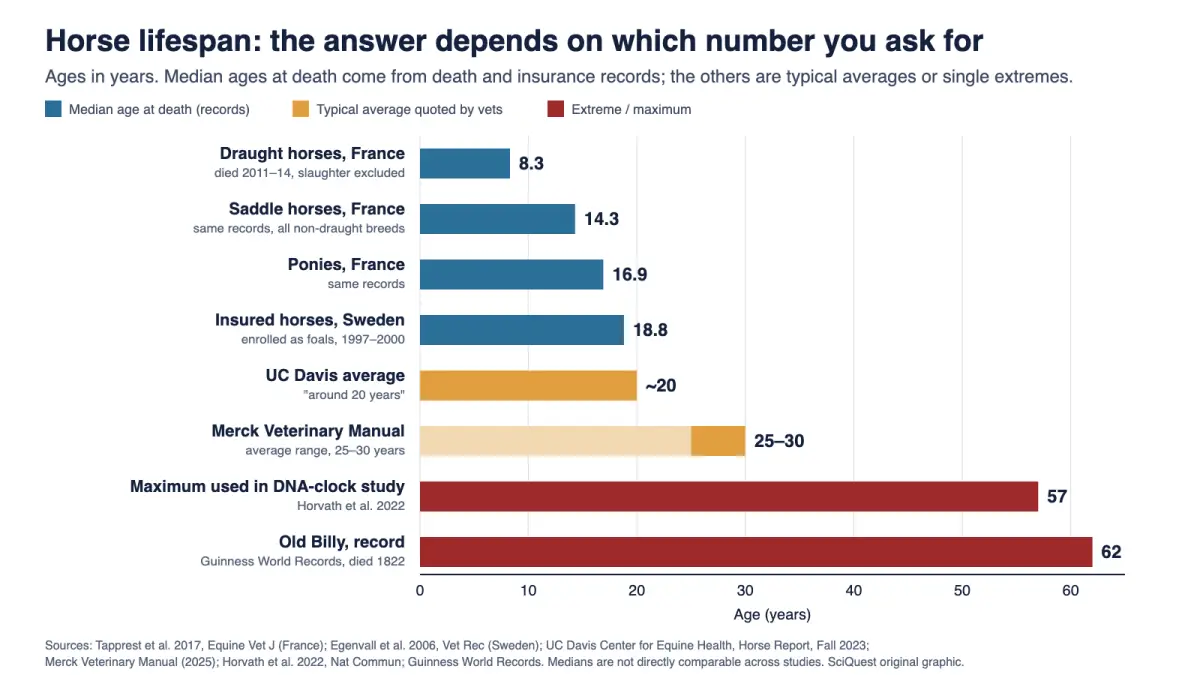
Veterinary references put the average horse lifespan at 25 to 30 years, but large death-record studies from France and Sweden found median ages at death between about 8 and 19 years, partly because many horses are put down after injury, colic or lameness long before old age.
A horse lives about 25 to 30 years on average, according to the Merck Veterinary Manual, and some reach their 40s. Size matters: the same manual notes that miniature horses can live 40 years or more. The record belongs to Old Billy, an English working horse who died in 1822 at 62, the greatest age Guinness World Records accepts as reliably recorded for a horse.
That 25-to-30 figure is the life a healthy, well-kept horse can expect. Records of when horses actually die tell a harsher story. In a survival analysis of French death records, saddle horses died at a median age of 14.3 years and ponies at 16.9. Swedish insured horses reached a median of 18.8. Part of that gap reflects decisions people make about sick, injured or unwanted horses, and it changes how to read every lifespan number you see.
Explain it like I’m busy:
- Typical lifespan: 25 to 30 years (Merck Veterinary Manual). UC Davis gives a lower average of about 20 years.
- Ponies outlive larger horses in French records: a median age at death of 16.9 years against 14.3 for saddle horses.
- Oldest on record: Old Billy, 62 years (1760 to 1822). Teeth can only give a rough age after about five.
Key facts about horse lifespan
- Typical range: 25 to 30 years on average, with miniature horses sometimes passing 40 (Merck Veterinary Manual, reviewed May 2025).
- When horses count as old: UK researchers define geriatric horses as those aged 15 or more; in the United States, horses aged 20 or more had the highest yearly death rate of any adult age group, 3.1% (USDA, 2015).
- Most deaths are euthanasia: in a UK cohort of 908 horses aged 15 or over, 94% of the 118 deaths were euthanasia, most often for lameness (24%) or colic (21%).
- Ponies live longest among French breed groups; draught horses had the shortest median, 8.3 years.
- Record: Old Billy, 62, listed by Guinness World Records.
Horse lifespan by source: what each number measures
Lifespan figures for horses disagree because they measure different things. A typical-lifespan figure describes a horse that dies of old age. A median age at death describes the real population, including young horses that die from accidents, illness or euthanasia.
| Source | Population | What is measured | Value (years) | Main caveat |
|---|---|---|---|---|
| Merck Veterinary Manual (2025) | Domestic horses in general | Average lifespan | 25 to 30; miniatures 40+ | Reference figure; no study cited on the page |
| UC Davis Center for Equine Health (2023) | Domestic horses in general | Average life expectancy | About 20; some into their 40s | Reference figure; no study cited on the page |
| Egenvall et al. 2006, Sweden | Horses with complete life insurance, enrolled before age 1, 1997 to 2000 | Median age at death (survival analysis) | 18.8 | Insured horses only; deaths counted through insurance claims |
| Tapprest et al. 2017, France | 10,335 ponies, saddle horses, draught horses and donkeys aged 2 or older, died 2011 to 2014 | Median age at death (survival analysis) | Ponies 16.9; saddle horses 14.3; draught horses 8.3; donkeys 8.4 | Slaughter excluded; only animals with a known birth date; only 93 donkeys |
| Horvath et al. 2022 | Horses (DNA-clock study) | Maximum lifespan used for the species | 57 | A modelling input, lower than the Guinness record |
| Guinness World Records | Old Billy, foaled 1760 | Greatest reliably recorded age | 62 | A single historical case |
Sources: Merck Veterinary Manual; UC Davis Center for Equine Health, The Horse Report, Fall 2023; Egenvall et al. 2006, Veterinary Record; Tapprest et al. 2017, Equine Veterinary Journal; Horvath et al. 2022, Nature Communications; Guinness World Records. Table compiled by SciQuest. The French and Swedish medians come from different populations and methods, so compare them with care.
What 25 to 30 years means for a horse
Think of the 25-to-30 figure as a horse’s potential, and the median ages at death as what happens in practice. Human life expectancy works the same way. A country’s average age at death can sit well below the age most healthy older people reach, because deaths in youth and middle age pull the average down.
The analogy has a limit. People rarely choose when a person dies, but for horses, owners and vets often do. In the UK study of horses aged 15 and older, led by J. L. Ireland at the University of Liverpool, 94% of deaths were euthanasia. So a horse’s lifespan reflects its body and also the judgments made about pain, prognosis and cost.
How scientists measure how long horses live
Researchers can’t follow every horse from birth, so they borrow records kept for other reasons. Jackie Tapprest and colleagues at the French agency Anses matched rendering-plant collection records (France’s “fallen stock” system) with the national horse register, which holds each animal’s birth date. That let them build survival curves for 10,335 equines aged 2 or older.
Their results split sharply by type. With a median age at death of 16.9 years, ponies had the highest survival, followed by saddle horses at 14.3 years. Draught horses and donkeys came out lowest, at 8.3 and 8.4 years. The authors point to a likely reason for the draught-horse figure: many entire male draught horses are intended for slaughter, and the data set excluded slaughter, which accounts for about 30% of equine deaths in France.
In Sweden, Agneta Egenvall’s team at the Swedish University of Agricultural Sciences used the records of the insurer Agria. For horses enrolled before their first birthday, the median age at death was 18.8 years. Joint problems were the most common cause of death or euthanasia.
The US Department of Agriculture took a third route in its 2015 national survey: it asked owners on operations with five or more equids in 28 states how many animals had died or been euthanised in the past year. Horses aged 20 or older died at 3.1% a year, almost four times the 0.8% rate for horses aged 5 to 19.
What affects how long a horse lives
Size and type
Ponies outlived larger breed groups in the French records, and the authors say the same pattern has been found in US and Swedish studies. They list proposed reasons, including greater hardiness, lighter workloads and better tissue repair; none has been proven. Among UK horses aged 15 or older, cobs, Thoroughbreds and their crossbreeds had a higher risk of death than other types.
Sex
In the Swedish insurance data, geldings (castrated males) died at the highest rate: 459 deaths per 10,000 horse-years, against 345 for mares and 214 for stallions. The French study found no clear difference by sex in horses aged 4 or older. These are associations in insured or registered populations, so they do not show that castration shortens life.
Body condition and pain
In the UK cohort, underweight horses had a higher risk of dying than horses in good condition. So did horses whose owners reported more clinical signs, or pain that limited normal daily activity. A related veterinary examination of 200 older horses from the same UK survey found dental problems in 95.4%, though only 24.5% of owners had reported any.
Common causes of death
US owners reported colic as the leading cause of death in horses aged 1 to 19, at 31.2% of deaths. In horses aged 20 or more, causes spread out: colic 13.4%, cancer 13.2%, neurologic problems 12.1% and chronic weight loss 11.7%. “Other” made up 26.6%, and old age was the most common condition in that group. Owners, not vets, reported these causes.
For care decisions, the sources stop short of a formula. UC Davis recommends dental examination as part of a horse’s yearly veterinary exam, and the UK researchers concluded that more veterinary involvement could catch problems owners miss. Any plan for an individual horse belongs with its vet.
Old Billy and the oldest horse on record
Guinness World Records lists Old Billy as the oldest horse ever, at 62. He was foaled in 1760, bred by Edward Robinson of Woolston, Lancashire, and died on 27 November 1822. He worked for the Mersey and Irwell Navigation Company, which bought him in 1763, according to Culture Warrington, which displayed his preserved head in 2024. A portrait by Charles Towne, dated 1823 and now at the Yale Center for British Art, is titled “Old Billy, a Draught Horse, Aged 62”.
The record is historical. It predates passports, microchips and DNA testing, so it can’t be checked the way a modern horse’s age can. Guinness describes the age as reliably recorded. Treat 62 as an extreme, far beyond what any horse owner should plan for.
How old is a horse in human years?
There is no validated conversion for an individual horse. Simple rules such as “multiply by 3” have no published basis that SciQuest could find. One research method does exist: in 2022, Steve Horvath at UCLA, Carrie Finno at UC Davis and colleagues built DNA-methylation “clocks” that compare horses and humans by relative age. Relative age is an animal’s age divided by its species’ maximum lifespan, which the team set at 57 years for horses and 122.5 years for people.
Here is that scaling worked through. The factor is 122.5 ÷ 57 = 2.15.
- A 10-year-old horse: 10 ÷ 57 = 0.175 of maximum lifespan, about a 21-year-old person.
- A 20-year-old horse: 0.351, about 43 human years.
- A 30-year-old horse: 0.526, about 64 human years.
The method breaks down at the young end. On this scale a 5-year-old horse equals a child of about 11, yet a horse that age typically has its complete set of permanent teeth. Development and ageing don’t run at a fixed ratio across a life, so a single multiplier misleads at one end or the other. The researchers built relative age to train a clock, not to give owners a conversion chart.
How vets estimate a horse’s age from its teeth
Horse teeth keep erupting through life, which makes them a rough clock. According to the Merck Veterinary Manual, permanent central incisors appear at about 2½ years, the intermediates at about 3½ and the corners at about 4½. After the permanent set is complete at about 5, wear patterns are used instead, and estimates become unreliable because diet, dental work and breed all change how teeth wear. Merck calls Galvayne’s groove, a mark once used to age older horses, of little value.
A Bristol study tested this directly. Four experienced equine clinicians estimated the ages of 434 Thoroughbreds of known age from photographs of their teeth, and the errors grew as the horses got older. The authors advised that vets tell owners an age from teeth is no more than “an informed guess”.
Horvath’s horse DNA clock did far better in the lab. It estimated age from blood and liver samples with a median error of 1.0 year, but it remains a research tool rather than a routine test.
Why it matters to you
If you own, lease or are thinking of buying a horse, the realistic planning horizon is decades. A 5-year-old bought today could still need care in its late 20s, and the US data suggest the yearly risk of death climbs steeply after 20. An age guessed from teeth alone, for a horse without papers, may be well out.
“But wait…”
If horses can live 30 years, why are median ages so low? Because the medians include every death from age 2 onward, including horses put down after injuries, colic or lameness, and in France many young draught horses leave the data set through slaughter. The 25-to-30 range describes horses that avoid those fates. Both numbers are correct; they answer different questions.
Related questions
Do ponies live longer than horses? In French death records, yes: ponies had a median age at death of 16.9 years against 14.3 for saddle horses. Merck adds that miniature horses can live 40 years or more.
At what age is a horse considered old? UK studies use 15 years for “geriatric”. In US data, horses aged 20 or older had the highest yearly death rate of any group except foals under 6 months.
Do other animals’ size and lifespan follow the same rule? Not always. Among dogs, bigger breeds die younger, and DNA clocks suggest they age faster; see our report on why big dogs die younger. For animals that outlive horses by far, see the world’s longest-living animals.
In one sentence
A well-kept horse can expect about 25 to 30 years and a rare few pass 40, but because many horses die or are put down well before old age, European death records put median ages at death at about 14 to 19 years for most horse types.
Quick check: did it click?
- What average lifespan does the Merck Veterinary Manual give for horses? 25 to 30 years, with miniature horses sometimes living 40 or more.
- Which group had the highest median age at death in the French records? Ponies, at 16.9 years.
- Can a vet tell a 15-year-old horse’s exact age from its teeth? No. After about age 5, tooth-based ages become unreliable; a Bristol study called them an informed guess.
Read next
- Why big dogs die younger: DNA study finds faster epigenetic ageing
- How long beluga whales live in the wild and in captivity
- The science behind why owning a pet is good for your health
Disclosure: This article was drafted with AI assistance and checked against the sources below. The relative-age conversions and the death-rate ratio are SciQuest calculations, the lifespan table was compiled by SciQuest, and the chart is an original SciQuest graphic. Care-related statements summarise the cited sources and are not veterinary advice. Spotted an error? See our corrections policy.
Sources
- J. Textor, Description and Physical Characteristics of Horses, Merck Veterinary Manual, reviewed May 2025 (average 25 to 30 years; miniature horses 40 or more)
- UC Davis Center for Equine Health, The Horse Report, Fall 2023 (average life expectancy around 20 years; some into their 40s; dental exams as part of yearly veterinary exams)
- A. Egenvall et al. (2006), Mortality of Swedish horses with complete life insurance between 1997 and 2000: variations with sex, age, breed and diagnosis, Veterinary Record 158, 397 to 406 (median age at death 18.8 years; mortality by sex; joint problems)
- J. Tapprest et al. (2017), Fallen stock data: An essential source of information for quantitative knowledge of equine mortality in France, Equine Veterinary Journal 49, 596 to 602, open access (median ages at death by breed category; slaughter about 30% of mortality; 10,335 equines)
- J. L. Ireland et al. (2011), Factors associated with mortality of geriatric horses in the United Kingdom, Preventive Veterinary Medicine 101, 204 to 218 (908 horses aged 15 or more; 94% euthanasia; lameness 24%, colic 21%; risk factors)
- J. L. Ireland et al. (2012), Comparison of owner-reported health problems with veterinary assessment of geriatric horses in the United Kingdom, Equine Veterinary Journal 44, 94 to 100 (dental abnormalities 95.4% detected, 24.5% owner-reported)
- USDA APHIS (2017), Equine Mortality in the United States, 2015 (death rates by age group; owner-reported causes of death)
- S. Horvath et al. (2022), DNA methylation aging and transcriptomic studies in horses, Nature Communications 13, 40 (relative age; maximum lifespans 57 and 122.5 years; clock median error 1.0 year)
- A. Wright, Estimation of Age by Examination of the Teeth in Animals, Merck Veterinary Manual, reviewed July 2026 (incisor eruption ages; unreliability after about 5 years; Galvayne’s groove)
- J. D. Richardson et al. (1995), An evaluation of the accuracy of ageing horses by their dentition: a matter of experience?, Veterinary Record 137, 88 to 90 (434 Thoroughbreds; “an informed guess”)
- Guinness World Records, Oldest horse ever (Old Billy, 62 years, 1760 to 1822)
- Culture Warrington (2024), World’s oldest horse comes home (Mersey and Irwell Navigation Company; head displayed in Warrington)
- Yale Center for British Art, Charles Towne, Old Billy, a Draught Horse, Aged 62 (1823)
Discover more from SciQuest
Subscribe to get the latest posts sent to your email.
Leave a comment