

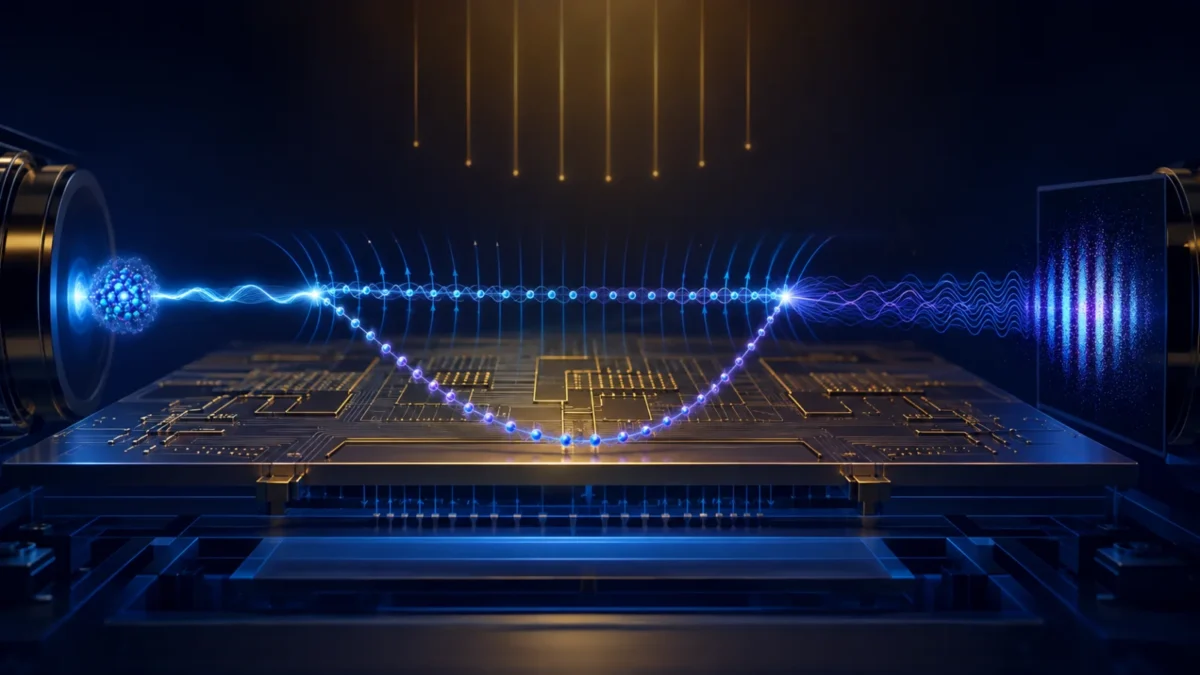
An atom-chip interferometer measured the predicted phase of ultracold rubidium atoms in free fall, finding quantum behavior consistent with Einstein’s equivalence principle in the tested regime.
Published: September 3, 2026, 9:27 p.m. PKT · Reporting cutoff: September 3, 2026, 9:15 p.m. PKT
What you need to know
- Researchers split the quantum wave associated with ultracold rubidium atoms into two paths near an atom chip.
- Magnetic fields held one path in place while the other followed a short ballistic free-fall trajectory.
- Recombining the paths revealed a phase difference consistent with the equivalence principle applied to a quantum wave.
- The team describes this as the first direct measurement of the predicted quantum phase of a freely falling object.
- The result does not prove gravity is quantum, unify quantum mechanics with general relativity or test extremely massive superpositions.
What happens when one quantum wave is allowed to fall while another is held still? Physicists have now performed that comparison with ultracold rubidium atoms and measured the difference when the two paths were reunited.
The result matched the quantum phase predicted from Einstein’s equivalence principle—the idea that gravity locally disappears in a freely falling frame. It is an elegant bridge between two descriptions of nature, but not the long-sought theory of quantum gravity.
How the Quantum Galileo Interferometer works
The experiment cooled clouds of rubidium atoms to just above absolute zero near a purpose-built atom chip. Microwave pulses placed the atoms in a quantum superposition, allowing their matter wave to follow two controlled paths.
Tiny electrical wires on the chip produced magnetic fields that countered gravity for one component, holding it relative to the laboratory. The other component received an upward impulse and then entered a state that was nearly insensitive to the magnetic field, allowing it to rise and fall ballistically.
A final pulse recombined the paths. Like overlapping ripples, the matter waves produced interference that encoded the phase accumulated between the held and freely falling components. The apparatus is called the Quantum Galileo Interferometer.
What Einstein’s equivalence principle predicts
In a small freely falling laboratory, objects appear weightless and the local effects of a uniform gravitational field can be transformed away. That insight is central to general relativity. Quantum objects add a complication because they behave as waves and can occupy superposed paths.
The measured phase was consistent with applying the equivalence principle to the falling quantum wave. According to the researchers, earlier atom interferometers used quantum particles to measure gravity, but this experiment directly compared the predicted phase of a freely falling branch with a held reference.
For background, see what Albert Einstein is most known for and SciQuest’s explanation of how gravity affects time.
What the experiment does not prove
The result does not show that the gravitational field itself has quantum properties. Nor does it reconcile quantum mechanics with general relativity at every scale. It tests whether ordinary quantum evolution remains consistent with an equivalence-principle prediction in one carefully controlled regime.
The experiment also did not reach the masses or coherence times needed to test Roger Penrose’s proposal that sufficiently massive superpositions might collapse because of gravity. The authors say related work with heavier objects, including nanodiamonds, could move toward that regime.
How other headlines framed it
- Oxford University emphasized an experimental connection between Einstein’s gravity and quantum matter while stating what was not proved.
- Science Media Centre Spain paired the announcement with independent expert explanation and explicit limits.
- Spektrum framed the result as a quantum free-fall test of a central relativistic principle.
Why the technique matters
The achievement is partly conceptual and partly instrumental. Controlling a matter wave so one branch falls while another remains supported creates a new way to compare reference frames with quantum systems. Increasing mass, separation and coherence time could make later experiments sensitive to departures that this one could not see.
Bottom line: Falling rubidium matter waves behaved as the tested Einstein principle predicts. The result strengthens an experimental bridge between quantum mechanics and gravity without claiming that the two theories have been unified.
Sources
- Dobkowski and colleagues, “Observation of the quantum phase of free fall and the consistency with the equivalence principle,” Science Advances, September 2, 2026.
- University of Oxford research release, September 3, 2026.
- Science Media Centre Spain expert reaction, September 2, 2026.
Editorial disclosure: The lead image is an original concept illustration, not a photograph of the apparatus or experimental data. SciQuest received no payment for this coverage. To report a possible error, contact SciQuest.
Discover more from SciQuest
Subscribe to get the latest posts sent to your email.
Leave a comment