

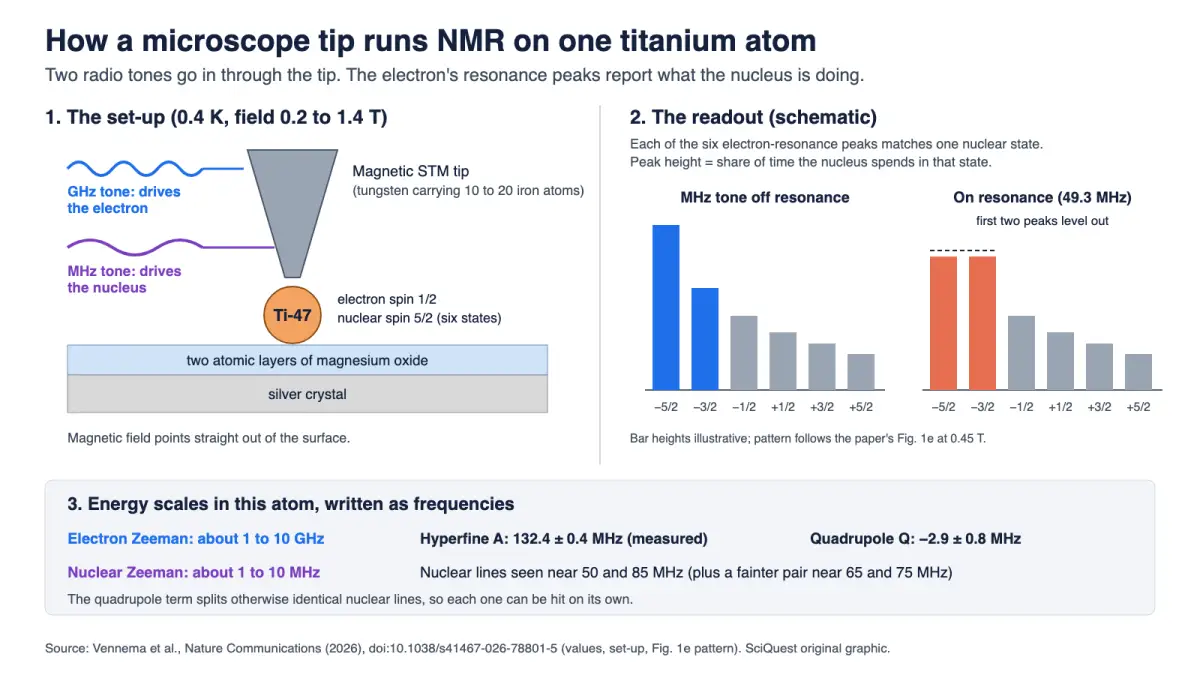
Feeding two radio tones through a microscope tip, Delft physicists picked out the nuclear spin lines of one titanium-47 atom near 50 and 85 MHz at fields up to 1.4 tesla, though they cannot yet say what physically flips the nucleus.
Peer reviewed · Accepted manuscript · Single-lab experiment
Physicists at Delft University of Technology have measured nuclear magnetic resonance (NMR), the technique behind chemistry’s spectrometers and hospital MRI, on one atom on a surface. Hester Vennema, Cristina Mier and colleagues in Sander Otte’s group drove the nucleus of a single titanium-47 atom with radio waves sent through a scanning tunnelling microscope tip, and read it out through the atom’s electron. The study, in Nature Communications on 24 October 2026, is a step toward using single nuclei as long-lived quantum bits. Coherent control has not been shown yet.
What you need to know
- Finding: The team resolved nuclear spin transitions of one titanium-47 nucleus near 50 and 85 MHz, plus a fainter pair near 65 and 75 MHz. The main pair held from 0.2 to 1.4 T.
- Method: Electron-nuclear double resonance (ENDOR) at 0.4 K: a GHz tone drives the electron, a MHz tone the nucleus, and the heights of six electron-resonance peaks report the nuclear state.
- Source: Vennema et al., Nature Communications, accepted manuscript published 24 October 2026.
- Why it matters: Earlier single-atom signals of this kind appeared only where the nucleus and electron were strongly mixed. Driving the nucleus where that mixing is weak is a requirement for using it as a qubit.
- Limitation: All measurements are continuous-wave. No coherence time was measured, and the authors cannot say what drives the nucleus.
Evidence at a glance
| Item | Assessment |
|---|---|
| Evidence status | Peer reviewed (three referees); “Article in Press” accepted manuscript, ahead of the final edited version. Laboratory experiment by one group. |
| Primary source | “Nuclear magnetic resonance on a single atom with a local probe”, Nature Communications, 24 October 2026, doi:10.1038/s41467-026-78801-5. Open access; raw data on Zenodo. |
| Evidence strength | Moderate: the lines appear across seven field values and match a spin model, with two negative controls, but signals are tens of femtoamperes and come from one lab and one microscope tip. |
| Principal limitation | Only steady-state (continuous-wave) signals. The nucleus has not been coherently controlled, and the driving mechanism is unknown. |
| Coverage at a glance | 0 distinct credible publishers as of 26 October 2026, 06:56 UTC (web and news search, TU Delft Applied Sciences news page). Not counted: the authors’ arXiv preprint and conference talk. |
Sources: the paper, its published peer review file, Crossref, arXiv and a SciQuest web and news search.
Is this a big deal?
A solid step for spin physics with scanning microscopes, clearing a doubt over earlier single-atom NMR signals. For quantum computing it is groundwork, not a working qubit.
What scientists found
A titanium-47 nucleus has spin 5/2, so in a magnetic field it can sit in six states. At 0.45 T, the flip between its two lowest states showed up near 50 MHz and near 85 MHz, one line for each direction of the electron spin. A fainter pair sat near 65 and 75 MHz.
Fitting the lines gave a hyperfine coupling between nucleus and electron of 132.4 ± 0.4 MHz and a quadrupole coupling of −2.9 ± 0.8 MHz. The quadrupole term, which arises because the nucleus’s charge is not perfectly round, splits lines that would otherwise overlap, so each can be targeted alone. Tracking the lines with field also fixed the signs of both couplings, which earlier work had to assume.
Show the maths: how weak is a nuclear magnet?
The paper gives the electron’s magnetic scale (the Bohr magneton) as 13.99 GHz per tesla and the nuclear magneton as 7.62 MHz per tesla. Dividing, 13,990 ÷ 7.62 ≈ 1,836, so a nucleus responds roughly 1,800 times less to the same field.
For titanium-47, multiply 7.62 MHz/T by its bulk g-factor, 0.315, and by 0.45 T: about 1.1 MHz. That is the nucleus’s own share of the signal. The lines near 50 and 85 MHz are much larger because the electron’s hyperfine field adds to it, and they sit either side of half the hyperfine coupling, about 66 MHz.
How they found it
The atoms sit on two layers of magnesium oxide on silver, at 0.4 K (−272.75 °C). The tungsten tip carries 10 to 20 iron atoms, making its current sensitive to the titanium electron’s spin.
A nucleus is too weak a magnet to read directly; the authors put its moment about three orders of magnitude below an electron’s. So the team used ENDOR, a method George Feher reported in 1956 for bulk samples. A GHz tone probes the electron, whose resonance splits into six peaks, one per nuclear state.
Think of those peaks as a live bar chart of where the nucleus spends its time. When the MHz tone hits a nuclear transition, the nucleus is shuffled between two states and their bars level out. The analogy has a limit: each bar is an average over many flips, not a snapshot.
Two controls backed this up. With the GHz tone parked away from the peaks, sweeping the MHz tone did nothing. A spinless titanium atom showed no features either.
Why it matters to you
Nothing changes for you this year. The long-term draw is that nuclear spins keep their state for a long time (seconds, in an earlier Delft study of a related titanium isotope), and a scanning microscope can arrange their atomic neighbours one by one. See what quantum computers are useful for.
What the evidence does not show
It does not show what makes the nucleus flip. The paper weighs three candidates and settles none: “the present measurements do not allow us to draw strong conclusions on the driving mechanism.”
The claim also narrowed under review. The December 2025 preprint said the nucleus could be driven efficiently “irrespective of its hybridization” with the electron. After a referee objected, the paper says “in the limit of weak hybridization”.
Signals weakened at high field, partly because radio amplitude could not be held constant above about 0.5 T. At 1.4 T only the main pair of lines was resolved. The measured nuclear g-factor, 0.37 ± 0.04, sits about 17% above the bulk value of 0.315.
How this fits what we already knew
Single nuclear spins are already controlled in diamond defects and in silicon (Pla et al., 2013), but without atom-by-atom control of their neighbours, the paper notes.
Scanning microscopes gained electron spin resonance in 2015 (Baumann et al.) and resolved hyperfine splitting in single iron and titanium atoms in 2018 (Willke et al.). Yang et al. polarised single copper nuclei that year. Their NMR-like signals involved the electron too. In the new data, comparable low-field features vanished by 0.2 T, while the ENDOR lines persisted to 1.4 T.
Outside views
SciQuest found no outside comment as of 26 October 2026 and has not yet interviewed anyone. The published peer review file offers independent views. One anonymous referee wrote that “the data are of high quality, and the interpretation is generally convincing,” but that “the driving mechanism itself remains unclear.” Another called it “a significant advance in the field.”
How other headlines framed it
As of 26 October 2026, 06:56 UTC, SciQuest found no news coverage or press release. The preprint has been on arXiv since 12 December 2025, and Vennema presented it at the APS Global Physics Summit on 17 March 2026.
What happens next
The authors anticipate pulsed experiments to measure the nucleus’s coherence time and show coherent control, and runs with varied driving fields and characterised tips to find what drives it. Seconds-long coherence is possible, they write, but unmeasured.
In one sentence
A Delft team drove and read out the nucleus of one titanium atom with a microscope tip, while it was barely mixed with its electron, but coherent control and the physics of the drive are still to come.
Quick check: did it click?
- Why six peaks? Titanium-47’s nucleus has spin 5/2, giving six states, and each shifts the electron’s resonance.
- What shows the MHz tone hit a nuclear transition? Two peaks level out.
- Has the nucleus’s coherence time been measured? No; that needs the pulsed experiments the authors plan.
Read next
- Thorium nuclear clock runs for a day: steering nuclei with tuned light.
- How does an atomic clock work? How a resonance frequency, locked onto caesium atoms, became the world’s timekeeper.
- What is quantum superposition? What coherent control would add.
Sources and disclosure
- Vennema, H. G., Mier, C., Stolte, E. W., Edens, L., Lee, J. & Otte, S. “Nuclear magnetic resonance on a single atom with a local probe.” Nature Communications (2026), Article in Press, published 24 October 2026. doi:10.1038/s41467-026-78801-5. Peer review file (CC BY 4.0) and data (Zenodo) linked from the article.
- Vennema et al. Preprint, arXiv:2512.11652v1, 12 December 2025.
- Stolte, E. W. et al. “Single-shot readout of the nuclear spin of an on-surface atom.” Nature Communications 16, 7785 (2025). doi:10.1038/s41467-025-63232-5.
- Baumann, S. et al. “Electron paramagnetic resonance of individual atoms on a surface.” Science 350, 417 (2015). doi:10.1126/science.aac8703.
- Willke, P. et al. “Hyperfine interaction of individual atoms on a surface.” Science 362, 336 (2018). doi:10.1126/science.aat7047.
- Yang, K. et al. “Electrically controlled nuclear polarization of individual atoms.” Nature Nanotechnology 13, 1120 (2018). doi:10.1038/s41565-018-0296-7.
- Pla, J. J. et al. “High-fidelity readout and control of a nuclear spin qubit in silicon.” Nature 496, 334 (2013). doi:10.1038/nature12011.
- Feher, G. “Observation of nuclear magnetic resonances via the electron spin resonance line.” Physical Review 103, 834 (1956). doi:10.1103/PhysRev.103.834.
Disclosure: This article was drafted with AI assistance and checked against the sources above, including the full accepted manuscript and its peer review file. The work was funded by a European Research Council Advanced Grant and the Dutch QuMat programme; the authors declare no competing interests. SciQuest calculations: 0.4 K = −272.75 °C; 0.37 ÷ 0.315 = 1.17; 13,990 ÷ 7.62 ≈ 1,836; 7.62 × 0.315 × 0.45 ≈ 1.08 MHz; 132.4 ÷ 2 = 66.2 MHz. The graphic is a SciQuest original based on the paper; its bar heights are illustrative. Spotted an error? See our corrections policy.
Discover more from SciQuest
Subscribe to get the latest posts sent to your email.
Leave a comment