

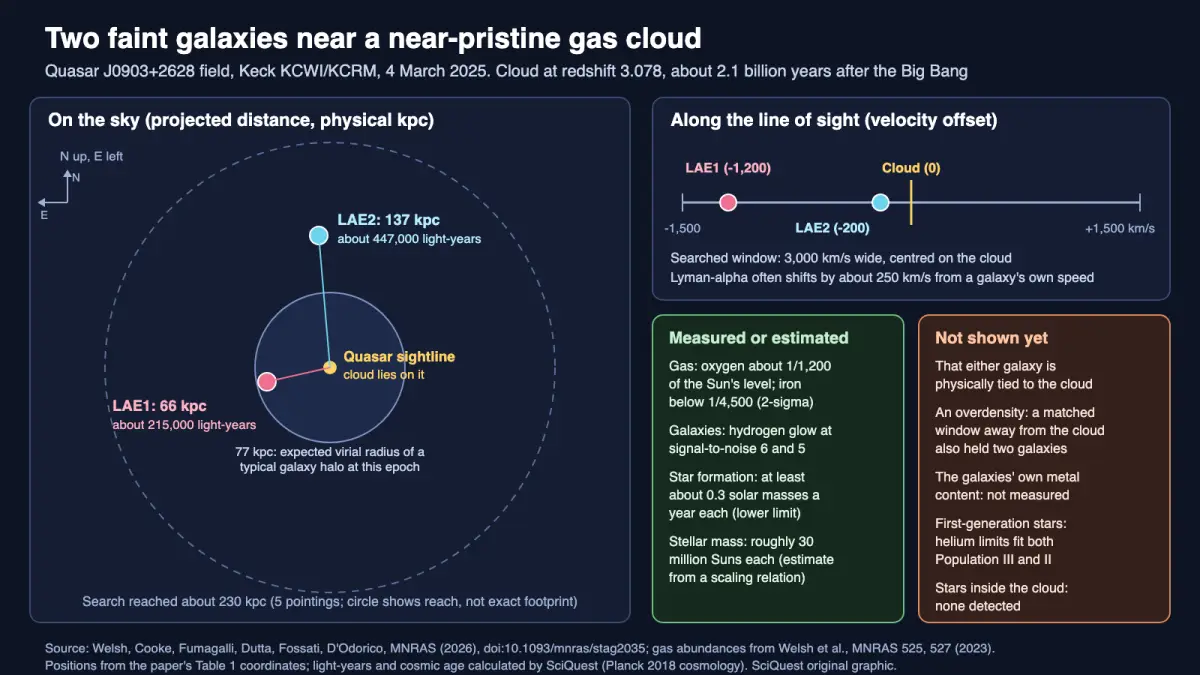
Keck Observatory spectra show two faint galaxies glowing in hydrogen light 66 and 137 kiloparsecs from a gas cloud with under 1/4,500 of the Sun’s share of iron, though a matched search away from the cloud turned up just as many galaxies.
Peer reviewed · Observational study · Two faint sources
Astronomers have spotted the first signs of star formation around one of the most chemically untouched gas clouds known. Louise Welsh of Durham University and INAF Trieste and five colleagues used the Keck Cosmic Web Imager on Maunakea to find two small galaxies near the cloud. We see it as it was about 2 billion years after the Big Bang. The study, in Monthly Notices of the Royal Astronomical Society, tests whether near-pristine gas can lead astronomers to primitive galaxies. The catch: the galaxies’ link to the cloud is inferred, not proven.
What you need to know
- Finding: Two Lyman-alpha emitters (galaxies seen by their hydrogen glow), LAE1 and LAE2, sit 66 and 137 physical kiloparsecs (kpc) from the sightline through the cloud.
- Method: One night of integral-field spectroscopy with Keck’s KCWI and KCRM, on 4 March 2025, reaching about 230 kpc around the quasar J0903+2628.
- Source: Welsh, Cooke, Fumagalli, Dutta, Fossati and D’Odorico, Monthly Notices of the Royal Astronomical Society, published online 24 October 2026 (open access).
- Why it matters: Galaxies near the most metal-poor gas could be places to study very primitive star formation at distances today’s telescopes can reach.
- Limitation: An equal velocity window away from the cloud also held two galaxies, so the pair is not an overdensity, and neither galaxy’s metal content has been measured.
Evidence at a glance
| Item | Assessment |
|---|---|
| Evidence status | Peer reviewed; observational study of one quasar field. SciQuest read the accepted manuscript posted by the journal. |
| Primary source | “Detection of star formation in a near-pristine pocket of the Universe”, MNRAS, stag2035, published online 24 October 2026, CC BY 4.0. Data: Keck Observatory Archive. |
| Evidence strength | Limited. Both detections are confident but faint (signal-to-noise 6 and 5 per pixel) and unresolved; star formation, mass and metal content are inferred from one emission line. |
| Principal limitation | The galaxies are not shown to be physically connected to the cloud; a control window found the same number of galaxies. |
| Coverage at a glance | 0 distinct publishers with their own reporting as of 26 October 2026, 07:00 UTC (web searches of news sites and the Durham University and Keck Observatory news pages). No press release found. A count is not evidence for or against the result. |
Sources: the paper (accepted manuscript, read in full) and SciQuest web searches.
Is this a big deal?
An early, careful step. It is the first reported detection of star formation around this kind of cloud. But two faint galaxies in one field cannot yet show that pristine gas is a reliable signpost.
What scientists found
A damped Lyman-alpha system, or DLA, is a thick cloud of mostly neutral hydrogen. It does not shine; it shows up as a deep absorption trough in the light of a more distant quasar. By definition it holds at least 1020.3 (about 2×10²⁰) hydrogen atoms in a column one square centimetre across.
This one, at redshift 3.078, is near-pristine. Astronomers call every element heavier than helium a “metal”, and this gas has almost none. Earlier Keck measurements put its oxygen at about 1/1,200 of the Sun’s level and its iron below about 1/4,500. A 2023 study by Welsh’s team found its chemistry is best modelled by the yields of a single Population III star, the theorised first generation that formed from metal-free gas.
The new search found two galaxies. LAE2 is farther out on the sky but only 200 km/s from the cloud’s velocity. LAE1 is closer on the sky but offset by 1,200 km/s.
How they found it
Think of the quasar as a distant streetlight seen through fog. The fog leaves fingerprints in the light, but only along one thin line of sight. To see what lives around the fog, you need a camera that records a spectrum at every point in the picture.
KCWI does that. The team tiled five pointings: a 45-minute exposure on the quasar and four hour-long ones around it, reaching three times the 77 kpc halo radius expected for a typical galaxy then. They inspected 1,186 spectra by eye within 1,500 km/s either side of the cloud. Two sources passed their confidence rules, and the red-channel data ruled out nearby galaxies posing as distant ones.
Why it matters to you
This won’t change anything in daily life. It speaks to where your body’s elements came from: the first stars made the first metals, and no Population III star has been directly detected. Clouds like this may be the cleanest record of that era (see our guide to the life cycle of a star).
What the evidence does not show
It does not show first-generation stars. The team found no helium emission at 1640 Å, a marker of very hot, metal-free stars, and their limits fit both Population III and ordinary Population II models.
Nor does it show the galaxies are metal-poor. That rests on narrow, faint lines and an estimated stellar mass of roughly 30 million Suns each, extrapolated along a mass-metallicity relation. Star formation is at least about 0.3 solar masses a year each, a lower limit because dust can hide hydrogen light. No stars inside the cloud itself were detected.
Then there is the control test. A window of the same width just beyond the search held two confident galaxies too, so the authors say the pair is not a significant overdensity. The galaxies may share a larger halo with the cloud, or trace separate structures.
How this fits what we already knew
Ryan Cooke, Max Pettini and Charles Steidel reported the cloud in 2017 as the most metal-poor DLA then known. In 2016, a MUSE study led by co-author Michele Fumagalli found five hydrogen-glowing galaxies near a different pristine cloud.
Independent teams have recently reported candidate near-pristine galaxies by other routes. Cai and colleagues described CR3, at redshift 3.19, with no significant metal lines; their title ends in a question mark. Vanzella and colleagues reported LAP2, a lensed source at redshift 4.19 with no detectable oxygen emission. JWST can follow up all of them.
Independent perspective
SciQuest found no comment from an astronomer outside the author team as of 26 October 2026, 07:00 UTC, and has not yet interviewed one. The context above comes from other groups’ published work.
How other headlines framed it
No news outlet or press release had covered the paper by 26 October 2026, 07:00 UTC. The authors’ framing: “This marks the first detection of star formation in the environment of a chemically near-pristine DLA.” SciQuest reads “environment” as nearby, not inside.
What happens next
The authors want rest-frame optical spectra, for example from JWST, to measure the galaxies’ metals, star-formation rates and dust. Surveys such as 4MOST could find more extremely metal-poor DLAs, turning one field into a sample.
In one sentence
Two faint galaxies turned up near one of the most pristine gas clouds known, a first that makes such clouds worth searching around, but their tie to the cloud and their own chemistry are still open.
Quick check: did it click?
- What is a damped Lyman-alpha system? A thick cloud of neutral hydrogen seen as an absorption trough in a background quasar’s light.
- Why aren’t the two galaxies proof of a crowd around the cloud? An equal window away from the cloud also contained two galaxies.
- Did the team see first-generation stars? No. The helium limits fit both Population III and Population II models.
Read next
- The Universe is making fewer stars, but it hasn’t run out of fuel: how hydrogen gas and star formation are linked over cosmic time.
- What is the Big Bang theory? The starting point for “2 billion years after the Big Bang”.
- How long does it take to travel one light-year? A sense of scale for 215,000 light-years.
Sources and disclosure
- Welsh L, Cooke R, Fumagalli M, Dutta R, Fossati M, D’Odorico V. “Detection of star formation in a near-pristine pocket of the Universe.” Monthly Notices of the Royal Astronomical Society, stag2035, published online 24 October 2026. doi:10.1093/mnras/stag2035 (accepted manuscript read in full).
- Welsh L, Cooke R, Fumagalli M, Pettini M. “Towards ultra metal-poor DLAs: linking the chemistry of the most metal-poor DLA to the first stars.” MNRAS 525, 527 (2023). arXiv:2307.03771.
- Cooke RJ, Pettini M, Steidel CC. “Discovery of the most metal-poor damped Lyman-alpha system.” MNRAS 467, 802 (2017). arXiv:1701.03103.
- Fumagalli M et al. “MUSE searches for galaxies near very metal-poor gas clouds at z~3.” MNRAS 462, 1978 (2016). arXiv:1607.03893.
- Cai S et al. “A Metal-free Galaxy at z = 3.19? Evidence of Late Population III Star Formation at Cosmic Noon.” ApJ Letters 993, L52 (2025). doi:10.3847/2041-8213/ae1608.
- Vanzella E et al. “A pristine, star-forming complex at z = 4.19.” Astronomy & Astrophysics 705, L12 (2026). doi:10.1051/0004-6361/202557153.
Disclosure: This article was drafted with AI assistance and checked against the sources above, including the full accepted manuscript. Calculations by SciQuest: 103.08 ≈ 1,200 and 103.66 ≈ 4,570 give the oxygen and iron fractions; 107.5 ≈ 32 million solar masses; 1 kpc = 3,262 light-years, so 66 and 137 kpc are about 215,000 and 447,000 light-years; the cosmic age of about 2.1 billion years at redshift 3.078 uses Planck 2018 parameters (H0 = 67.66 km/s/Mpc, Ωm = 0.311), matching the paper’s “2 Gyrs”. Galaxy positions in the graphic come from the paper’s coordinates. The graphic is a SciQuest original. Spotted an error? See our corrections policy.
Discover more from SciQuest
Subscribe to get the latest posts sent to your email.
Leave a comment