

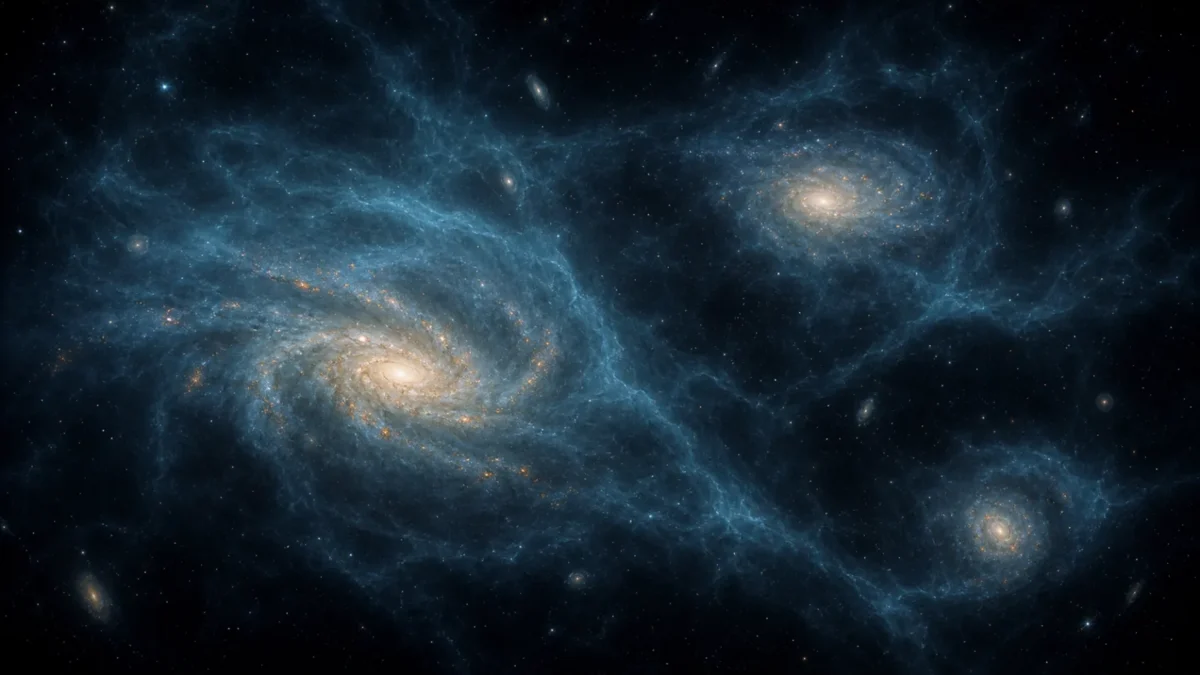
FAST and DESI observations of about 2.5 million galaxies indicate that cosmic star formation fell by a factor of 2.46 over 4.5 billion years while the atomic-hydrogen reservoir declined far less.
Published: September 1, 2026, 9:30 p.m. PKT · Reporting cutoff: September 1, 2026, 9:15 p.m. PKT
What you need to know
- The analysis combined 21-centimetre hydrogen spectra from FAST with optical redshifts from DESI.
- It covered about 2.5 million galaxies across roughly 12,000 square degrees of sky.
- Cosmic star formation declined by a factor of 2.46 over the past 4.5 billion years.
- Raw atomic-hydrogen density declined by only 1.35 ± 0.10; a conservative correction reduced the inferred change to 1.12 ± 0.10.
- The result rules against rapid depletion of atomic hydrogen as the main explanation, but does not identify one final cause.
The universe is forming stars much more slowly than it did several billion years ago. The obvious explanation would be a dwindling supply of hydrogen—but the largest low-redshift analysis of its kind finds that galaxies still retain a surprisingly stable reservoir of neutral atomic gas.
That shifts the mystery. The late universe may not be short of raw material; it may have become worse at turning that material into the dense molecular clouds where stars actually form.
FAST and DESI weighed hydrogen across 2.5 million galaxies
Neutral atomic hydrogen emits a faint radio signal at a wavelength of 21 centimetres. Individual distant galaxies are often too faint for a clean detection, so the researchers aligned and combined—or “stacked”—many spectra from the Five-hundred-meter Aperture Spherical Telescope, FAST.
Optical spectroscopy from the Dark Energy Spectroscopic Instrument, DESI, supplied galaxy distances. Together, the datasets covered approximately 2.5 million galaxies, redshifts from zero to 0.41 and about 12,000 square degrees of sky.
The raw measurements showed cosmic atomic-hydrogen density falling by a factor of 1.35 ± 0.10 over 4.5 billion years. After the team applied a conservative forward-model correction for survey and measurement effects, the inferred decline was just 1.12 ± 0.10. Over the same interval, cosmic star-formation-rate density fell by a factor of 2.46.
Why abundant atomic hydrogen does not guarantee new stars
Atomic hydrogen is not the final fuel inside a stellar nursery. Before gravity can collapse gas into stars, much of it must cool, become denser and convert into molecular hydrogen. Heating, turbulence, magnetic fields, stellar feedback and the supply of fresh gas from the cosmic web can regulate those transitions.
The new result therefore separates the presence of raw gas from its usability. Galaxies can retain broad envelopes and disks of atomic hydrogen while producing fewer cold, dense molecular clouds. Molecular-gas measurements are known to evolve more closely with the star-formation rate, reinforcing that distinction.
For a closer look at the end product, SciQuest’s guide to the life cycle of a star explains how dense clouds collapse and how stellar evolution proceeds after ignition.
What the measurements do not yet explain
Stacking recovers the average signal of a population, not a detailed hydrogen map of every galaxy. The correction from a raw 1.35-fold decline to 1.12-fold depends on a forward model, so the exact number carries systematic uncertainty.
Nor does the study identify one switch that slowed star formation. Reduced gas accretion, inefficient conversion to molecular hydrogen, feedback from stars or black holes and changing galaxy structure may all contribute. The central conclusion is narrower: rapid exhaustion of cosmic atomic hydrogen is not the primary driver.
How other headlines framed it
- Nature Astronomy emphasizes the weak evolution of cosmic atomic hydrogen over 4.5 billion years.
- The institutional release focuses on the FAST–DESI survey and the contradiction between stable gas and declining star formation.
- ScienceNet China frames the reader question directly: why has the universe’s star-making slowed?
The next missing measurement
Researchers now need equally broad measurements of molecular gas and the physical conditions that control phase conversion. Comparing atomic gas, molecular gas and star formation in the same galaxy populations would test where the supply chain is breaking down.
Bottom line: The universe still contains abundant atomic hydrogen. Its declining birth rate of stars appears to be a problem of conversion and regulation, not simply an empty fuel tank.
Sources
- Zhang et al., “Weak evolution of cosmic atomic hydrogen over the past 4.5 billion years,” Nature Astronomy, September 1, 2026.
- Open prepublication version and abstract, arXiv.
- Research summary distributed by EurekAlert, September 1, 2026.
Editorial disclosure: The lead image is an original concept illustration of galaxies and diffuse gas, not an observation, survey map or study figure. SciQuest received no payment for this coverage. To report a possible error, contact SciQuest.
Discover more from SciQuest
Subscribe to get the latest posts sent to your email.
Leave a comment