

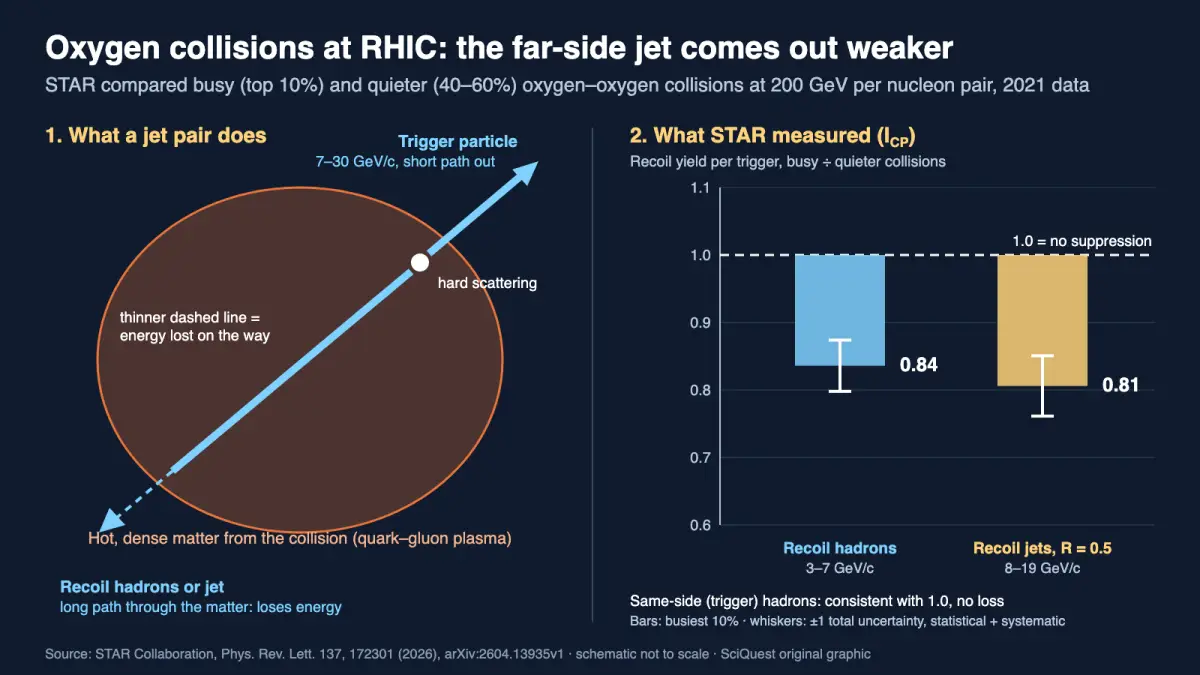
In the busiest 10% of oxygen–oxygen collisions recorded at Brookhaven in 2021, STAR counted about 16% fewer hadrons and 19% fewer jets recoiling from a high-momentum particle than in quieter collisions, a gap the team attributes to energy loss in quark–gluon plasma.
Peer reviewed · Collider measurement · Single experiment
Physicists with the STAR experiment at Brookhaven National Laboratory’s Relativistic Heavy Ion Collider (RHIC) report jet quenching in collisions of oxygen nuclei at 200 GeV per nucleon pair. Jets and particles that had to cross the collision zone came out about 20% less often in the busiest, most head-on collisions than in less busy ones. Jet quenching is a hallmark of quark–gluon plasma, so the result suggests this hot matter forms even when two 16-nucleon nuclei meet at about 1/27 of the LHC’s oxygen energy. How strong the evidence is depends on the baseline chosen.
What you need to know
- Finding: In the busiest 10% of collisions, recoiling hadrons fell to 0.836 and recoiling jets to 0.806 of their rate in quieter collisions. Particles on the trigger’s own side showed no drop.
- Method: STAR analysed about 500 million oxygen–oxygen collisions from 2021, counting what flew out opposite a charged particle with 7 to 30 GeV/c of transverse momentum.
- Source: STAR Collaboration, Physical Review Letters 137, 172301, published online 20 October 2026.
- Why it matters: Small collision systems had shown plasma-like flow but no clear jet quenching. The paper calls oxygen the smallest system in which it has now been observed.
- Limitation: It compares busy with quiet oxygen collisions, and the significance ranges from 2.7 to 5.2 standard deviations depending on the baseline.
Evidence at a glance
| Item | Assessment |
|---|---|
| Evidence status | Peer reviewed; collider measurement by one collaboration (STAR, 391 authors). |
| Primary source | “Measurement of Jet Quenching in O+O Collisions at √sNN = 200 GeV by the STAR Experiment at RHIC”, Phys. Rev. Lett. 137, 172301, online 20 October 2026. Read via arXiv:2604.13935v1. |
| Evidence strength | Moderate to strong: hadrons and jets agree and a built-in control shows no drop, but the significance depends on the baseline and no second experiment has published this at RHIC energy. |
| Principal limitation | The theory calculations used to rule out non-plasma causes are, in the authors’ words, “not precisely comparable” with the measurement. |
| Coverage at a glance | 0 distinct publishers with their own reporting as of 21 October 2026, 07:40 UTC. Not counted: Brookhaven’s release and its verbatim reposts on Phys.org and Newswise. |
Sources: the paper, the APS abstract page, Crossref, and a SciQuest web and news search.
Is this a big deal?
For nuclear physicists, a solid step. Small systems had shown one plasma signature, collective flow, without the other, jet quenching. In oxygen at RHIC energy, both now appear. It does not settle where plasma formation switches off.
What scientists found
Quark–gluon plasma is matter so hot and dense that quarks and gluons, the particles inside protons and neutrons, roam free. The paper notes it filled the universe a few microseconds after the Big Bang. Colliders make a speck of it that lasts less than a billionth of a billionth of a second, Brookhaven says.
When two quarks or gluons collide hard, they fly apart back to back as jets, narrow sprays of particles. A jet that crosses plasma loses energy on the way. That is jet quenching.
STAR picked one fast “trigger” particle and counted what came out opposite it. In the busiest 10% of collisions, recoiling hadrons of 3 to 7 GeV/c were at 0.836 ± 0.021 (stat.) ± 0.032 (syst.) of their rate in the 40–60% reference group. Recoil jets of 8 to 19 GeV/c, measured with radius R = 0.5, were at 0.806 ± 0.037 ± 0.025.
How they found it
The data come from RHIC’s 2021 oxygen run, about 500 million collisions. STAR’s tracker recorded charged particles, while a separate forward detector measured how busy each collision was, so jets could not make a collision look busy.
Comparing busy with quiet collisions was deliberate. The usual measure, RAA, compares nucleus collisions with proton collisions and needs a model of how many nucleon pairs collided. In small systems that estimate is very uncertain, the paper says. Counting recoils per trigger cancels it. This ratio is called ICP.
The trigger side is the control. Particles travelling with the trigger were not suppressed, which the paper reads as the trigger’s jet losing negligible energy. Li Yi of Shandong University, who oversaw the analysis, compared the far side with “shooting a bullet through, say, water” in Brookhaven’s release. The analogy has a limit: jet particles keep moving at nearly light speed. What changes is that energy is knocked out of, or spread beyond, the cone counted as the jet. STAR puts this at an effective shift of 0.70 ± 0.15 (stat.) ± 0.10 (syst.) GeV/c for R = 0.5 jets, roughly 4 to 9% of a jet’s momentum in this range.
Why it matters to you
It won’t change anything you do. It is about origins: how small a speck of matter can still behave like the early universe’s quark soup. For the force that normally keeps quarks confined, see the strongest force in the universe.
What the evidence does not show
Not all of the drop has to be plasma. Quarks and gluons are distributed differently inside nuclei than inside free protons, which can shift jet rates without any plasma. Three theory calculations of that effect all predicted a few percent more recoils, not fewer. But they compare all oxygen collisions with proton collisions, which the authors flag as not precisely comparable.
The strength of the claim moves with the baseline. Against no change, the hadron and R = 0.5 jet drops are 4.3 standard deviations, meaning 4.3 times the combined uncertainty. Against the trigger-side control, the hadron result is 3.3. Across all baselines it is 2.7 to 5.2, and the authors write “strong evidence”. It is one experiment, and its ICP cannot be lined up directly with LHC RAA values.
How this fits what we already knew
RHIC has seen jet quenching in gold collisions for years. Gold nuclei hold 197 nucleons, about 12 times oxygen’s 16. Flow patterns later turned up in far smaller systems, down to proton–proton collisions, but the paper lists no earlier evidence of jet quenching in them.
The LHC first collided oxygen in 2025, at 5.36 TeV per nucleon pair. CMS reported an RAA dipping to 0.69 ± 0.04 near 6 GeV, and CERN says ATLAS, ALICE and LHCb also see energy-loss signs. In the release, Yi notes that higher energy should make a hotter, denser plasma and a bigger signal. STAR’s result indicates the signal survives at 27 times lower energy.
Independent perspective
SciQuest found no comment from a physicist outside STAR as of 21 October 2026, 07:40 UTC, and has not yet interviewed one. Brookhaven’s Rongrong Ma, a STAR member, described the earlier state of play in the release: “We haven’t seen any unambiguous signal, so it’s still kind of under debate in these small systems.”
How other headlines framed it
Only Brookhaven’s release, “Oxygen Collisions Quench Jets’ Energy at RHIC“, has covered it, reposted verbatim by Phys.org and Newswise. It presents a single 20% figure as a clear plasma sign. The paper gives separate hadron and jet values, a significance range and a caveat on its theory baselines.
What happens next
RHIC stopped running in early 2026. Its final run ended with more oxygen collisions on 6 February 2026, recorded by STAR and the newer sPHENIX detector, and Brookhaven says more results are to come. Those data could test whether the suppression holds and how it depends on a jet’s path through the plasma.
In one sentence
In head-on oxygen collisions at RHIC, jets and particles that cross the collision zone come out up to about a fifth less often, a sign that quark–gluon plasma forms even in this small system at low energy, though how much of the drop is plasma depends on the baseline.
Quick check: did it click?
- Why compare busy and quiet oxygen collisions instead of oxygen and proton collisions? It cancels a very uncertain model estimate of how many nucleons collided.
- What is the built-in control? Particles on the trigger’s own side, which were not suppressed.
- Can STAR’s 0.81 be set beside CMS’s 0.69? No. CMS measured RAA against proton collisions at 27 times the energy.
Read next
- What is the strongest force in the universe? The force that binds quarks inside protons and neutrons, until a collider briefly frees them.
- What are the parts of an atom? Nucleons, explained.
- Why is the Big Bang theory the most accepted? The evidence for the hot early universe this plasma recreates.
Sources and disclosure
- STAR Collaboration (B. E. Aboona et al.). “Measurement of Jet Quenching in O+O Collisions at √sNN = 200 GeV by the STAR Experiment at RHIC.” Physical Review Letters 137, 172301, published online 20 October 2026. doi:10.1103/9w2y-bz9n. Version read: arXiv:2604.13935v1 (15 April 2026), the only arXiv version.
- Brookhaven National Laboratory. “Oxygen Collisions Quench Jets’ Energy at RHIC.” News release, 20 October 2026 (source of all quotes).
- CMS Collaboration. “Observation of Suppressed Charged-Particle Production in Ultrarelativistic Oxygen-Oxygen Collisions.” Physical Review Letters 136, 162301 (2026). doi:10.1103/89sf-9t1x; abstract read via arXiv:2510.09864.
- CERN. “Oxygen collisions at the LHC show new indications of extreme state of matter.” 24 July 2026.
Disclosure: This article was drafted with AI assistance and checked against the sources above, using the open arXiv version of the paper rather than the final journal text. The research was funded by the US Department of Energy Office of Science, the US National Science Foundation and agencies in other countries. Calculations by SciQuest: 1 − 0.836 = 16.4% and 1 − 0.806 = 19.4%; combined uncertainties √(0.021² + 0.032²) ≈ 0.038 and √(0.037² + 0.025²) ≈ 0.045; 5,360 GeV ÷ 200 GeV ≈ 27; 197 ÷ 16 ≈ 12; 0.70 ÷ 19 ≈ 4% and 0.70 ÷ 8 ≈ 9%. The graphic is a SciQuest original drawn from the paper’s values. Spotted an error? See our corrections policy.
Discover more from SciQuest
Subscribe to get the latest posts sent to your email.
Leave a comment