

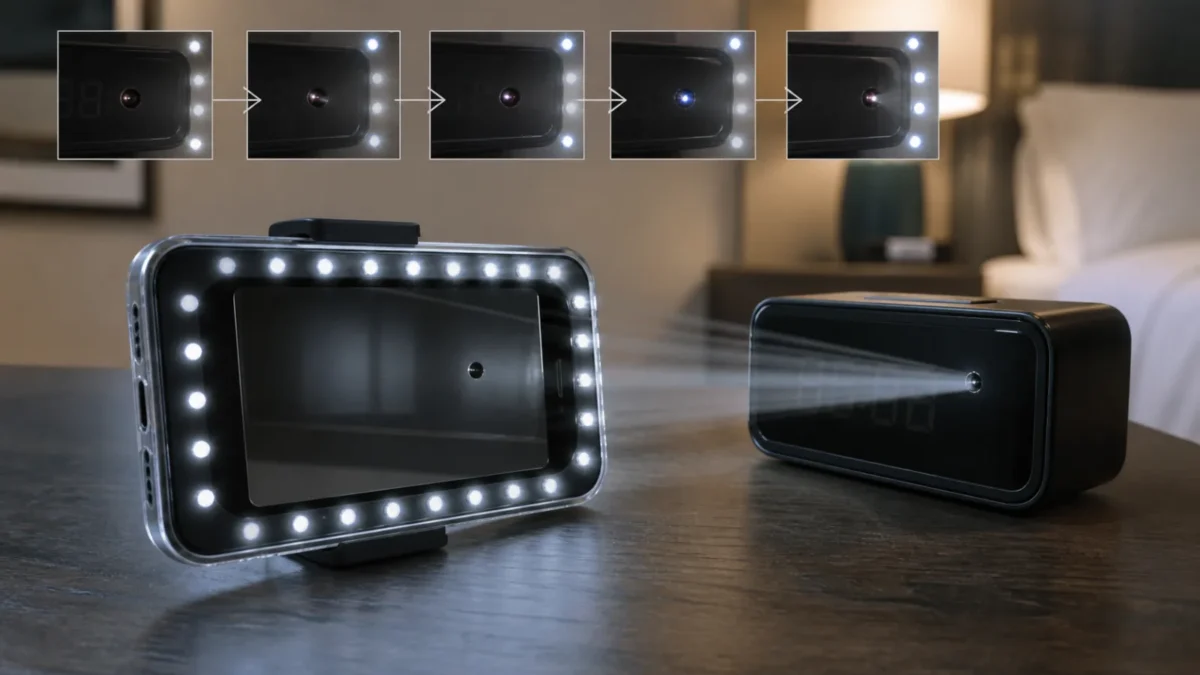
A research prototype called SweepLED combines a smartphone with a low-cost directional LED case to detect concealed camera lenses from their changing reflections, reaching about 94% detection accuracy across 30 tested objects in scans lasting under five seconds.
Published: August 30, 2026, 11:25 p.m. PKT · Reporting cutoff: August 30, 2026, 11:15 p.m. PKT
What you need to know
- SweepLED uses a phone case fitted with directional LEDs; it is not a normal phone-only app.
- The phone stays still while the LEDs illuminate a suspicious object from different angles.
- Software analyzes how reflections move and change to distinguish a lens from shiny plastic, glass or metal.
- The prototype achieved approximately 94% detection accuracy across 30 objects in the reported evaluation.
- It remains a research prototype, and a negative scan cannot guarantee that a room contains no hidden camera.
A bright dot is easy to find. Knowing whether it comes from a camera lens or a harmless piece of polished plastic is much harder. SweepLED tackles that problem by changing the light rather than asking a traveler to interpret one suspicious glint.
The system was developed by researchers from the Korea Advanced Institute of Science and Technology, the National University of Singapore and Singapore Management University. Its core components reportedly cost less than US$7, although that figure is a research bill of materials—not a promised retail price.
How the hidden-camera detector works
A camera lens contains several curved optical surfaces, an aperture and an image sensor. Light entering this structure can produce a sequence of reflections that changes in a characteristic way when the illumination direction moves.
SweepLED places multiple narrow-beam LEDs around a smartphone. The user points the phone at a suspicious object and holds it still while the LEDs switch on in sequence. The phone records a short video, and the system extracts candidate reflections from successive frames.
The algorithm then compares how those reflections change across lighting angles and, when available, across more than one viewing position. That temporal pattern helps separate a camera lens from ordinary shiny surfaces that might fool a simple flashlight-based detector.
What the 94% result means—and what it does not
The researchers reported approximately 94% accuracy during tests involving 30 kinds of everyday objects and a scan time below five seconds. That result indicates that the optical principle is promising. It does not mean the device will find 94% of every hidden camera in every hotel, rental or changing room.
Performance can change with viewing distance, room lighting, lens orientation and the material covering a concealed camera. A diffuser or heavily obscured opening may suppress the distinctive reflection. The user must also decide which objects to inspect; the prototype does not generate an instant, complete map of a room.
Because SweepLED detects the lens rather than a wireless transmission, it could in principle find a camera that is powered off or recording locally. Conversely, it cannot prove that an unfamiliar electronic object is safe, and it should not replace professional inspection where personal safety is at risk.
Why this differs from existing detectors
Radio-frequency detectors look for wireless transmissions, which can miss cameras that are inactive or store footage locally. Basic optical detectors illuminate a room and leave the user to recognize a lens reflection. Network scans only reveal devices connected to the same visible network.
SweepLED’s contribution is automated interpretation of changing optical reflections using inexpensive hardware attached to a device many people already carry. The practical advantage will depend on whether a future product can reproduce the laboratory system’s carefully controlled lighting and analysis.
How other headlines framed SweepLED
- KAIST emphasized the decoupled illumination sweep and the optical differences between lenses and ordinary reflective objects.
- EurekAlert’s institutional release highlighted a smartphone-based AI detector for everyday privacy protection.
- Frandroid led with the low component cost while also noting that the 94% figure came from controlled tests.
What happens next
The team has presented a working research system, not announced a product launch. A consumer version would need broader independent testing across phone cameras, room conditions, concealment materials and adversarial designs. It would also need a clear way to communicate uncertainty so that users do not mistake “not detected” for “definitely absent.”
Bottom line: SweepLED is a clever, experimentally tested method for recognizing camera-lens reflections with a phone and a low-cost light accessory. It is not yet a commercial device or a guarantee against covert recording.
Sources
- Yun et al., “Hide-and-sweep: Detecting concealed cameras via LED illumination sweeps,” MobiSys 2026.
- KAIST research overview, August 20, 2026.
- KAIST publication record and reported performance.
Editorial disclosure: The lead image is a concept illustration of the detection method, not a photograph of the researchers’ prototype or proof that a particular object contains a camera. SciQuest received no payment to cover this research. To report a possible error, contact SciQuest.
Discover more from SciQuest
Subscribe to get the latest posts sent to your email.
Leave a comment