

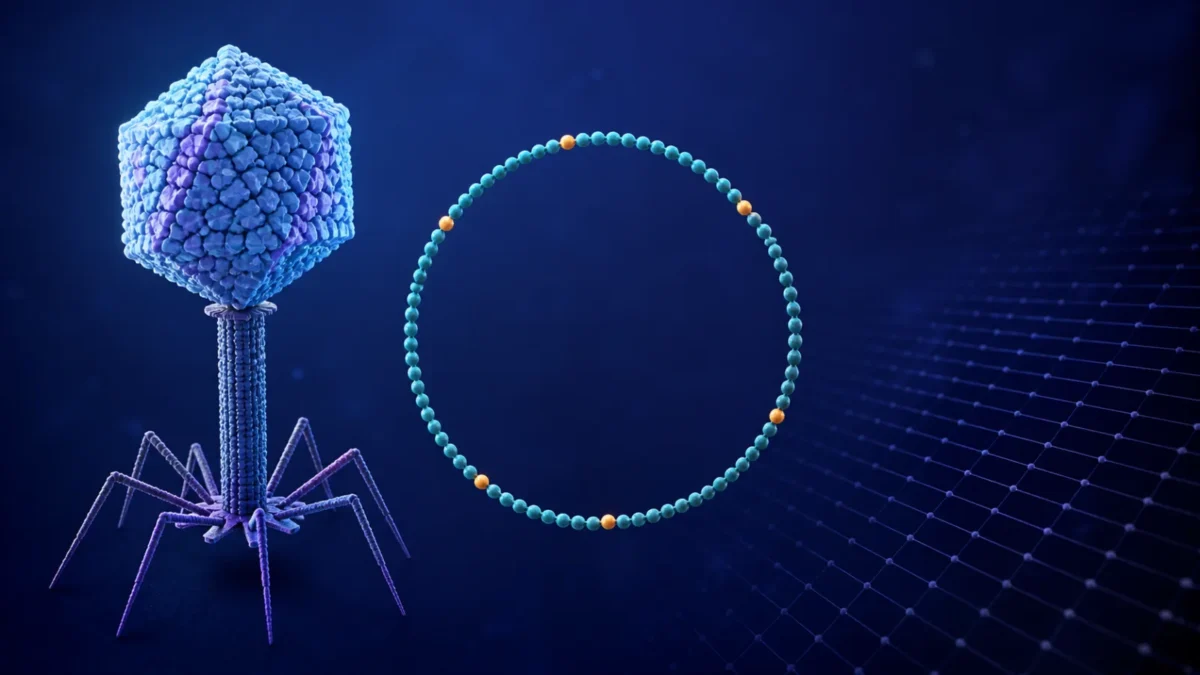
Researchers tested more than 44,000 versions of the 5,386-nucleotide bacteriophage ΦX174 genome and found that leading biological AI models still struggled to predict many mutations that damaged or killed the virus.
Published: September 1, 2026, 9:30 p.m. PKT · Reporting cutoff: September 1, 2026, 9:15 p.m. PKT
What you need to know
- ΦX174 is a small bacteriophage with a circular, single-stranded DNA genome that infects Escherichia coli, not people.
- The researchers made every possible single-nucleotide substitution and every possible single-amino-acid substitution.
- About half of the nucleotide changes and 60% of the amino-acid changes reduced viral fitness.
- Some lethal effects remained unexplained even in one of biology’s most intensively studied genomes.
- The work is a preprint and has not yet completed peer review.
A genome can be only 5,386 DNA letters long and still contain rules that neither decades of research nor today’s artificial intelligence fully understands. That is the message from a sweeping mutation experiment on ΦX174—pronounced “phi X 174”—a virus famous for becoming the first complete DNA genome ever sequenced.
The researchers did not merely sample a few genes. They systematically changed individual DNA letters and protein building blocks, then let thousands of variants compete. The resulting map shows which changes the virus tolerates, which help it and which stop it from reproducing.
A near-complete mutation map of a whole viral genome
ΦX174 has a circular, single-stranded DNA genome encoding 11 proteins. Huijin Wei, Xianghua Li, Ben Lehner and colleagues created more than 44,000 variants: all three alternatives at individual nucleotide positions and all 19 alternatives for individual amino acids in the viral proteins.
They cultured pooled variants with susceptible E. coli for 80 minutes, enough for roughly two or three infection cycles. Sequencing before and after the competition revealed which variants multiplied and which disappeared.
Approximately half of single-nucleotide mutations and 60% of amino-acid substitutions harmed the phage. A small number improved fitness even though ΦX174 has been adapted to laboratory conditions for decades. That mix of fragility and remaining opportunity is precisely what makes comprehensive experimental maps valuable.
Why AI missed biologically important effects
Modern biological AI systems often infer mutation effects from protein sequences, structures or evolutionary patterns. Those inputs are powerful, but a genome does more than encode isolated proteins. DNA can contain regulatory signals, overlapping instructions and structures involved in replication or packaging. Viral proteins must also interact with one another and with the host cell.
The study found many detrimental changes that models did not predict reliably. Among harmful amino-acid substitutions, some probably disrupted protein interactions and others damaged buried structural regions. A remaining fraction could not be explained convincingly.
This does not show that AI is useless in genetics. It shows why predictions need experimental testing and why better training data must represent whole biological systems. SciQuest’s report on self-blinking probes for DNA imaging describes another way improved measurements can expose biology that models alone cannot supply.
What this experiment does not mean
ΦX174 infects bacteria. It is not a human pathogen, and the experiment does not predict a new epidemic or prove that all viral mutations are dangerous. Most harmful mutations actually reduce a virus’s ability to reproduce.
The work also cannot yet be treated as settled. Peer reviewers may question the fitness assay, statistical thresholds, library construction or model comparisons. Replication in other laboratories and tests in different host conditions would show how much of the map is environment-specific.
How other headlines framed it
- The preprint presents a genome-wide experimental fitness map and benchmarks models against measured mutation effects.
- Nature emphasizes the surprising effects of rewriting nearly every DNA letter and the limits exposed in leading AI systems.
Why the map matters beyond one tiny phage
Large mutation maps can help researchers identify overlooked genomic functions, improve models and design smaller experiments more intelligently. They can also reveal when apparently harmless changes alter packaging, regulation or interactions rather than protein shape.
Bottom line: A nearly exhaustive test of one famously simple genome exposed hundreds of effects that remain hard to explain. The result is less an AI defeat than a precise measurement of what biological prediction still lacks.
Sources
- Wei, Li and Lehner, ΦX174 mutational-landscape preprint, bioRxiv, July 2026.
- Ewen Callaway, “Mutating every DNA letter of a genome shows surprising effects—and the limits of AI,” Nature, September 1, 2026.
Editorial disclosure: The lead image is an original concept illustration of a bacteriophage and circular genome, not a microscopy image or study figure. SciQuest received no payment for this coverage. To report a possible error, contact SciQuest.
Discover more from SciQuest
Subscribe to get the latest posts sent to your email.
Leave a comment