

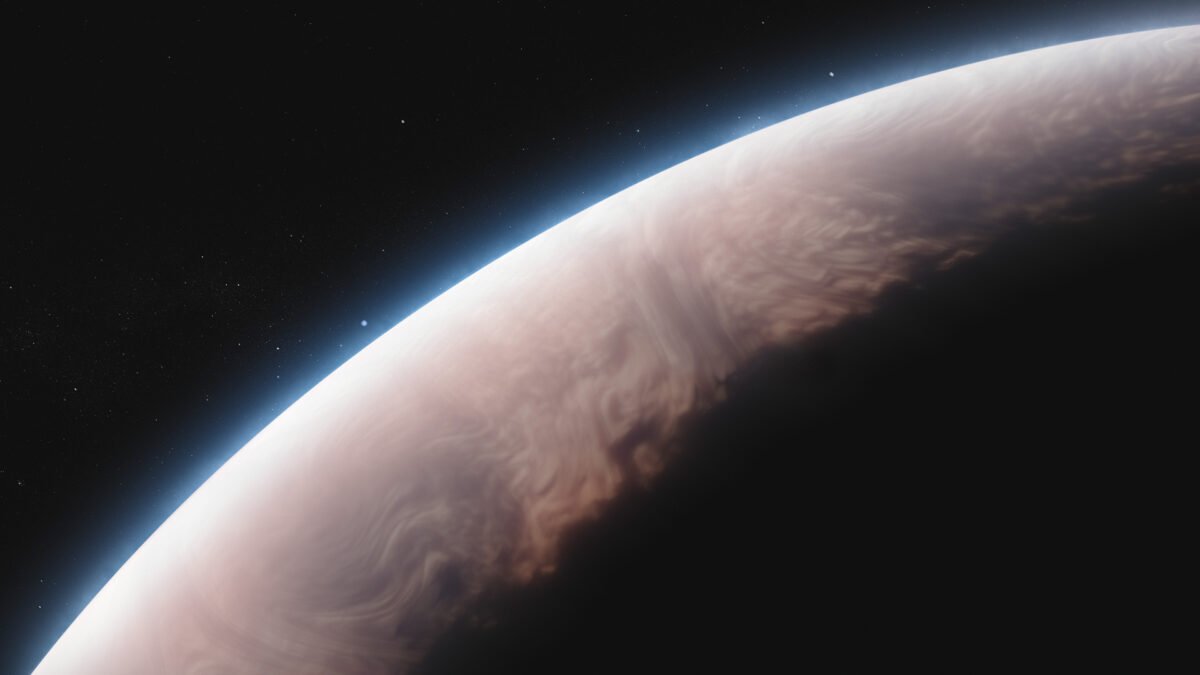
By reading starlight through each part of the planet’s edge, astronomers found WASP-17b’s evening side about 650 K hotter and noticeably puffier than its morning side, although the planet’s outline departs from a circle by only about 1 to 2 percent.
Peer reviewed · Observational study of one planet · First use of a new method
A team led by Lili Alderson of Cornell University used the James Webb Space Telescope to map the edge of a giant exoplanet’s atmosphere angle by angle, rather than as a single average. Reported in Nature Astronomy on 14 October 2026, the map of the hot Jupiter WASP-17b shows a hotter, more extended evening side and a cooler, thinner morning side, as models of fast equatorial winds predicted, and the method could now be tried on other planets. The catch: the morning-side temperature is uncertain by hundreds of kelvin, and the analysis assumed the planet’s north and south halves match.
What you need to know
- Finding: Retrieved temperatures rise from about 858 K at WASP-17b’s morning equator to 1,522 K at its evening equator, and the hotter evening edge stands taller.
- Method: The team fitted JWST transit light curves from 0.6 to 12 micrometres with a non-circular outline, then read a separate spectrum at each angle around the planet’s edge.
- Source: Alderson, Wakeford, Grant and 18 co-authors, Nature Astronomy, 14 October 2026 (open access).
- Why it matters: It is the first time a planet’s transmitting edge has been mapped from equator to pole, giving models of alien weather a direct test.
- Limitation: One planet, observed in March 2023, with a morning-side temperature uncertain by roughly +430/−230 K and a north–south symmetry built into the fit.
Evidence at a glance
| Item | Assessment |
|---|---|
| Evidence status | Peer reviewed; observational study of a single planet; first application of the transmission strings method to real data |
| Primary source | “A spatial map of the atmospheric limb of a hot Jupiter”, Nature Astronomy, published online 14 October 2026, DOI 10.1038/s41550-026-02986-4. Full text open access. |
| Evidence strength | Moderate. The evening-versus-morning temperature contrast agrees with two separate JWST techniques (a dayside eclipse map and nightside emission) and with circulation models. But it rests on one planet and one observing run per instrument, and the cooler side is poorly constrained. |
| Principal limitation | The morning-side temperature (858 K, +434/−233 K) is far less certain than the evening side, and the fit assumed the northern and southern hemispheres are mirror images. |
| Coverage at a glance | 0 independent publishers found as of 14 October 2026, 13:00 UTC. Counted: outlets with their own reporting on the paper. Excluded: the University of Bristol and Cornell University releases on EurekAlert, and reposts of the Bristol release on Phys.org and Newswise. |
Sources: the Nature Astronomy paper (text, Methods and Table 1); University of Bristol and Cornell University releases, 14 October 2026; SciQuest search of news coverage.
Is this a big deal?
It is a solid methods milestone, not a surprise about the planet: the result matches what wind models and earlier JWST studies already suggested. What is new is the ability to read conditions at any chosen angle around a planet’s edge, including near the poles, from ordinary transit data. If it works on more planets, astronomers gain a map where they used to have a single average.
What scientists found
WASP-17b is a gas giant about 1.9 times Jupiter’s radius but only about half its mass, orbiting its star every 3.7 days. That makes it extremely puffy: our calculation puts its average density near 97 kg/m³, about a tenth that of water. Its star lies about 1,300 light-years away (405.9 parsecs, or 1,324 light-years, in the NASA Exoplanet Archive).
The planet is tidally locked, so one side always faces its star. Air carried by winds from the dayside crosses into the night over the evening terminator, the boundary between day and night on the planet’s eastern side; air returning from the nightside crosses back over the morning terminator.
The new map found a steady change between the two. The retrieved temperature rises from 858 K (about 585 °C) at the morning equator, through about 1,290 K near the pole, to 1,522 K (about 1,249 °C) at the evening equator. The contrast is 664 K, with an uncertainty range of about 400 to 1,110 K. Hotter gas stands taller, and the authors calculate that the evening side’s scale height, the height over which atmospheric pressure drops by a fixed factor, is about 1.8 times the morning side’s.
Water vapour and carbon dioxide, the two molecules the data could measure reliably, showed no clear change in abundance around the edge.
How they found it
When a planet crosses its star, a thin ring of atmosphere at its edge, called the limb, lets some starlight through. Gases in that ring absorb particular colours, so the planet looks slightly bigger at those wavelengths. Standard analyses treat the planet as a perfect circle and get one spectrum averaged around the whole ring.
Transmission strings drop that assumption. Developed at the University of Bristol by David Grant and Hannah Wakeford, and run with the open-source software Harmonica, the method lets the planet’s outline bend, described by a mathematical series of waves. The light curve’s exact shape as the planet slides on and off the star reveals which parts of the outline stand taller at each wavelength.
Picture working out the shape of a biscuit by timing exactly when its edges begin and stop blocking a lamp as you slide it past. The analogy breaks down on scale: here the “bumps” are about 1 percent of the radius, measured through a dip in starlight known to a precision of about 120 parts per million at each angle.
The team reused transits taken in March 2023 by three of Webb’s instruments (NIRISS, NIRSpec and MIRI) for the TST DREAMS programme, led by Cornell’s Nikole Lewis. They built spectra at angles from 0° to 180° in 24 wavelength bins, then fitted each angle as if it were a separate planet. Each wavelength bin took about two weeks to fit across 40 computer cores.
“Rather than assuming your planet is a circle with the same radius all the way around, our technique allows you to pull out different distances from the center to the edge of the planet,” Alderson said in Cornell’s release.
Why it matters to you
Nothing changes in your daily life. This is a step in learning what other worlds are like and how their weather works. The same technique, applied to cooler and smaller planets in future, could help astronomers avoid mistaking an averaged atmosphere for a uniform one, which matters when they hunt for molecules on distant planets.
What the evidence does not show
It does not show a visibly egg-shaped planet. Cornell’s release calls the outline “slightly egg-shaped”, but the paper puts the variation around the limb at about 0.9 to 1.6 percent of the planet’s radius. By our calculation that is roughly 1,200 to 2,200 km on a planet about 136,000 km in radius.
It also does not map the north and south separately. To keep the computing manageable, the fit assumed the two hemispheres mirror each other, based on earlier circulation models of WASP-17b. The authors note this may need relaxing for other planets.
Clouds are a competing explanation for part of the pattern. A 2025 study led by Guangwei Fu found WASP-17b’s morning limb spectrum muted and attributed that to high-altitude aerosols, meaning haze or cloud particles. The new paper could not pin down any cloud properties, so it cannot fully separate a cooler morning from a cloudier one. Its temperature range does span the predicted switch from silicate to salt clouds, the authors note.
How this fits what we already knew
Earlier JWST work on WASP-17b found quartz cloud particles in 2023 and, in a 2024 eclipse map led by Daniel Valentine, a dayside hot spot shifted about 19° east, a sign of an eastward equatorial jet. The new limb temperatures fit those results and the planet’s nightside emission.
Other teams have compared morning and evening limbs before by splitting the planet into two halves. WASP-17b’s contrast is larger than those reported for the three planets below, consistent with models that predict bigger contrasts on hotter planets.
| Planet | Equilibrium temperature (K) | Morning–evening contrast (K) |
|---|---|---|
| WASP-107b | 770 | about 100 |
| WASP-39b | 1,100 | 177 |
| WASP-94Ab | 1,540 | 280 |
| WASP-17b (this study) | 1,760 | 664 (+449/−259) |
Source: values as compiled in Alderson et al., Nature Astronomy (2026), Discussion. Earlier studies used different methods and instruments, so the comparison is approximate.
Independent perspective
SciQuest has not yet interviewed an astronomer outside the team, and we found no published independent comment by 13:00 UTC on 14 October. The study’s lead author framed the agreement with theory as the headline result. “Theory predicts that the morning and the evening sides should have a strong temperature difference, and WASP-17b fits really nicely in that trend – pretty much bang-on what we thought it would be,” Alderson said in the Bristol release.
Wakeford, an associate professor at Bristol and the paper’s second author, said: “Planets are temperamental, their atmospheres complex and chaotic.”
How other headlines framed it
No independent outlet had covered the study when we checked, so this compares the institutional announcements.
- University of Bristol led with the “real shape” of hot-planet atmospheres, describing a deformed sphere rather than a circle.
- Cornell University emphasised the planet’s “true shape” and called it slightly egg-shaped, adding that water and carbon dioxide stay consistent around the limb.
- Phys.org republished the Bristol release with an automated summary.
What happens next
A further JWST programme (GO-8309, led by Cornell’s Elijah Mullens and S. E. Moran) will observe WASP-17b again with MIRI to sharpen spectra beyond 5 micrometres, which the authors say may reveal whether cloud types change around the limb. Alderson and Wakeford say the method can now be tried on many more planets. The main constraint is signal, because fitting a bent outline needs very precise light curves.
In one sentence
JWST has mapped the edge of WASP-17b’s atmosphere angle by angle, confirming a hotter, puffier evening side, but the shape change is small and the cooler side remains uncertain.
Why it matters to you: it won’t touch daily life, but it gives astronomers a way to stop treating a planet’s atmosphere as one uniform ring.
Quick check: did it click?
- Which side of WASP-17b’s limb is hotter? The evening side, at about 1,522 K, versus about 858 K on the morning side.
- Is WASP-17b visibly egg-shaped? No. The variation around the limb is about 1 to 2 percent of the radius.
- What does transmission strings replace? The assumption that the planet is a perfect circle, which gives only one averaged spectrum.
Read next
- How does the James Webb telescope work? The instruments behind this map.
- How many planets are there in the Milky Way? Where WASP-17b sits among thousands of known worlds.
- Jupiter vs the Sun, for a sense of the giant-planet scale WASP-17b exceeds.
Sources and disclosure
- Alderson L, Wakeford HR, Grant D, Lewis NK, et al. “A spatial map of the atmospheric limb of a hot Jupiter.” Nature Astronomy, published online 14 October 2026. doi:10.1038/s41550-026-02986-4
- University of Bristol. “Trailblazing technique uncovers real shape of scorching-hot exoplanet atmospheres”, news release via EurekAlert, 14 October 2026.
- Cornell University. “Pulling strings: New method maps exoplanet’s true shape”, news release via EurekAlert, 14 October 2026.
- NASA Exoplanet Archive. WASP-17 b overview (system distance 405.9 pc; published masses 0.45–0.53 Jupiter masses in most solutions).
- Grant D, Wakeford HR. “Transmission strings: a technique for spatially mapping exoplanet atmospheres around their terminators.” Monthly Notices of the Royal Astronomical Society 519, 5114–5127 (2023). doi:10.1093/mnras/stac3632
- Valentine D, et al. “JWST-TST DREAMS: Non-uniform dayside emission for WASP-17b from MIRI/LRS.” The Astronomical Journal 168, 123 (2024). doi:10.3847/1538-3881/ad5c61
- Grant D, et al. “JWST-TST DREAMS: Quartz clouds in the atmosphere of WASP-17b.” The Astrophysical Journal Letters (2023). doi:10.3847/2041-8213/acfc3b
- Fu G, et al. “Overcast mornings and clear evenings in hot Jupiter exoplanet atmospheres.” arXiv:2507.15854 (2025; listed as accepted to The Astrophysical Journal Letters).
- NASA. Jupiter fact sheet (radius 71,492 km; mean density 1,326 kg/m³).
Disclosure: This article was drafted with AI assistance and checked against the sources above, including the full open-access paper and its Table 1. Density, kilometre and Celsius conversions are SciQuest calculations from the paper’s values (1.9 Jupiter radii, 0.5 Jupiter masses) and NASA’s Jupiter fact sheet. Quotes are verbatim from the Bristol and Cornell releases. The graphic is a SciQuest original drawn from Table 1. SciQuest has no conflicts of interest. Spotted an error? See our corrections policy.
Discover more from SciQuest
Subscribe to get the latest posts sent to your email.
Leave a comment