

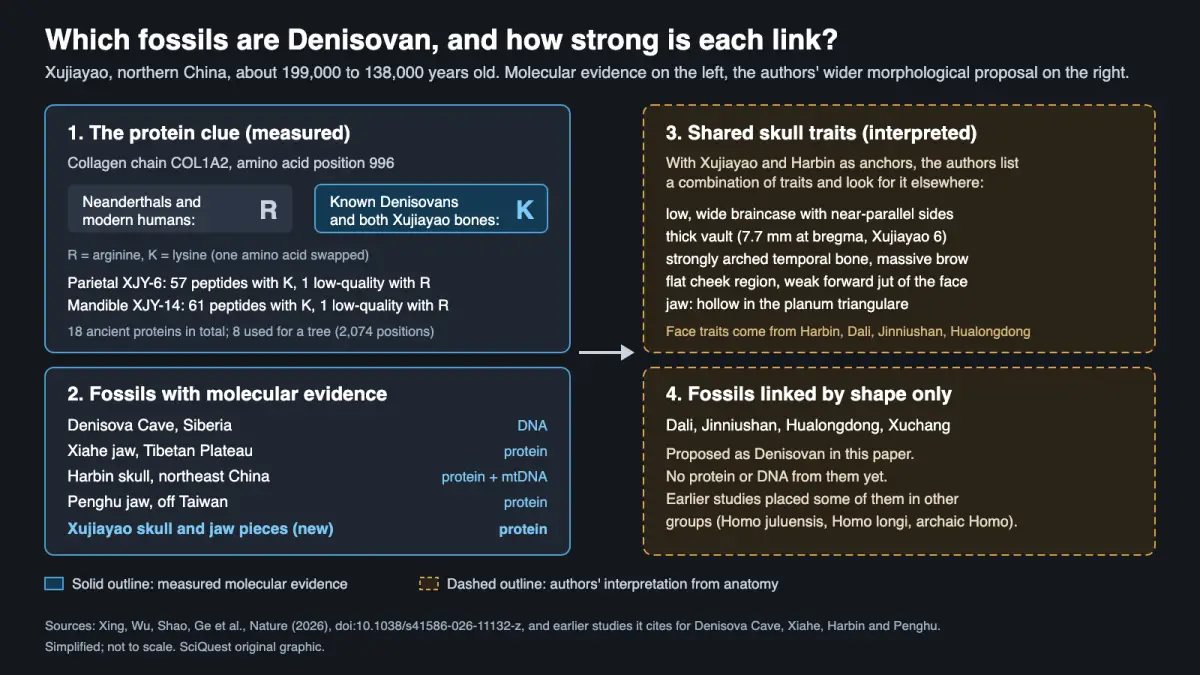
Collagen from two Xujiayao bones dated to about 199,000 to 138,000 years ago carries an amino acid that, among humans studied so far, only Denisovans have, though the Denisovan face described alongside it is assembled from other skulls.
Peer reviewed · Ancient-protein analysis of 2 specimens · Anatomical comparison
Two fossils from Xujiayao, a 20-piece hominin collection from northern China, belonged to Denisovans, the extinct cousins of Neanderthals first identified from DNA. Song Xing, Qiaomei Fu and colleagues at the Institute of Vertebrate Paleontology and Paleoanthropology in Beijing report it in Nature, based on a single Denisovan-only amino acid in bone collagen. They then use Xujiayao and the Harbin skull to define a shared Denisovan skull pattern, and argue that most other Chinese fossils of the period, including Dali, Jinniushan and Hualongdong, were Denisovan too. That second step rests on anatomy alone.
What you need to know
- Finding: A skull bone (XJY-6) and a jaw piece (XJY-14) both carry lysine at position 996 of the collagen chain COL1A2, a variant seen in every Denisovan tested and no Neanderthal or modern human.
- Method: Mass spectrometry of drilled bone powder gave 18 ancient proteins; the team then compared skull, jaw and tooth anatomy across East Asian fossils.
- Source: Xing, Wu, Shao, Ge and 10 co-authors, Nature, published 21 October 2026 (open access).
- Why it matters: Xujiayao is one of East Asia’s largest fossil sets from this period, so a molecular label makes it a reference for Denisovan anatomy.
- Limitation: Dali, Jinniushan, Hualongdong and Xuchang are called Denisovan from anatomy alone, and the face traits come from fossils other than Xujiayao.
Evidence at a glance
| Item | Assessment |
|---|---|
| Evidence status | Peer reviewed; ancient-protein (palaeoproteomic) analysis of 2 specimens plus anatomical comparison of museum fossils, casts and 3D models. |
| Primary source | “The proteome of Middle Pleistocene Xujiayao and common Denisovan morphology”, Nature, published online 21 October 2026, doi:10.1038/s41586-026-11132-z, CC BY-NC-ND 4.0. |
| Evidence strength | Strong for Xujiayao being Denisovan: the diagnostic variant appears in 118 peptides across both bones, passes an ancient-damage test, and the protein tree groups Xujiayao with Denisovans at above 99% probability. Limited for the four fossils added by anatomy alone. |
| Principal limitation | The molecular link rests on one amino acid position, which can sort a fossil into the Denisovan group but cannot say how Denisovan populations relate to each other. |
| Coverage at a glance | 4 distinct publishers with their own write-ups (Nature News, Global Times, Phys.org, Anthropology.net) as of 24 October 2026, 13:00 UTC. Not counted: three aggregator or low-editorial sites that restated the same material. |
Sources: the paper’s full text on nature.com and a SciQuest read of the coverage under “How other headlines framed it”.
Is this a big deal?
For Xujiayao, yes: fossils argued over for almost 50 years now have a molecular label from two separate bones. The broader claim, that most of China’s skulls from this period were Denisovan, is a serious proposal that still needs proteins from those skulls.
What scientists found
Workers dug up 20 hominin skull, jaw and tooth fossils at Xujiayao, in the Nihewan Basin, between 1976 and 1979. Combined uranium-series and electron-spin-resonance dating puts them at about 199,000 to 138,000 years old. They have been labelled Neanderthal, early Homo sapiens and, most recently, the type fossils of a proposed species, Homo juluensis. Both sampled bones carry the Denisovan variant, so the authors assign the Xujiayao hominins to “a late Middle Pleistocene East Asian Denisovan population”, and go no further than that.
How they found it
The team scanned both bones in 3D, then drilled tiny holes for powder. Mass spectrometry, which weighs protein fragments to read their sequence, found 15,194 distinct peptides. To weed out modern contamination they used deamidation, a slow chemical change that builds up in old protein: the main bone collagens were 45% to 95% changed, the usual contaminants 10% or less. Eighteen proteins passed every filter.
Think of the marker as an inherited spelling quirk: a family that always writes one word differently. At COL1A2 position 996, Neanderthals and modern humans have arginine (R); Denisova Cave, Xiahe, Penghu and Harbin individuals have lysine (K). Xujiayao gave 118 peptides with K and just 2 low-quality ones with R. The analogy has a limit: one quirk names the family, not the branch, and the protein tree could not resolve relationships inside the Denisovan group (below 50% support).
Which skull traits are now called Denisovan
With Xujiayao and Harbin as anchors, the authors list a mix of old and new features. No single fossil shows all of them; in the paper’s words, the suite “does not appear simultaneously in individual specimens”.
| Trait | Also found in | Evidence from |
|---|---|---|
| Low skull profile with near-parallel side walls | Early Neanderthals, H. heidelbergensis; differs from most H. erectus and modern humans | Xujiayao 6 and other East Asian fossils |
| Thick skull vault (7.7 mm at bregma, 12.0 mm at the parietal bulge) | Homo erectus | Xujiayao 6 |
| Strongly arched temporal bone at the side of the skull | Later Homo, including modern humans | Xujiayao and others |
| Inner-ear canal placement; suprainiac fossa (a small pit at the back of the skull) | Late Neanderthals | Xujiayao, Xuchang |
| Hollow on the inner jaw (planum triangulare) | Uncommon in other Homo | Xujiayao, Xiahe, Penghu |
| Low sloping forehead, massive brow, squarish eye sockets, broad nose opening, flat cheeks, weak forward jut of the face | Fits traits predicted from Denisovan genetic data, the authors say | Harbin, Jinniushan, Hualongdong, Dali (Xujiayao has no face) |
Source: Xing et al., Nature (2026), main text and Fig. 4. Trait wording simplified by SciQuest.
Why it matters to you
This changes nothing in daily life. It is a question of where we came from: some living people carry Denisovan DNA from interbreeding, yet until recently few fossils could be tied to these relatives. A skull-based checklist lets museum fossils be reassessed even where DNA does not survive.
What the evidence does not show
Only 2 of the 20 Xujiayao fossils were sampled; extending the label to the rest assumes they come from one population, which the shared deposit supports but does not prove. The facial traits come from other sites’ fossils, and Dali, Jinniushan, Hualongdong and Xuchang have no molecular data at all.
The paper also disputes a rival view rather than settling it. Homo juluensis was distinguished partly by brain volume of 1,700 to 1,800 ml (about 1.7 litres), against 1,120 to 1,420 ml in other fossils of the period. The authors argue the gap fits inside the modern human range of 1,090 to 1,880 ml, so it reflects variation within one population.
How this fits what we already knew
Denisovans were first defined from DNA in a Siberian cave, as a sister group of the Neanderthals. Proteins later identified jaws from Xiahe on the Tibetan Plateau (2019) and Penghu, Taiwan (2025), and in 2025 Fu’s group tied the Harbin skull to Denisovans with protein and mitochondrial DNA. Counting anatomy too, the authors suggest Denisovans could have lived in East Asia from at least 300,000 to 45,000 years ago. Xujiayao also yielded scrapers and stone balls; see what tools were made in the Stone Age.
Outside views
In Nature’s news story, palaeogeneticist Sally Wasef of Queensland University of Technology said protein work complements DNA because proteins outlast it. Fabrice Demeter of the University of Copenhagen called the study a major step toward knowing what Denisovans looked like and where they lived. Nature lists Demeter among the paper’s peer reviewers, so his view is not fully independent. As of 24 October 2026, SciQuest found no public response from Christopher Bae or Xiujie Wu, who proposed H. juluensis, and has not interviewed anyone.
How other headlines framed it
- Nature News led with the face and issued a same-day clarification changing “skulls” to “skull fragments”.
- Global Times called it the first anatomy-based way to identify Denisovans, but said Xujiayao had been classed as Homo longi; the paper says Homo juluensis.
- Phys.org hedged with “may have looked like” and carried no outside comment.
- Anthropology.net judged the protein result well supported and the wider reassignment much less secure, as SciQuest does.
What happens next
The direct test is chemical. Protein results from Dali, Jinniushan, Hualongdong or Xuchang would confirm or break the anatomical grouping, and supporters of H. juluensis may reply in print. SciQuest will update this story if either appears.
In one sentence
A single collagen variant in two bones firmly places the Xujiayao fossils with the Denisovans, while the claim that most of China’s archaic skulls were Denisovan rests on anatomy and awaits a molecular check.
Quick check: did it click?
- What is the molecular marker? Lysine (K) instead of arginine (R) at position 996 of the collagen chain COL1A2.
- Does the Denisovan face come from Xujiayao? No. Xujiayao has no face bones; the facial traits come from Harbin, Jinniushan, Hualongdong and Dali.
Read next
- Neanderthal wooden spears survive as moulds in Spain: what the Denisovans’ sister group left behind.
- Monkey feet complicate a key assumption about human evolution: another test of how anatomy is read.
- What tools were made in the Stone Age? The technology of the period.
Sources and disclosure
- Xing S, Wu Z, Shao Q, Ge J, Bennett EA, Rao H, Lin S, Zhao Y, Liu F, Liu Y, Zhou K, Feng X, Jiangzuo Q, Fu Q. “The proteome of Middle Pleistocene Xujiayao and common Denisovan morphology.” Nature, published 21 October 2026. doi:10.1038/s41586-026-11132-z.
- Fu Q et al. “The proteome of the late Middle Pleistocene Harbin individual.” Science 389, 704–707 (2025). doi:10.1126/science.adu9677.
- Fu Q et al. “Denisovan mitochondrial DNA from dental calculus of the >146,000-year-old Harbin cranium.” Cell (2025). doi:10.1016/j.cell.2025.05.040.
- Chen F et al. “A late Middle Pleistocene Denisovan mandible from the Tibetan Plateau.” Nature 569, 409–412 (2019). doi:10.1038/s41586-019-1139-x.
- Tsutaya T et al. “A male Denisovan mandible from Pleistocene Taiwan.” Science 388, 176–180 (2025). doi:10.1126/science.ads3888.
- Bae CJ, Wu X. “Making sense of eastern Asian Late Quaternary hominin variability.” Nature Communications 15, 9479 (2024). doi:10.1038/s41467-024-53918-7.
- Fieldhouse R. “This is what the mysterious Denisovans looked like.” Nature News, 21 October 2026. doi:10.1038/d41586-026-03360-0.
- Coverage read for framing: Global Times, Phys.org, Anthropology.net.
Disclosure: This article was drafted with AI assistance and checked against the sources above, including the full open-access paper. The authors declare no competing interests. Counts by SciQuest: 57 + 61 = 118 lysine-bearing peptides and 1 + 1 = 2 arginine-bearing peptides across the two bones, from the paper’s per-specimen figures. Comments from Sally Wasef and Fabrice Demeter are paraphrased from Nature’s news story. The graphic is a SciQuest original built from the paper’s reported values. Spotted an error? See our corrections policy and editorial standards.
Discover more from SciQuest
Subscribe to get the latest posts sent to your email.
Leave a comment