
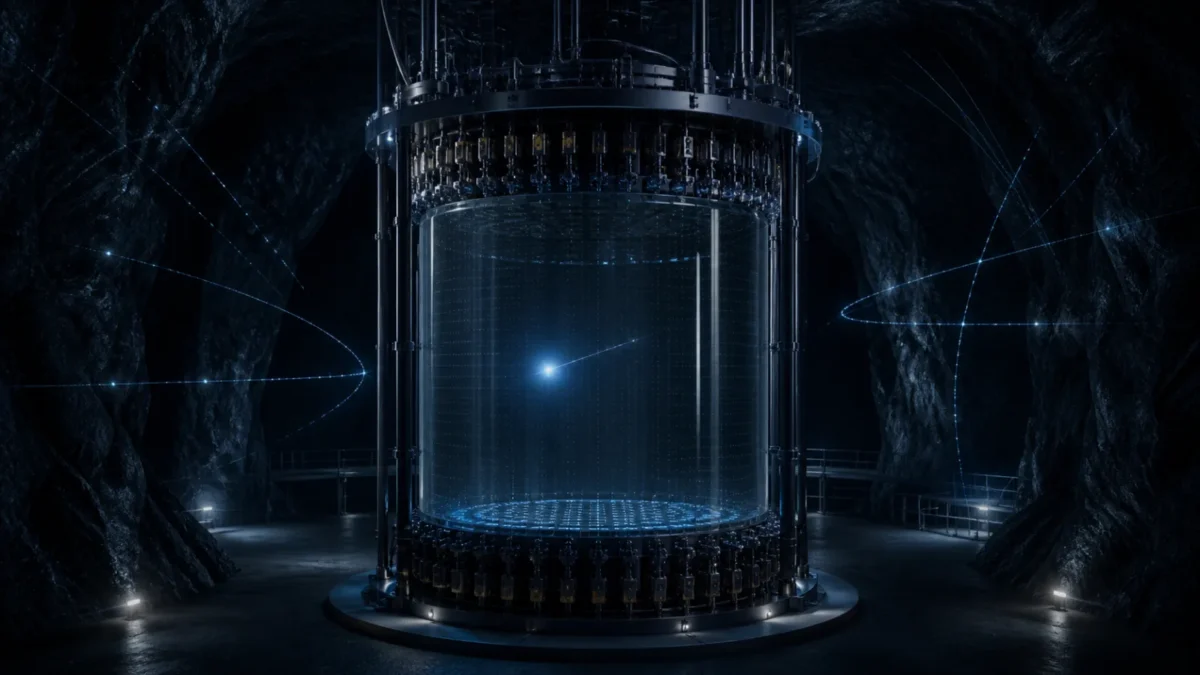
A 220-day search by the LUX-ZEPLIN experiment left one unexplained 248-kiloelectronvolt nuclear-recoil candidate, an intriguing event that is compatible with some heavy-WIMP models but is nowhere near a dark-matter discovery.
Published: September 1, 2026, 9:30 p.m. PKT · Reporting cutoff: September 1, 2026, 9:15 p.m. PKT
What you need to know
- LUX-ZEPLIN recorded one unusual high-energy event in 220 live days of new data collected between March 2023 and April 2024.
- The event deposited about 248 kiloelectronvolts of recoil energy in the liquid-xenon detector.
- Its characteristics can fit interactions from a very heavy weakly interacting massive particle, or WIMP.
- The collaboration has not claimed dark matter; an unmodeled background, detector artifact or statistical fluctuation could explain it.
- More exposure and better background tests are required before the event can be interpreted.
Deep beneath South Dakota, a detector built to notice almost nothing recorded one event that physicists cannot yet comfortably classify. The flash is interesting because its energy and nuclear-recoil signature resemble what some models predict when a massive dark-matter particle strikes a xenon nucleus.
But the most important word is resemble. The LUX-ZEPLIN collaboration reported a candidate, not a detection. History is full of rare-event anomalies that disappeared when experiments collected more data or understood their instruments better.
What the LUX-ZEPLIN detector recorded
LUX-ZEPLIN, usually shortened to LZ, uses a dual-phase chamber containing tonnes of ultra-pure liquid xenon. A particle interaction can produce a prompt flash of light and free electrons; the relative timing and strength of those signals help researchers estimate the event’s position and decide whether it resembles a nuclear recoil or a more common electronic recoil.
The new analysis examined 220 live days of data and expanded the nuclear-recoil search to energies as high as 270 kiloelectronvolts. After researchers removed artificial “salted” events inserted to reduce analyst bias, one event remained near 248 kiloelectronvolts.
That energy is higher than the range emphasized in conventional searches for lower-mass WIMPs. In the interaction models tested by the team, the candidate is compatible with a dark-matter particle heavier than roughly 200 gigaelectronvolts per c2, with some interpretations favoring masses near 1,000 gigaelectronvolts per c2. Compatibility is not identification: multiple processes can occupy the same region of detector data.
Why one flash can be exciting without being evidence of discovery
Dark matter is inferred from its gravitational effects on galaxies, galaxy clusters and the large-scale universe. Direct-detection experiments ask a narrower question: does the unseen matter occasionally collide with ordinary atomic nuclei? A repeatable excess with the right energy distribution and detector behavior would provide a powerful answer.
One event cannot establish that pattern. Its probability depends on background estimates, detector response and the many models tested. A rare radioactive decay, neutron interaction, unusual charge behavior or another poorly modeled process may be responsible. The collaboration’s caution is therefore a scientific strength, not a weakness.
For background on the larger mystery, see SciQuest’s explanation of where astronomers infer dark matter is found and how NASA’s Roman Space Telescope will map the dark universe through gravitational observations rather than direct particle detection.
How other headlines framed it
- The LZ preprint frames the work as a higher-energy effective-field-theory search and reports constraints alongside the event.
- Nature asks whether the event could be a first glimpse of dark matter while stating immediately that it is only one data point.
What would make the case stronger
The decisive ingredient is more data. If LZ or another xenon experiment records additional events with a consistent energy spectrum, spatial distribution and nuclear-recoil signature, researchers can test whether a dark-matter model explains them better than backgrounds do.
Bottom line: LZ saw a genuinely interesting unexplained event. It is a reason to watch the next dataset—not a reason to say dark matter has been found.
Sources
- LUX-ZEPLIN Collaboration, “Dark Matter EFT Nuclear Recoil Search at Higher Energies,” preprint, September 1, 2026.
- Davide Castelvecchi, “Is this the first glimpse of dark matter? Data point excites physicists,” Nature, September 1, 2026.
Editorial disclosure: The lead image is an original concept illustration, not a photograph of LZ or a visualization of the candidate event. SciQuest received no payment for this coverage. To report a possible error, contact SciQuest.