

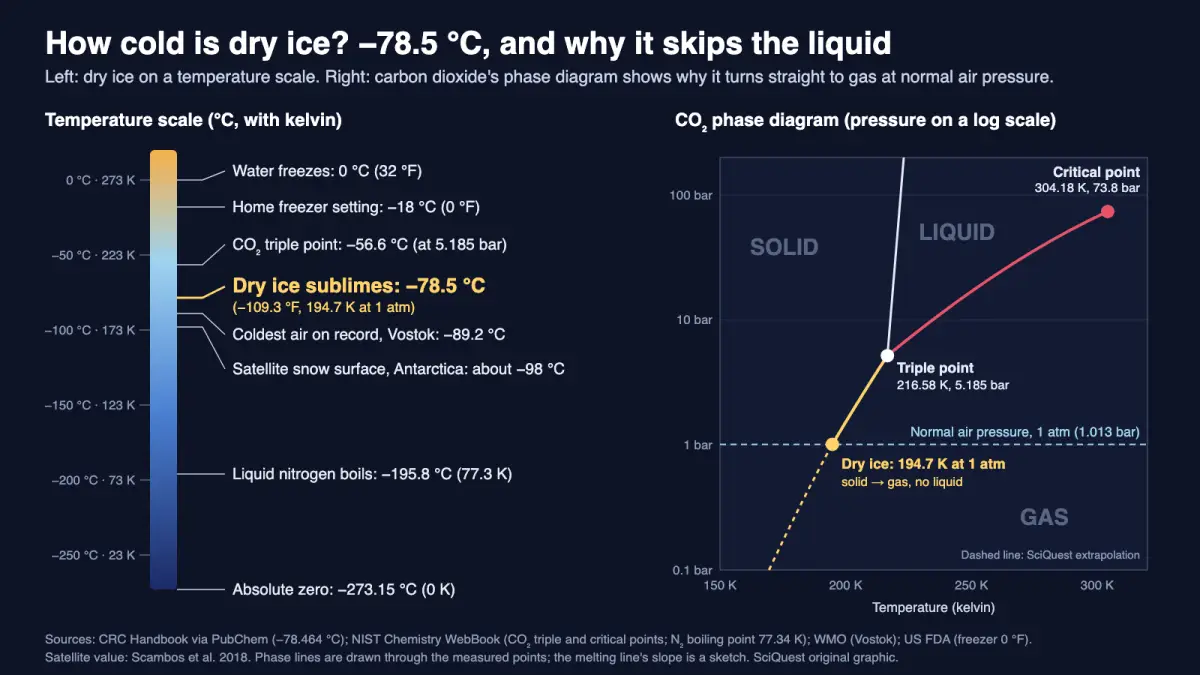
Solid carbon dioxide turns straight into gas at −78.5 °C under normal air pressure, which makes it about 60 °C colder than a home freezer, a little warmer than the coldest air ever recorded in Antarctica, and 117 °C warmer than liquid nitrogen.
Dry ice is −78.5 °C (−109.3 °F, or 194.7 K) at sea-level air pressure. That is the temperature at which solid carbon dioxide (CO2) turns directly into gas, a change called sublimation. The CRC Handbook of Chemistry and Physics gives the value more precisely as −78.464 °C at a pressure of one standard atmosphere.
A block of dry ice sitting in a cooler stays pinned near that temperature while it slowly disappears. It never leaves a puddle, because at everyday pressures carbon dioxide cannot exist as a liquid. That one fact explains its name, its cooling power and most of its hazards.
Explain it like I’m busy:
- Dry ice is −78.5 °C (−109.3 °F, 194.7 K) at normal air pressure.
- It skips the liquid stage because liquid CO2 needs at least 5.185 bar, about five times normal air pressure.
- It is cold enough to cause frostbite on contact, and the gas it releases can build up in closed spaces, so handle it with insulated gloves and good ventilation.
Key facts about dry ice temperature
- Sublimation point: −78.464 °C at 1 atm (CRC Handbook, via PubChem), usually rounded to −78.5 °C or −109.3 °F.
- Triple point: 216.58 K (−56.57 °C) at 5.185 bar, the lowest pressure at which liquid CO2 can exist (NIST Chemistry WebBook).
- Compared with liquid nitrogen: liquid nitrogen boils at 77.34 K (−195.81 °C), so it is about 117 °C colder than dry ice.
- Cooling power: subliming 1 kg of dry ice absorbs about 573 kJ of heat, roughly 1.7 times the 334 kJ needed to melt 1 kg of water ice (SciQuest calculation).
- Gas released: 1 kg of dry ice becomes about 547 litres of CO2 gas at 20 °C, which is why sealed containers can burst (SciQuest calculation).
| What | Celsius (°C) | Fahrenheit (°F) | Kelvin (K) | Type of value |
|---|---|---|---|---|
| Water freezes (1 atm) | 0 | 32 | 273.15 | Defined reference point |
| Recommended home freezer setting (US FDA) | −18 | 0 | 255 | Recommendation |
| CO2 triple point (at 5.185 bar) | −56.57 | −69.83 | 216.58 | Measured |
| Dry ice sublimes (1 atm) | −78.46 (−78.5) | −109.2 (−109.3) | 194.69 (194.7) | Measured; rounded values in brackets |
| Lowest air temperature on record, Vostok, Antarctica (21 July 1983) | −89.2 | −128.6 | 184.0 | Measured at a weather station |
| Coldest snow surfaces seen from satellites, East Antarctica | about −98 | about −144 | about 175 | Satellite estimate of surface, not air |
| Liquid nitrogen boils (1 atm) | −195.81 | −320.46 | 77.34 | Measured |
| Absolute zero | −273.15 | −459.67 | 0 | Defined |
Sources: CRC Handbook of Chemistry and Physics, 95th edition, via PubChem (dry ice); NIST Chemistry WebBook (CO2 triple point, Angus et al. 1976 and Marsh 1987; nitrogen boiling point, Jacobsen et al. 1986); WMO (Vostok); Scambos et al. 2018 (satellite); US FDA (freezer). Conversions are SciQuest calculations: K = °C + 273.15 and °F = °C × 1.8 + 32. The CRC value converts to −109.24 °F; the familiar −109.3 °F comes from converting the rounded −78.5 °C.
What −78.5 °C means
Think of a pan of boiling water. At sea level it stays near 100 °C however high you turn the burner, because the extra heat goes into turning liquid into steam. Dry ice works the same way at −78.5 °C: heat flowing in from the room is spent turning solid CO2 into gas, so the block’s temperature stays pinned while the block shrinks. The analogy has two limits. Dry ice has no liquid stage at all, and its pinned temperature is a ceiling, not a floor: a block can be chilled below −78.5 °C (in liquid nitrogen, for example), but at normal pressure it cannot warm above it and stay solid.
In everyday terms, dry ice is about 60 °C colder than the −18 °C (0 °F) the US Food and Drug Administration recommends for a home freezer. Yet the coldest air ever measured on Earth, −89.2 °C at Russia’s Vostok station in Antarctica on 21 July 1983, was 10.7 °C colder still, according to the World Meteorological Organization. Satellites have spotted snow surfaces near −98 °C in shallow hollows on the East Antarctic plateau, as our guide to the coldest place on Earth explains.
Why dry ice sublimates instead of melting
Every substance has a phase diagram, a map showing whether it is solid, liquid or gas at each combination of temperature and pressure. The three regions meet at a single spot called the triple point. For water, that spot sits at a tiny pressure, 0.0061 bar according to NIST, so liquid water is common at everyday pressures. For carbon dioxide, it sits at 216.58 K (−56.57 °C) and 5.185 bar, according to the NIST Chemistry WebBook.
Normal air pressure is 1.013 bar, about one fifth of that. Below the triple-point pressure, there is no liquid region on the map at all. Warm solid CO2 at 1 atm and it crosses straight from the solid region into the gas region, at −78.5 °C. Squeeze carbon dioxide above 5.185 bar and it can melt into a liquid, which is why NIOSH notes that carbon dioxide is shipped as a liquefied compressed gas.
How scientists know the temperature of dry ice
The sublimation point is a measured property, not an estimate. It is defined as the temperature at which the vapour pressure of solid CO2, the pressure of the gas it gives off in a closed space, equals one standard atmosphere (101.325 kPa). Vapour-pressure measurements across a range of temperatures, such as Giauque and Egan’s 1937 data from 154 to 196 K listed by NIST, pin down that crossing point, and reference handbooks evaluate and compile the results. The CRC Handbook’s value is −78.464 °C, and the US Department of Energy’s PAC chemical database lists the same figure.
The triple point is known even more tightly. NIST lists 216.58 K with an uncertainty of 0.008 K and notes it is recommended as a fixed point for thermometry, meaning laboratories can use it to calibrate thermometers.
Worked calculation: how much heat dry ice soaks up
The NIST Chemistry WebBook lists an enthalpy of sublimation of 25.2 kJ/mol near 195 K (Giauque and Egan, 1937). That is the heat needed to turn one mole of solid CO2 into gas.
- Moles in 1 kg: 1,000 g ÷ 44.01 g/mol = 22.72 mol.
- Heat absorbed: 22.72 mol × 25.2 kJ/mol = 573 kJ per kg.
- For comparison, melting ice at 0 °C takes 334 J per gram, or 334 kJ per kg, according to the European Space Agency’s education pages.
- Ratio: 573 ÷ 334 = 1.7.
So, kilogram for kilogram, dry ice absorbs about 1.7 times more heat as it disappears than water ice absorbs as it melts. It also starts 78.5 °C colder and leaves nothing wet behind, which is why it is used to ship frozen food and laboratory samples. The calculation ignores the extra heat the cold gas picks up as it warms to room temperature, so the real cooling per kilogram is a little higher.
Worked calculation: how much gas 1 kg makes
Using the ideal gas law at 20 °C and 1 atm, each mole of gas fills 24.06 litres. Then 22.72 mol × 24.06 L/mol = 547 litres of CO2 from a single kilogram of dry ice. Solid dry ice has a density of about 1.56 g/cm3 (US Coast Guard data, via PubChem), so 1 kg occupies 0.64 litres. The gas therefore takes up about 850 times the volume of the solid, matching the “approximately 1:850” ratio in the University of Edinburgh’s safety guidance.
What changes the answer
Pressure. −78.5 °C applies at one standard atmosphere. At higher pressure the sublimation temperature rises along the curve in the phase diagram, up to −56.57 °C at the triple point. At lower pressure, such as at high altitude, it is a little colder.
Rounding. You will see −78.5 °C, −78 °C, −109.3 °F and −109 °F. The University of Edinburgh’s guidance says approximately −78 °C, and the NIOSH Pocket Guide lists −109 °F. All describe the same measured value at different precision.
“Times colder” comparisons. Some sellers describe dry ice as several times colder than a freezer. Ratios like that don’t work on the Celsius or Fahrenheit scales, where zero is arbitrary. On the kelvin scale, which starts at absolute zero, a freezer at 255 K is only about 1.3 times warmer than dry ice at 194.7 K. The useful comparison is the difference: about 60 °C.
How long does dry ice last?
That depends on the container, the amount and the shape. Youngstown State University’s dry ice safety procedure says dry ice sublimates at about 5 to 10 pounds (about 2.3 to 4.5 kg) every 24 hours in a typical storage cooler, and that blocks last longer. A better-insulated cooler slows the loss, but the cooler must not be airtight, as the next section explains.
Is dry ice dangerous? Frostbite, gas build-up and sealed containers
The hazards follow from the temperature and the gas. The points below come from the NIOSH Pocket Guide to Chemical Hazards and university safety offices, and they are not a substitute for the instructions supplied with dry ice or your local safety rules.
- Cold burns. NIOSH lists frostbite as a hazard of skin and eye contact with dry ice. Youngstown State University warns that bare hands can be burned or frostbitten “in a short period of time” and advises insulated gloves. The University of Edinburgh recommends loose-fitting, thermally insulated gloves or tongs, plus eye protection.
- Gas in closed spaces. The University of Edinburgh warns that subliming dry ice can raise CO2 to dangerous levels in poorly ventilated areas, and advises against transporting it in closed vehicles or storing it in unventilated rooms, cold rooms or walk-in fridges. NIOSH lists headache, dizziness, restlessness and difficulty breathing among the symptoms of overexposure.
- Sealed containers. Both universities warn that dry ice in a tightly sealed or unvented container can build up enough pressure to burst it. Our calculation above shows why: 1 kg becomes about 547 litres of gas.
- Swallowing. The University of Edinburgh states that swallowing solid CO2 causes severe internal damage and can be fatal. Dry ice used to make fog in drinks or punch should never be eaten or swallowed.
For a sense of scale, NIOSH sets an Immediately Dangerous to Life or Health (IDLH) concentration for CO2 of 40,000 parts per million, or 4% of the air. Our illustration: if all 547 litres from 1 kg of dry ice stayed in a sealed 10 m3 space, such as a small store room 2 m × 2 m × 2.5 m, the gas would make up about 5.5% of the volume. Real rooms leak and CO2 pools unevenly, so this is a worst-case sketch, not a safety threshold, but it shows why ventilation matters.
Why dry ice makes fog
Drop dry ice into warm water and white fog spills out, a familiar Halloween effect. The CO2 gas itself is invisible. The fog is made of tiny droplets of liquid water.
A common explanation says moisture from the room’s air condenses on the cold CO2. Chemist Thomas S. Kuntzleman and colleagues described that explanation as incorrect in a 2015 paper in the Journal of Chemical Education, building on earlier work by Luck and co-workers. In Kuntzleman’s account, water from the container evaporates into each rising bubble of cold CO2 and condenses into droplets inside the bubble, so the cloud is already forming before the bubbles reach the surface. The same safety rules apply to party fog: use it in a ventilated space and keep the solid pieces out of reach.
Why it matters to you
If you use dry ice for a Halloween display, a cooler on a camping trip or a parcel of frozen food, the number tells you two practical things. It is cold enough to injure skin quickly, so gloves or tongs are needed. And it is always turning into gas, so it needs a vented container and fresh air.
“But wait…” if dry ice is so cold, why doesn’t Antarctic air freeze CO2 out of the sky?
The −78.5 °C figure applies when the CO2 is at a full atmosphere of pressure, as it is around a block of dry ice. In ordinary air, carbon dioxide is a trace gas: NOAA’s global monthly mean for July 2026 was 426.10 parts per million, so CO2 supplies only about 0.04% of the air pressure. Following the sublimation curve down to that pressure, with NIST’s sublimation enthalpy held constant, gives a frost point of roughly −143 °C at sea level. That is our rough extrapolation, but it lands far below the −89.2 °C Vostok record, so Earth’s air never gets cold enough to snow dry ice. It is the same trend the dashed line shows in the phase diagram.
Related questions
What is dry ice’s temperature in Fahrenheit, Celsius and kelvin? About −109.3 °F, −78.5 °C and 194.7 K at sea-level pressure.
Is dry ice colder than liquid nitrogen? No. Liquid nitrogen boils at −195.8 °C (77.3 K), about 117 °C colder than dry ice.
Is dry ice colder than regular ice? Yes, much colder. Water ice melts at 0 °C, while dry ice sublimes at −78.5 °C. Our explainer on whether hot water freezes faster than cold water covers the water side of the story.
Can dry ice burn you? Yes. It causes cold burns, which NIOSH classes as frostbite, on skin or eye contact. Handle it with insulated gloves or tongs. For the opposite end of the temperature scale, see our guide to flame temperatures by colour.
In one sentence
Dry ice is solid carbon dioxide at −78.5 °C (−109.3 °F, 194.7 K) that turns straight into gas at normal air pressure, which makes it a powerful, mess-free coolant and also the reason it needs gloves, ventilation and an unsealed container.
Quick check: did it click?
- What is the temperature of dry ice at sea-level pressure? −78.5 °C, −109.3 °F or 194.7 K.
- Why doesn’t dry ice melt into a liquid? Liquid CO2 needs at least 5.185 bar, about five times normal air pressure, so at 1 atm it sublimates.
- Which is colder, dry ice or liquid nitrogen? Liquid nitrogen, at −195.8 °C, about 117 °C colder.
Read next
- What is the coldest place on Earth? The record depends on how you measure it
- How hot is fire? Flame temperature by colour
- Will hot water freeze faster than cold water?
Disclosure: This article was drafted with AI assistance and checked against the sources below. The unit conversions, the heat-absorption and gas-volume calculations, the 1:850 check, the closed-room illustration and the frost-point extrapolation are SciQuest calculations, and the temperature scale and phase diagram are an original SciQuest graphic. Safety points are limited to what the cited agencies and university safety offices state and await review by a qualified editor. Spotted an error? See our corrections policy.
Sources
- PubChem, Carbon dioxide (CID 280) (boiling/sublimation point −78.464 °C, citing the CRC Handbook of Chemistry and Physics, 95th edition, via HSDB, and the US DOE PAC database; solid density 1.56, citing US Coast Guard CHRIS; molar mass 44.01 g/mol)
- NIST Chemistry WebBook, Carbon dioxide: phase change data (triple point 216.58 K and 5.185 bar; critical point 304.18 K and 73.80 bar; enthalpy of sublimation 25.2 kJ/mol at 195 K, Giauque and Egan 1937)
- NIST Chemistry WebBook, Nitrogen: phase change data (boiling point 77.34 K, Jacobsen, Stewart and Jahangiri 1986) and Water: phase change data (triple-point pressure 0.0061 bar)
- NIOSH, Pocket Guide to Chemical Hazards: Carbon dioxide (−109 °F, sublimes; shipped as a liquefied compressed gas; frostbite from dry ice contact; IDLH 40,000 ppm; REL 5,000 ppm; symptoms)
- University of Edinburgh Health and Safety Department, Dry ice (approximately −78 °C; 1:850 gas ratio; ventilation, vehicles, unvented containers, ingestion, gloves)
- Youngstown State University, Standard Operating Procedure: Safe Handling of Dry Ice (−78.5 °C, −109.3 °F; 5 to 10 pounds every 24 hours in a typical storage cooler; sealed containers; frostbite)
- World Meteorological Organization (2020), WMO verifies −69.6 °C Greenland temperature as Northern Hemisphere record (world record −89.2 °C, Vostok, 21 July 1983)
- T. A. Scambos et al. (2018), Ultralow surface temperatures in East Antarctica from satellite thermal infrared mapping: the coldest places on Earth, Geophysical Research Letters (snow surfaces about −98 °C)
- NOAA Global Monitoring Laboratory, Trends in globally averaged CO2 (July 2026 monthly mean 426.10 ppm)
- US Food and Drug Administration, Are you storing food safely? (freezer 0 °F, −18 °C)
- European Space Agency Eduspace, Ice: a special substance (334 J per gram to melt ice at 0 °C)
- T. S. Kuntzleman, N. Ford, J.-H. No and M. E. Ott (2015), A molecular explanation of how the fog is produced when dry ice is placed in water, Journal of Chemical Education 92, 643 to 648; and T. Kuntzleman, The dry-ice-in-water cloud, ChemEd X (2016)
Discover more from SciQuest
Subscribe to get the latest posts sent to your email.
Leave a comment