

Liquid nitrogen sits at its boiling point of −195.8 °C at sea-level pressure, 117 °C colder than dry ice, and the physics that holds it there also explains why drops skate across a floor, how long a flask lasts and why a spill indoors can suffocate.
Liquid nitrogen is −195.8 °C (−320.4 °F, or 77.36 K) at normal sea-level air pressure. That number is its boiling point. NIST’s reference data for nitrogen put it at 77.355 K at one standard atmosphere, and most textbooks round it to −196 °C or 77 K.
An open flask of liquid nitrogen is boiling the whole time it sits on a bench. Heat from the room keeps turning liquid into gas, and that steady boiling holds the liquid at the same temperature until it is gone. On the kelvin scale, which starts at absolute zero, room temperature (20 °C) is about 3.8 times warmer than liquid nitrogen.
Explain it like I’m busy:
- Liquid nitrogen is −195.8 °C, −320.4 °F or 77.36 K at sea level, usually rounded to −196 °C, −320 °F or 77 K.
- That is a boiling point, so it changes with pressure: about 71.8 K at half an atmosphere and 83.6 K at two atmospheres.
- It freezes skin on contact, and one litre turns into roughly 690 litres of gas that can push oxygen out of a closed room.
Key facts about liquid nitrogen’s temperature
- Boiling point (1 atm): 77.355 K, which is −195.795 °C or −320.43 °F (NIST reference equation of state, Span and colleagues, 2000). The older evaluation listed in the NIST Chemistry WebBook gives 77.34 K.
- Freezing point: nitrogen’s triple point is 63.15 K (−210.0 °C, −346 °F) at 0.1252 bar, the lower limit of NIST’s reference equation. At normal air pressure it freezes at about 63.3 K, so the liquid range at sea level is only about 14 degrees wide.
- Critical point: 126.19 K (−146.96 °C) at about 34 bar. Above this temperature no amount of squeezing turns nitrogen gas into a liquid.
- Density: about 806 kg per cubic metre at its boiling point, so a litre weighs about 0.81 kg (NIST; the US FDA gives 0.807 g/mL).
- Heat to boil it away: about 199 kJ per kilogram, or 161 kJ per litre (SciQuest calculation from NIST data).
| Point | Kelvin (K) | Celsius (°C) | Fahrenheit (°F) | Type of value |
|---|---|---|---|---|
| Dry ice sublimes (1 atm), for comparison | 194.69 | −78.46 | −109.2 | Measured (CRC Handbook) |
| Nitrogen’s critical point (33.98 bar) | 126.19 | −146.96 | −232.5 | Measured |
| Liquid nitrogen boils at 2 bar (about two atmospheres) | 83.6 | −189.5 | −309.1 | From NIST reference equation |
| Liquid nitrogen boils at 1 atm (sea level) | 77.36 | −195.80 | −320.43 | From NIST reference equation; rounded −196 °C, −320 °F, 77 K |
| Liquid nitrogen boils at 0.5 bar (half an atmosphere) | 71.8 | −201.3 | −330.4 | From NIST reference equation |
| Nitrogen’s triple point: liquid, solid and gas together (0.1252 bar) | 63.15 | −210.00 | −346.0 | Measured |
| Liquid helium boils (1 atm), for comparison | 4.22 | −268.93 | −452.1 | From NIST reference equation |
| Absolute zero | 0 | −273.15 | −459.67 | Defined |
Sources: NIST Chemistry WebBook, nitrogen phase-change data (triple-point pressure and critical point) and thermophysical properties (Span and colleagues 2000 equation of state for nitrogen; helium saturation data); CRC Handbook of Chemistry and Physics, 95th edition, via PubChem (dry ice). Conversions are SciQuest calculations: °C = K − 273.15 and °F = °C × 1.8 + 32. Values at 0.5 and 2 bar are read from NIST’s saturation tables and rounded to 0.1 K.
What −196 °C means
Drop an ice cube into a glass of lemonade and it sits at 0 °C until the last sliver melts, because the heat flowing in from the drink goes into melting ice rather than warming it. Liquid nitrogen in a warm room behaves the same way, only at −195.8 °C: the room’s heat goes into turning liquid into gas, so the temperature stays put while the liquid shrinks. The comparison has a limit. Ice melts into a liquid that stays in your glass, while liquid nitrogen boils into an invisible gas that spreads into the room, and that difference drives most of its hazards.
The scale is easier to feel in kelvin, where zero means no thermal energy left to remove. Your body, at about 310 K, is roughly four times warmer than liquid nitrogen. Even dry ice, at −78.5 °C, is 117 °C warmer than liquid nitrogen; our dry ice explainer covers why that solid skips the liquid stage altogether.
Liquid nitrogen is also far colder than any weather on Earth. The world’s coldest recorded air temperature, −89.2 °C at Vostok station in Antarctica on 21 July 1983 according to the World Meteorological Organization, is still about 107 °C warmer, as our guide to the coldest place on Earth explains.
How scientists know the temperature of liquid nitrogen
A boiling point is measured. It is the temperature at which the pressure of the vapour above the liquid equals the air pressure pushing down on it, and evaluators fit many such measurements with one equation.
For nitrogen, the standard is a reference equation of state published in 2000 by Span, Lemmon, Jacobsen, Wagner and Yokozeki in the Journal of Physical and Chemical Reference Data. NIST uses it for its online nitrogen tables, which give a boiling temperature of 77.355 K at 1.01325 bar. An earlier 1986 evaluation by Jacobsen and colleagues, still listed in the NIST Chemistry WebBook, gives 77.34 K. The two differ by 0.015 K, far less than the rounding most people use.
Independent measurements cross-check the tables. In 1933 Giauque and Clayton measured the heat needed to boil nitrogen at 77 K as 5.6 kJ per mole, as listed by NIST. The modern equation gives 5.58 kJ per mole at the boiling point, the same value to the precision of the old measurement.
Why nitrogen was hard to liquefy
The critical point explains why liquid nitrogen did not exist until the 1880s. Above 126.19 K, nitrogen cannot be squeezed into a liquid at any pressure, so it first has to be cooled below about −147 °C. In 1883, at the Jagiellonian University in Kraków, chemist Karol Olszewski and physicist Zygmunt Wróblewski carried out the first successful liquefaction of the components of air, according to the university’s museum.
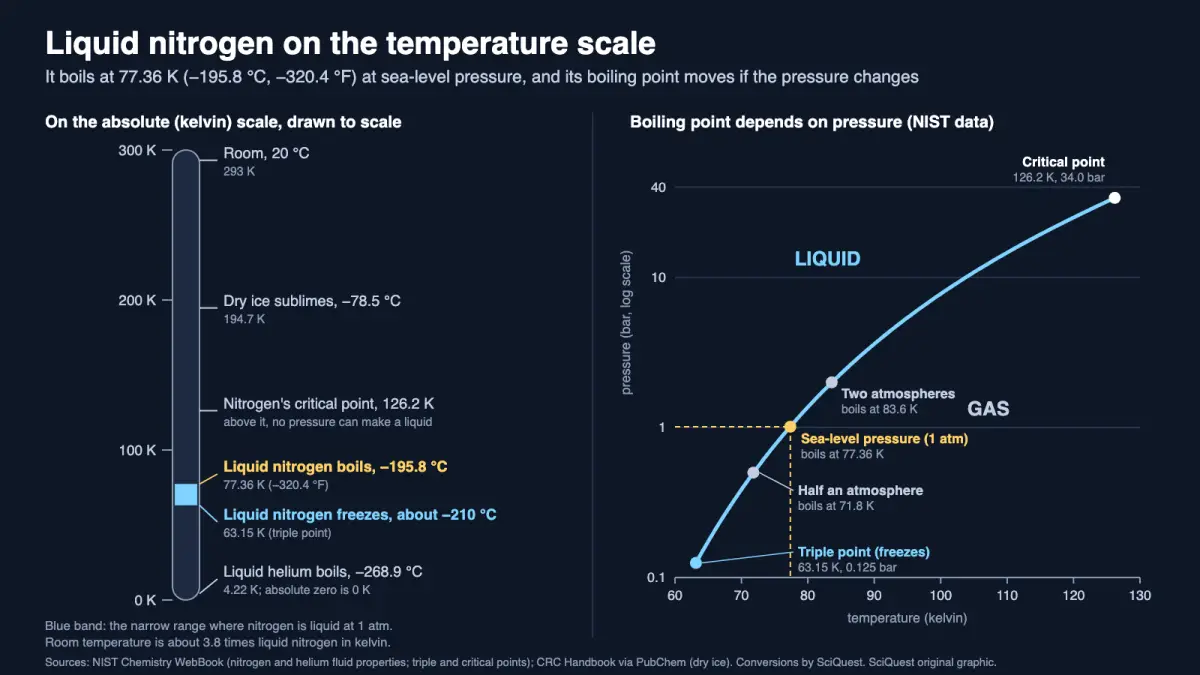
The chart below places liquid nitrogen on a kelvin scale and plots NIST’s boiling curve from the triple point up to the critical point.
How long does liquid nitrogen last?
That depends on how fast heat leaks into the container, which is why storage flasks, called dewars, are built like vacuum flasks. The arithmetic is simple, and it shows how small the heat leak has to be.
Worked calculation:
- Heat to boil 1 kg: 77.16 kJ/kg (vapour) − (−122.02 kJ/kg) (liquid) = 199.2 kJ/kg, from NIST’s saturation table at 1 atm.
- Heat to boil 1 litre: 199.2 kJ/kg × 0.806 kg/L = 160.6 kJ.
- A heat leak of 1 watt delivers 1 joule per second, or 86.4 kJ per day.
- So each watt boils off 86.4 ÷ 160.6 = 0.54 litres a day, and 1 litre lasts about 1.9 days per watt of heat leak.
A flask that leaks 2 W would lose about a litre a day. One that leaks a quarter of a watt would lose about 0.13 litres a day. Manufacturers publish this as a “standard” or “normal” evaporation rate. University of Cambridge safety guidance notes that old dewars often lose nitrogen faster than new ones and suggests assuming double the new-flask rate. The calculation ignores the extra cooling the cold gas provides as it warms on the way out, which stretches real holding times a little.
How much gas does a litre of liquid nitrogen make?
Using NIST densities, 1 litre of liquid nitrogen (806 g) becomes 692 litres of nitrogen gas at 20 °C and 1 atm. At 15 °C the figure is 680 litres, and at 25 °C it is 704 litres.
That explains the spread of quoted figures: the University of Cambridge says “~680 litres of gas at room temperature”, the University of Edinburgh 683 litres, and several popular pages 694. They simply assume slightly different room temperatures.
What changes the answer
Pressure. Lower the pressure and liquid nitrogen boils colder: about 71.8 K (−201.3 °C) at half an atmosphere. Raise it and the liquid gets warmer before it boils: about 83.6 K (−189.5 °C) at two atmospheres, which matters inside pressurised storage tanks. The coldest it can get as a liquid is 63.15 K at the triple point, where it freezes solid.
Rounding and conversion. The precise boiling point converts to −320.4 °F. Many pages give −321 °F because they convert the rounded −196 °C, which gives −320.8 °F. Neither is badly wrong, but −320 °F is the closer whole number.
“Times colder” claims. Ratios only make sense in kelvin, where zero is absolute. Saying liquid nitrogen is “twice as cold” as dry ice in Celsius is meaningless. In kelvin, dry ice is about 2.5 times warmer than liquid nitrogen.
Why liquid nitrogen skates across the floor
Pour a little liquid nitrogen on a floor and the drops glide around like beads instead of wetting the surface. To liquid nitrogen, a room-temperature floor is more than 200 °C hotter than its boiling point, so the bottom of each drop boils instantly and the drop rides on a thin cushion of its own vapour. This is the Leidenfrost effect, the same thing that makes water drops dance on a very hot pan. Physicist David Quéré’s 2013 review in the Annual Review of Fluid Mechanics describes how, with no contact between liquid and solid, these drops move with very little friction.
That vapour layer is brief and unreliable protection. The FDA’s food guidance states plainly that liquid nitrogen can cause rapid freezing on contact with living tissue.
What liquid nitrogen is used for
- Food: the US Food and Drug Administration says retailers use it for rapid freezing of foods such as ice cream, to process dry herbs and spices and to chill drinks quickly, as well as for a smoke effect.
- Cryopreservation: a 2024 review of biobanking in the International Journal of Molecular Sciences describes storage at −196 °C in liquid nitrogen as the most common method for cells and tissues, and says keeping samples below their glass transition temperature ensures long-term stability. The same review notes that even liquid nitrogen storage has limits.
- Freezing warts and verrucas: the UK’s NHS says a podiatrist can freeze a verruca with liquid nitrogen (cryotherapy) and a GP may be able to freeze a wart so it falls off a few weeks later, sometimes over several sessions. The NHS also notes that warts usually go away on their own, though it can take months or years. This is a description of the treatment, not advice; a clinician decides whether it suits a particular person.
- Testing materials in the cold: engineers test metals at 77 K because a liquid nitrogen bath holds a sample at that temperature. Our report on niobium–titanium alloys that stay tough at 20 K compares results at 298 K, 77 K and 20 K.
- Not cold enough for MRI magnets: superconducting MRI scanners depend on liquid helium, according to a 2026 analysis in NMR in Biomedicine. Helium boils at 4.22 K, about 73 degrees colder than liquid nitrogen.
Is liquid nitrogen dangerous?
Yes, in two main ways, and the second catches people out. The points below come from the US Chemical Safety and Hazard Investigation Board (CSB), the FDA and university safety offices. They are not a substitute for the supplier’s safety data sheet or local safety rules.
Cold burns. At −196 °C, liquid nitrogen freezes skin on contact. The FDA warns that both liquid nitrogen and dry ice can cause severe damage to skin and internal organs if mishandled or swallowed. In August 2018 it advised consumers and retailers about the risk of serious injury from foods and drinks prepared by adding liquid nitrogen just before serving, because the liquid may not fully evaporate before it reaches the customer.
Suffocation without warning. Air is about 78% nitrogen and 20.9% oxygen, and nitrogen itself is not poisonous. The danger is that boiling liquid nitrogen adds gas that pushes oxygen out, and people cannot smell the change. The CSB counted 85 workplace nitrogen asphyxiation incidents in the United States from 1992 to 2002, which killed 80 people and injured 50. Its bulletin says an atmosphere of only 4 to 6 percent oxygen causes a coma in less than 40 seconds.
A 2021 case shows the hazard directly. On 28 January 2021, a liquid nitrogen freezer at the Foundation Food Group poultry plant in Gainesville, Georgia, overflowed after a bent “bubbler tube” disabled its level control. The CSB found that the liquid vaporised into a four- to five-foot-high (about 1.2 to 1.5 m) cloud that killed six workers by asphyxiation and seriously injured three more employees and a firefighter. At least 14 employees entered the freezer room or the area around it to investigate or attempt rescues.
How little it takes is easy to estimate. The US workplace safety agency OSHA requires oxygen to be kept between 19.5 and 23.5 percent, according to the CSB. Our illustration: if 1 litre of liquid nitrogen boiled off into a sealed 10 cubic metre store room (2 m × 2 m × 2.5 m) and its 692 litres of gas pushed out the same volume of air, oxygen would fall to about 19.5%. Five litres would take it to roughly 14 to 15.5%, depending on whether the gas displaces air or simply mixes in, a range where the CSB’s table lists poor judgment and faulty coordination. The University of Cambridge uses the same worst-case method for risk assessments; it ignores ventilation and uneven mixing, so treat it as a sketch, not a safety threshold. Cambridge also notes that freshly boiled-off nitrogen is cold and denser than air, so it can pool near the floor.
Why it matters to you
You are most likely to meet liquid nitrogen as a smoking dessert, in a clinic’s freezing spray or in a school lab. The temperature explains why a drop on skin injures fast; the expansion explains why it needs somewhere for the gas to go, and why the FDA wants it fully evaporated before food or drink is served.
“But wait…” if liquid nitrogen is boiling, shouldn’t it be hot?
Boiling only means the liquid’s vapour pressure has reached the pressure around it. Water reaches that point at 100 °C at sea level; nitrogen reaches it at −195.8 °C, at sea-level pressure. So the bubbles you see in an open flask of liquid nitrogen are real boiling, at a temperature cold enough to freeze skin on contact.
Related questions
How cold is liquid nitrogen in Fahrenheit? −320.4 °F at sea-level pressure. You will also see −320 °F, and −321 °F, which comes from converting the rounded Celsius value.
How cold is liquid nitrogen in kelvin? 77.36 K at 1 atm, usually written as 77 K.
How cold is liquid nitrogen in Celsius? −195.8 °C at sea level, which nearly every lab manual and safety sheet rounds to −196 °C.
Is liquid nitrogen colder than dry ice? Yes, by about 117 °C. Dry ice is −78.5 °C; see our dry ice temperature explainer for why it behaves so differently.
Is liquid nitrogen the coldest liquid? No. Liquid helium boils at 4.22 K (−268.9 °C), and for the hot end of the scale see our guide to flame temperatures by colour.
In one sentence
Liquid nitrogen is −195.8 °C (−320.4 °F, 77.36 K) at sea level because that is where it boils, and the same boiling that holds it at that temperature turns each litre into about 690 litres of gas, which is why it needs gloves, ventilation and an unsealed container.
Quick check: did it click?
- What is the temperature of liquid nitrogen at sea level in all three units? −195.8 °C, −320.4 °F and 77.36 K, usually rounded to −196 °C, −320 °F and 77 K.
- Why does liquid nitrogen stay at the same temperature while it boils away? Heat from the room goes into turning the liquid into gas, so the temperature stays at the boiling point until the liquid is gone.
- Why is a liquid nitrogen spill dangerous in a small closed room? Each litre becomes about 690 litres of gas that pushes out oxygen, and nobody can smell the change.
Read next
- How cold is dry ice? −78.5 °C, why it skips liquid, and safe handling
- What is the coldest place on Earth? The record depends on how you measure it
- Niobium–titanium alloys stay tough at 20 K (−253 °C) in lab tests
Disclosure: This article was drafted with AI assistance and checked against the sources below. The unit conversions, the heat-per-litre and holding-time calculation, the gas-volume figures and the closed-room illustration are SciQuest calculations from NIST data, and the temperature scale and boiling curve are an original SciQuest graphic. Safety and medical points are limited to what the cited agencies, the NHS and university safety offices state, and await review by a qualified editor. Spotted an error? See our corrections policy.
Sources
- NIST Chemistry WebBook, Nitrogen: phase change data (freezing point 63.3 K, Streng 1971; boiling point 77.34 K, Jacobsen, Stewart and Jahangiri 1986; triple point 63.14 K and 0.1252 bar (63.151 K in the 2000 equation of state); critical point 126.19 K and 33.978 bar; enthalpy of vaporisation 5.6 kJ/mol at 77 K, Giauque and Clayton 1933)
- NIST Chemistry WebBook, Thermophysical properties of fluid systems: nitrogen (saturation temperature, liquid density, enthalpies and gas density at 1.01325 bar; based on R. Span, E. W. Lemmon, R. T. Jacobsen, W. Wagner and A. Yokozeki (2000), A reference equation of state for the thermodynamic properties of nitrogen, Journal of Physical and Chemical Reference Data 29, 1361 to 1433) and helium (boiling temperature 4.22 K at 1 atm)
- PubChem, Carbon dioxide (CID 280) (sublimation point −78.464 °C, citing the CRC Handbook of Chemistry and Physics, 95th edition)
- US Food and Drug Administration (2018), Liquid nitrogen and dry ice in food, Food Code Reference System (density 0.807 g/mL at its boiling point; food uses; rapid freezing of living tissue; 30 August 2018 advisory)
- US Chemical Safety and Hazard Investigation Board (2003), Hazards of Nitrogen Asphyxiation, Safety Bulletin 2003-10-B (85 incidents, 80 deaths and 50 injuries, 1992 to 2002; 78 percent nitrogen in air; OSHA 19.5 to 23.5 percent oxygen; coma in under 40 seconds at 4 to 6 percent oxygen; effects table from the Compressed Gas Association)
- US Chemical Safety and Hazard Investigation Board (2023), CSB releases final report into 2021 fatal liquid nitrogen release at Foundation Food Group facility in Georgia (28 January 2021; bent bubbler tube; four- to five-foot cloud; six deaths; four seriously injured; at least 14 employees entered)
- University of Cambridge Occupational Health and Safety Service (2020), Reduced Oxygen Atmospheres: Resulting from the Use of Cryogens or Compressed Gases in the Workplace, HSD053C rev4 (air composition; about 680 litres of gas per litre; worst-case calculation method; evaporation rates of old dewars; cold nitrogen denser than air)
- University of Edinburgh, College of Medicine and Veterinary Medicine (2013), Liquid Nitrogen: local rules and guidance (683 litres of gas per litre)
- D. Quéré (2013), Leidenfrost Dynamics, Annual Review of Fluid Mechanics 45, 197 to 215 (drops levitating on their own vapour with little friction)
- Khaydukova and colleagues (2024), Current State and Challenges of Tissue and Organ Cryopreservation in Biobanking, International Journal of Molecular Sciences 25, 11124 (storage at −196 °C in liquid nitrogen; glass transition; limits of storage)
- NHS, Warts and verrucas (freezing by a GP; liquid nitrogen cryotherapy by a podiatrist; warts usually clear on their own)
- Ayyildiz and Erturk (2026), Helium Supply-Chain Vulnerability of MRI Services: A Global Ecological Analysis of Imaging Capacity and Health-System Resilience, NMR in Biomedicine 39, e70370 (superconducting MRI depends on liquid helium)
- World Meteorological Organization (2020), WMO verifies −69.6 °C Greenland temperature as Northern Hemisphere record (world record −89.2 °C, Vostok, 21 July 1983)
- Jagiellonian University Museum Collegium Maius, Karol Olszewski Room (Olszewski and Wróblewski, first successful liquefaction of air components, 1883)
Discover more from SciQuest
Subscribe to get the latest posts sent to your email.
Leave a comment