

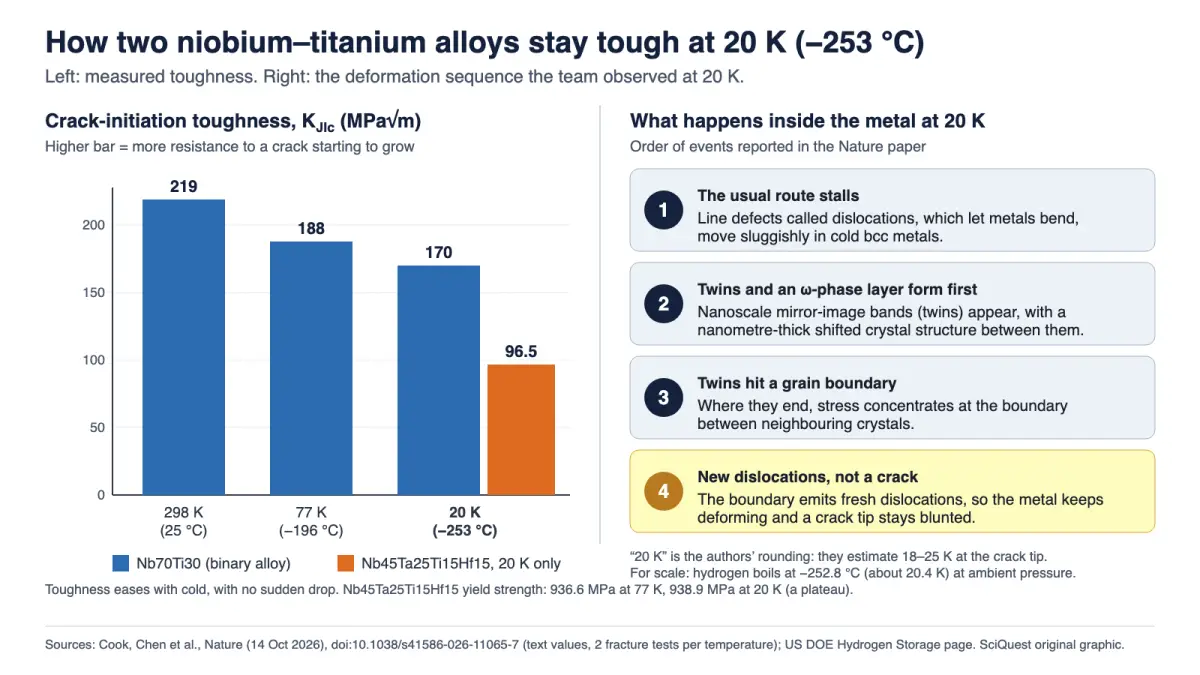
At an estimated 18 to 25 K, the simpler of the two alloys kept a crack-initiation toughness of 170 MPa√m, only about 22% below its room-temperature value, and neither alloy showed a sudden switch to brittle failure in a small set of lab tests.
Peer reviewed · Laboratory materials study · Two alloys, small number of test samples
Two experimental niobium–titanium alloys kept bending instead of shattering at 20 kelvin (−253 °C), a temperature that normally makes metals of their crystal type brittle. The result, from a team at UC Berkeley, Lawrence Berkeley National Laboratory and the University of Oxford, was published in Nature on 14 October 2026. Under a microscope, the researchers saw the metal build fresh defects of its own at the boundaries between crystals, which let it keep deforming. The tests used a few small samples of two alloys, and nobody has yet made or tested a real cryogenic part from them.
What you need to know
- Finding: Nb70Ti30 and Nb45Ta25Ti15Hf15 showed no measurable ductile-to-brittle transition down to about 20 K. Yield strength levelled off below 77 K instead of climbing steeply.
- Method: Pull tests and fracture-toughness tests on helium-cooled samples at the ISIS Neutron and Muon Source in Oxfordshire, followed by electron microscopy, atom-probe mapping and stress modelling.
- Source: Cook, Chen and colleagues, Nature, published 14 October 2026 (open access).
- Why it matters: Metals with this crystal structure, the family that includes iron, tungsten and chromium, usually turn brittle in the cold. The paper points to a different design rule: help the metal create new defects rather than only move existing ones.
- Limitation: Three pull tests and two fracture tests per temperature, on lab-made material; near a crack, fracture was already partly brittle along grain boundaries.
Evidence at a glance
| Item | Assessment |
|---|---|
| Evidence status | Peer reviewed; laboratory mechanical tests plus microscopy; mechanism is the authors’ interpretation of what they observed |
| Primary source | “Competing mechanisms toughen bcc binary and medium-entropy alloys at 20 K”, Nature, received 17 June 2025, accepted 20 August 2026, published 14 October 2026, DOI 10.1038/s41586-026-11065-7. SciQuest read the full open-access text. |
| Evidence strength | Moderate for the measured properties, because they come from standard test methods with error bars and peer review; limited for the general design rule, because only two closely related alloys were tested with few samples |
| Principal limitation | Small sample counts on lab-made alloys, at a test temperature estimated rather than measured on the samples (18 to 25 K); no tests on real components, in hydrogen, or under repeated loading |
| Coverage at a glance | 1 distinct credible publisher with its own reporting found as of 15 October 2026, 04:46 UTC (Interesting Engineering). Counted: outlets with an original article on this paper that SciQuest opened. Excluded: the University of Oxford release and its reposts (EurekAlert!, Tech Xplore), a syndicated copy on Yahoo News, and an automated rewrite site. |
Sources: Nature article page and Methods; University of Oxford release via EurekAlert!, 14 October 2026.
Is this a big deal?
It is a solid step for materials science, and an early one for engineering. A cold-induced brittle transition limits this whole metal family, from steels that turn brittle at or slightly below room temperature to refractory alloys that do so at up to 1,200 °C, according to the paper. Finding two alloys that sidestep it at 20 K, and showing the steps that let them do so, gives alloy designers something to test. It does not give anyone a new tank, pipe or rocket part yet.
What scientists found
Metals come in a few common crystal patterns. In a body-centred cubic (bcc) metal, each atom sits at the centre of a cube of eight neighbours. Iron, tungsten, chromium and niobium all have this arrangement. Many of them share a weakness: below a certain temperature, called the ductile-to-brittle transition temperature, they stop stretching and start to crack.
The new paper reports no such transition down to about 20 K in two niobium–titanium-based alloys. One is a simple binary mix, Nb70Ti30 (70% niobium and 30% titanium by atoms). The other is a four-metal “medium-entropy” alloy, Nb45Ta25Ti15Hf15, which adds tantalum and hafnium.
For a sense of scale, a room at 20 °C sits at about 293 K, so 20 K is roughly one-fifteenth of that on the absolute temperature scale. Hydrogen turns liquid at −252.8 °C at ambient pressure, according to the US Department of Energy, which is about 20.4 K.
The paper’s numbers show a gentle slope, not a cliff:
- Strength levelled off. The four-metal alloy began to deform permanently at 938.9 ± 22.6 MPa at 20 K and 936.6 ± 22.4 MPa at 77 K (−196 °C). In a typical bcc metal, that strength shoots up as temperature falls.
- Toughness stayed high. The binary alloy’s crack-initiation toughness was 170 MPa√m at 20 K, compared with 188 at 77 K and 219 at room temperature (298 K). The four-metal alloy measured about 96.5 MPa√m at 20 K, rising to about 118 as the crack grew.
- Stretch fell but did not vanish. The four-metal alloy stretched about 50% less before breaking at 20 K than at 77 K. Across both alloys, the paper reports fracture strains of roughly 14% at 20 K.
Fracture toughness, measured in MPa√m, describes how hard you have to load a cracked part before the crack starts to run. In the authors’ words, the alloys still show “significant plasticity ahead of the crack tip” at 20 K, which is why they conclude there is no brittle transition.
How they found it
The joint first authors, David H. Cook and Xiaoyu Chen of UC Berkeley and Berkeley Lab, ran the tests on the ENGIN-X beamline at the ISIS Neutron and Muon Source in Oxfordshire. A load frame pulled samples inside a vacuum chamber, with cryocoolers chilling the grips and helium gas cooling the samples.
The samples were too small to carry a thermometer without disturbing the crack. So the team clamped a larger steel dummy sample in the grips with a sensor on its back. The grips reached 8 to 15 K and the sample edge 28 to 35 K. The researchers estimate the crack tip at 18 to 25 K and call it 20 K for simplicity.
They ran two kinds of test. Plain pull tests on small dog-bone-shaped bars measured strength and stretch. Fracture tests used blocks with a sharpened fatigue crack, loaded until the crack grew, with crack lengths worked out using the ASTM E1820 standard method.
The team then cut thin slices from the broken samples, including one from a grain boundary about 30 micrometres ahead of a crack, and examined them with transmission electron microscopes at Berkeley Lab’s National Center for Electron Microscopy. Atom-probe tomography at Pacific Northwest National Laboratory mapped individual atoms near the grain boundaries.
Why the alloys didn’t snap
Metals bend because of dislocations, line-shaped flaws in the crystal that slide through it under stress. In bcc metals, a common type called screw dislocations moves only with help from heat. Cool the metal and they slow down, so strength climbs steeply, the zone that can deform around a crack tip shrinks, and eventually the metal fails in a brittle way.
In these alloys, a different process starts first. Small regions of the crystal flip into mirror-image orientation, forming nanoscale bands called twins. Between the twins, the team found a nanometre-thin layer of a different atomic arrangement, the omega (ω) phase. Twinning barely depends on temperature, so it does not lock up in the cold.
The twins then run into grain boundaries, where neighbouring crystals meet. That collision concentrates stress. In most bcc metals, a twin hitting a boundary like this starts a crack. Here, the boundary released new dislocations instead. Those spread the strain and blunted the crack tip.
The University of Oxford compares this to a road network opening new routes when the usual roads freeze. That fits the main point: the metal makes fresh paths for deformation. Where it breaks down is risk. Roads don’t weaken the city, but the ω phase along these new routes is itself predicted to be brittle.
“Traditionally, the focus was on how readily existing dislocations can move through a metal but now it appears that the ability to create new dislocations at interfaces may also be critical,” Cook, now at the University of Cambridge, said in the Oxford release.
Chemistry at the boundaries seems to matter. Atom-probe maps showed titanium and hafnium piling up in a band about 3 nm wide at grain boundaries in the four-metal alloy, raising those elements to 42 atomic percent there. The authors argue this local mix eases dislocation formation but also favours the brittle ω phase. They call titanium and hafnium a “double-edged sword”.
Why it matters to you
This won’t change anything you use this year. Equipment that holds very cold fluids, or swings between extreme heat and cold, needs metals that won’t crack unexpectedly, and this is a possible new route to them. The Oxford release names possible uses in the energy, transport and aerospace sectors. Oxford’s Dong Liu, a corresponding author, said this class of materials “will be extremely useful for components experiencing extreme hot and cold temperatures in one application”. Those are the researchers’ expectations, and the paper itself does not test any device or application.
Liquid hydrogen fits the temperature, but neither the paper nor the release claims the alloys suit hydrogen tanks, and the helium-cooled samples never met hydrogen.
What the evidence does not show
- No real parts. These were small, carefully processed lab samples, with three pull tests and two fracture tests per temperature.
- Some brittleness near cracks. In fracture tests, the broken surfaces were partly intergranular, meaning cracks ran along grain boundaries, with signs of brittle features. Toughness still fell from room temperature to 20 K in the binary alloy.
- Sensitive to impurities. Both alloys had low oxygen. The authors postulate that adding oxygen above about 1 atomic percent would probably push the brittle transition above 20 K.
- Not tested: repeated loading (fatigue), long service times, welds, large sections, hydrogen exposure, or a temperature read directly at the crack.
How this fits what we already knew
The same research network has worked on cold-tough alloys for years. In 2022, a Science paper led by Dong Liu reported exceptional fracture toughness in CrCoNi-based alloys at 20 K. Those alloys have a face-centred cubic structure, where twinning and phase changes already help at cryogenic temperatures. The new paper notes that these tricks work far less well in bcc alloys, so the new result tackles a harder family.
In 2024, Cook and colleagues reported in Science that the four-metal Nb45Ta25Ti15Hf15 alloy combines high strength and toughness across a wide temperature range, including 77 K, helped by kink bands. The new work extends the tests down to 20 K. It also adds the simpler Nb70Ti30, chosen to have the same average number of outer electrons per atom. Neither alloy showed a brittle transition, which led the authors to argue that electronic structure, not chemical complexity, controls the effect.
Twinning itself is old news in cold bcc metals. Earlier studies on chromium and silicon iron linked it to brittle failure. What’s new is a case where twins hitting boundaries produce dislocations instead of cracks.
Independent perspective
SciQuest has not yet obtained independent comment on this paper. Nature lists Alexander Kauffmann, Tomohito Tsuru and an anonymous reviewer as its peer reviewers and has made their reports available. The authors declare no competing interests. The research was principally funded by the US Department of Energy, and Liu’s support includes the EU Clean Hydrogen Partnership’s HyCavern project.
“For decades, the ductile-to-brittle transition has been viewed as a fundamental limitation of body-centred cubic metals,” Liu said in the Oxford release.
How other headlines framed it
- University of Oxford (also reposted by Tech Xplore): framed the work as metal defying the deep freeze and introduced it as “a class of metal”, although the study tested two alloys.
- Interesting Engineering: led with a new class of tough metals and a clean-energy angle, listing liquid-hydrogen and deep-space uses that the study did not test.
What happens next
The authors list open questions they have not yet answered: how oxygen shifts the balance between twinning and the ω phase, and how grain size changes the twinning stresses. Any practical use would first need fatigue data and tests on larger, welded parts. SciQuest will update this story if follow-up results appear. For other extremes of temperature in nature, see our guide to the coldest place on Earth and the opposite end, the hottest thing in the universe.
In one sentence
Two niobium–titanium alloys stayed tough at about 20 K because twins and a thin ω-phase layer made grain boundaries release new dislocations instead of cracks, a promising design rule that has so far been tested only on small lab samples.
Quick check: did it click?
- Why do bcc metals usually turn brittle in the cold? Their screw dislocations need heat to move, so in the cold they stall and the metal can’t deform around a crack.
- What did the alloys do differently at 20 K? Nanoscale twins with an ω-phase layer formed first, and where they hit grain boundaries, the boundaries released new dislocations.
- Were the alloys tested in liquid hydrogen? No. Samples were cooled with helium gas, and hydrogen exposure was not part of the study.
Read next
- Scientists made titanium float, even after the material cracked, another lab study about how metal structures cope with damage
- What is the coldest place on Earth?, for the natural cold that metal equipment actually meets
- What is the hottest thing in the universe?, the other end of the temperature scale
Sources and disclosure
- Cook DH, Chen X, O’Leary M, et al. “Competing mechanisms toughen bcc binary and medium-entropy alloys at 20 K.” Nature, published 14 October 2026. nature.com/articles/s41586-026-11065-7 (DOI 10.1038/s41586-026-11065-7). Open access, CC BY 4.0; full text, Methods and Table 1 read.
- University of Oxford. “Metal defies the deep freeze, staying tough at -253°C”, EurekAlert!, 14 October 2026 (source of all quotes).
- Cook DH, et al. “Kink bands promote exceptional fracture resistance in a NbTaTiHf refractory medium-entropy alloy.” Science 384, 178–184 (2024). doi:10.1126/science.adn2428
- Liu D, et al. “Exceptional fracture toughness of CrCoNi-based medium- and high-entropy alloys at 20 kelvin.” Science 378, 978–983 (2022). doi:10.1126/science.abp8070
- US Department of Energy, Hydrogen and Fuel Cell Technologies Office. Hydrogen Storage (hydrogen boiling point, −252.8 °C).
Disclosure: This article was drafted with AI assistance and checked against the sources above. Kelvin conversions, the 22% toughness drop and the one-fifteenth temperature comparison are SciQuest calculations; the graphic is a SciQuest original built from values in the paper’s text. Quotes come from the University of Oxford release, not SciQuest interviews. SciQuest has no conflicts of interest. Spotted an error? See our corrections policy.
Discover more from SciQuest
Subscribe to get the latest posts sent to your email.
Leave a comment