

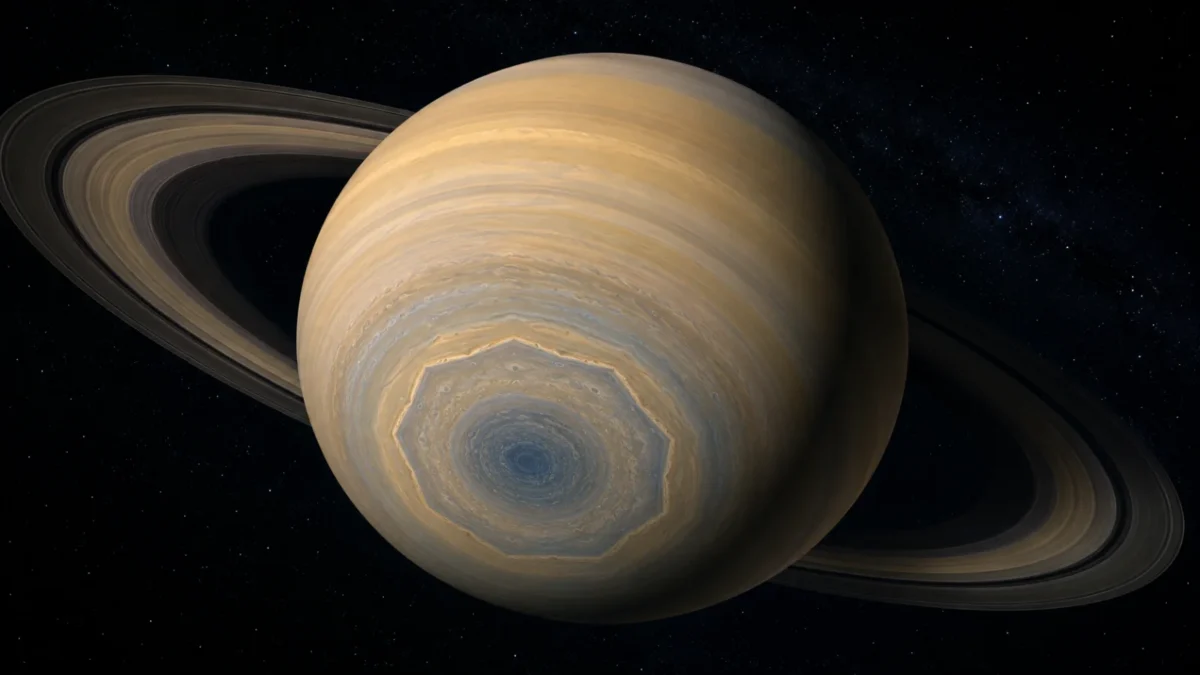
Hubble observations reveal a moving 10-sided atmospheric wave around Saturn’s south pole, giving the planet a second giant polygonal jet pattern alongside its long-lived northern hexagon.
Published: September 3, 2026, 9:27 p.m. PKT · Reporting cutoff: September 3, 2026, 9:15 p.m. PKT
What you need to know
- Hubble images from 2023–2025 show a vast decagon-shaped wave encircling Saturn’s south pole.
- The pattern sits in a fast atmospheric jet and moves eastward at roughly 10 kilometers per hour.
- Some sides exceed about 16,700 kilometers, making the feature wider than Earth.
- The southern decagon appears less stable than Saturn’s northern hexagon, which has persisted for more than four decades.
- Researchers do not yet know exactly when the decagon formed, how long it will last or why Saturn produces polygonal weather.
Saturn’s north pole has worn a hexagon for decades. Its south pole has now answered with a decagon: a gigantic, ten-sided wave rippling through the cloud tops around a polar cyclone.
The geometry is not a solid object or a rigid wall of clouds. It is a meandering atmospheric wave embedded in a jet stream, and it appears to be changing. That makes the discovery valuable not just because it looks strange, but because it offers a natural experiment in how rotating planetary atmospheres organize themselves.
What Hubble saw at Saturn’s south pole
As Saturn’s southern hemisphere tilted back into view, Hubble observations in 2023 revealed angular structure around the pole. Follow-up images in 2024 and 2025, supported by large ground-based telescopes and skilled amateur observations, confirmed a ten-sided pattern extending through several cloud layers.
The decagon drifts eastward at about 10 kilometers per hour (6 miles per hour). Its corners are not equally sharp, and portions change contrast, signs that the wave may still be evolving. Researchers estimate that it formed sometime after the region was last clearly observable and before its 2023 appearance.
How can weather form a polygon?
Fast jets can become unstable and develop waves. On a rotating planet, those waves may become trapped around a latitude circle, producing repeating bends that look like straight sides and corners when viewed from above.
Laboratory and computer studies have reproduced polygon-like flow under some conditions, but Saturn is the only known planet with enormous regular atmospheric polygons at both poles. Comparing the moving southern decagon with the more stationary northern hexagon can test which combinations of wind speed, vertical structure and seasonal change sustain each shape.
For more Saturn context, read how Saturn’s gravity compares with Earth’s and why the planet’s rings sometimes seem to vanish.
What the evidence does not show
The images do not establish that the decagon will endure. Saturn’s northern hexagon has survived for at least one Saturnian year—about 30 Earth years—whereas the south-polar pattern has only a few years of direct observations.
Researchers also have not identified a single definitive mechanism. The feature’s motion and changing contrast distinguish it from its northern counterpart and leave room for several atmospheric explanations.
How other headlines framed it
- NASA emphasized Hubble’s tracking of a newly recognized south-polar decagon.
- The Associated Press highlighted the scale and instability of the 10-sided cloud pattern.
- Scientific American framed it as a mysterious atmospheric wave and contrasted it with the northern hexagon.
What happens next
Saturn’s southern hemisphere will become increasingly favorable for observation over the next several years. Repeated imaging can show whether the sides sharpen, fade, change number or settle into a longer-lived structure, while spectroscopy and wind measurements probe different altitudes.
Bottom line: Saturn’s south-polar decagon is a real, immense atmospheric wave. Its geometry is now well observed; the physics that created and sustains it remains the mystery.
Sources
- Science Advances, primary research article on Saturn’s south-polar decagon, September 2, 2026.
- NASA Hubble mission release, September 2, 2026.
- ESA/Hubble release, September 2, 2026.
Editorial disclosure: The lead image is an original concept illustration, not a Hubble observation or study figure. SciQuest received no payment for this coverage. To report a possible error, contact SciQuest.
Discover more from SciQuest
Subscribe to get the latest posts sent to your email.
Leave a comment