

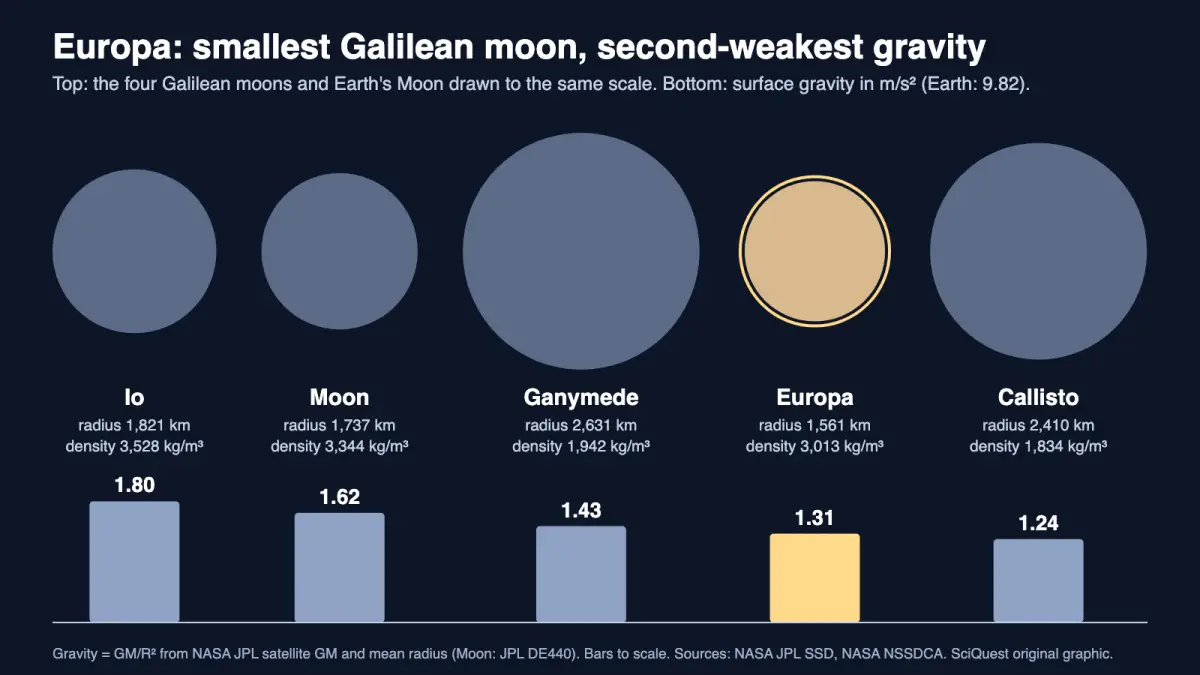
Europa probably hides a salty ocean under its ice, but at 1,561 km in radius and only 0.8% of Earth’s mass it pulls so gently that a dropped hammer takes almost three times as long to fall 2 m as it would at home.
Gravity on Europa is about 1.31 m/s², or 13.4% of Earth’s mean surface gravity of 9.82 m/s². That figure comes from dividing Europa’s gravitational parameter, measured by NASA spacecraft tracking, by the square of its 1,560.8 km mean radius. It is a little less than one-seventh of Earth’s pull and about 81% of the gravity on our own Moon.
In practical terms, a person whose bathroom scale reads 70 kg on Earth would see about 9.4 kg on Europa. Their mass would be unchanged; only the force pressing them into the ice would shrink.
Explain it like I’m busy:
- Europa’s surface gravity is 1.315 m/s² by SciQuest’s calculation from NASA JPL data, rounded to 1.31 m/s² in NASA’s fact table: 0.134 of Earth’s and 0.81 of the Moon’s.
- Scientists know it because Europa’s mass bends the paths of passing spacecraft, which shows up as a tiny Doppler shift in their radio signals.
- Low gravity shapes the hunt for life there: plume material, the weight of the ice shell and the design of any future lander all depend on it.
Key facts about Europa’s gravity
- Surface gravity: 1.315 m/s² (calculated from NASA JPL’s GM and mean radius); NASA’s Galilean satellite fact table lists 1.31 m/s².
- Compared with Earth: 0.134 of Earth’s mean 9.82 m/s². Your weight would fall to about 13% of its Earth value.
- Mass and size: 4.80 × 10²² kg and a mean radius of 1,560.8 ± 0.3 km, making Europa the smallest of Jupiter’s four large moons and slightly smaller than Earth’s Moon.
- Escape velocity: about 2.03 km/s, 18% of Earth’s 11.19 km/s.
- Among its neighbours: Europa has the second-weakest gravity of the Galilean moons. Only Callisto (1.24 m/s²) is lower, even though Callisto is far bigger.
What 1.31 m/s² would feel like
Drop a hammer on Europa and it gains 1.31 m/s of downward speed every second, against 9.82 m/s on Earth. From shoulder height, about 2 m, it would take 1.74 s to reach the ice instead of 0.64 s. You would have time to watch it fall.
Jumping changes even more. Push off with the same leg power that lifts you 0.5 m on Earth and, ignoring the bulk of a spacesuit, you would rise about 3.7 m on Europa and stay in the air for roughly 4.8 s rather than 0.64 s. The analogy that fits best is a trampoline, because the slow rise and long hang time feel similar. It breaks down quickly, though: a trampoline gives you extra speed, while Europa gives you none. You leave the ground at your normal speed and gravity simply takes much longer to take it away.
| Quantity | Earth | Moon | Europa |
|---|---|---|---|
| Surface gravity (m/s²) | 9.82 | 1.62 | 1.31 |
| Weight of a 70 kg person (N) | 687 | 114 | 92 |
| Earth-calibrated scale reading (kg) | 70.0 | 11.6 | 9.4 |
| Time to fall 2 m (s) | 0.64 | 1.57 | 1.74 |
| Height of a jump that reaches 0.5 m on Earth (m) | 0.5 | 3.0 | 3.7 |
Source: Earth’s mean gravity from the NASA NSSDCA Earth fact sheet; Moon and Europa gravity calculated by SciQuest from NASA JPL GM and mean-radius values (1.624 and 1.315 m/s²). Weight = 70 kg × g; scale reading = 70 kg × g ÷ 9.82; fall time = √(2h ÷ g); jump height = 0.5 m × 9.82 ÷ g. No air resistance or spacesuit is included.
How to calculate gravity on Europa
Surface gravity follows from Newton’s law of gravitation, g = GM/R². G is the gravitational constant, M the moon’s mass and R the distance from its centre to the surface. Planetary scientists rarely use G and M separately, because spacecraft tracking measures their product, GM, far more precisely than either one alone.
NASA JPL’s table of satellite physical parameters gives Europa’s GM as 3,202.71210 km³/s² and its mean radius as 1,560.80 km. Converting to metres:
g = 3.2027121 × 10¹² m³/s² ÷ (1.5608 × 10⁶ m)² = 3.2027121 × 10¹² ÷ 2.43610 × 10¹² = 1.315 m/s²
Divide that by Earth’s mean 9.82 m/s² and you get 0.134. Divide GM by G (6.674 × 10⁻¹¹ m³ kg⁻¹ s⁻²) and you recover Europa’s mass: about 4.799 × 10²² kg, matching the 4.800 × 10²² kg on NASA’s Jovian satellite fact sheet.
The same numbers give the escape velocity, the launch speed needed to leave Europa for good without further thrust: v = √(2GM/R) = √(2 × 3.2027 × 10¹² ÷ 1.5608 × 10⁶) ≈ 2,026 m/s, or about 2.0 km/s, as NASA’s fact table lists.
Why a moon almost the Moon’s size pulls less
For a sphere, surface gravity is proportional to average density times radius. Europa’s mean density is 3,013 kg/m³ and its radius 1,560.8 km; the Moon’s are 3,344 kg/m³ and 1,737.4 km (NASA JPL). Multiply the two ratios, 0.901 × 0.898, and you get 0.81, the same ratio as their gravities. Europa is slightly smaller, and it is slightly less dense because its rocky interior is wrapped in a thick layer of water and ice.
How scientists know Europa’s mass and radius
Nobody has dropped anything on Europa. Its gravity is known from the way it tugs on spacecraft that fly past.
Galileo: listening to a radio signal stretch
NASA’s Galileo orbited Jupiter from 1995 and made 12 close flybys of Europa, according to NASA’s Europa overview. As the spacecraft fell toward the moon and swung away, Europa’s gravity changed its speed by tiny amounts. Those speed changes shifted the frequency of Galileo’s radio signal as received on Earth, the Doppler effect.
In 1998, J. D. Anderson of JPL and colleagues at JPL and the University of California, Los Angeles, used radio Doppler data from four of those encounters to model Europa’s interior in Science. They concluded that Europa is most likely differentiated, with a metallic core, a rock mantle and an outer shell of water ice and liquid about 80 to 170 km thick. Their data could not completely rule out a mixed rock-and-metal interior, and the core’s size was uncertain. A team led by Luis Gomez Casajus reanalysed the Galileo tracking data and published an updated gravity field in Icarus in 2021.
Juno and today’s best values
NASA’s Juno spacecraft, which orbits Jupiter, passed about 360 km from Europa’s surface on 29 September 2022, using its microwave radiometer to probe the ice shell (more on that below). The GM value JPL lists today comes from its JUP365 ephemeris of Jupiter’s regular moons, credited to R. A. Jacobson (2021), and is given as 3,202.71210 ± 0.00181 km³/s². The mean radius, 1,560.80 ± 0.30 km, comes from the International Astronomical Union’s 2015 report on cartographic coordinates and rotational elements.
Those uncertainties are tiny. The GM error is 0.00006%, and the radius error shifts g by about 0.04%, so Europa’s gravity is 1.3147 ± 0.0005 m/s² by SciQuest’s error propagation. Any disagreement you see between sources comes from rounding, not from doubt about the value.
Europa Clipper: mapping how the moon flexes
NASA’s Europa Clipper launched on 14 October 2024 and is due to reach Jupiter in April 2030, then make 49 close flybys of Europa. Its gravity experiment uses the spacecraft’s own telecommunications system. Dustin Buccino, a JPL scientist and engineer on the gravity investigation, describes the method this way: “It’s like when a firetruck goes by and the pitch of the siren changes.”
Clipper’s goal goes beyond the average pull. NASA says the team will measure how Europa’s gravity field changes shape as the moon moves closer to and farther from Jupiter on its slightly elliptical orbit. How much it flexes, captured in a quantity called the tidal Love number, depends on how much water lies beneath the ice and how close to the surface it sits.
What changes the answer: 1.31, 1.314, 1.315 or 1.32?
Search results quote several values, and they agree more than they appear to:
- 1.315 m/s² is GM/R² from JPL’s current data to three decimal places. The Planetary Society’s Europa page uses this figure.
- 1.314 m/s² appears in Wikipedia’s infobox and differs only in the last digit.
- 1.31 m/s² is NASA NSSDCA’s rounded value in its Galilean satellite fact table.
- 1.32 m/s² turns up in some tables, but 1.3147 rounds to 1.31 at two decimal places, so it is a rounding slip, not a different measurement.
The Earth comparison also depends on which “Earth gravity” you use. Against Earth’s mean 9.82 m/s², Europa’s ratio is 0.1339; against standard gravity, 9.80665 m/s², it is 0.1341. Both round to 13.4%, or about one-seventh.
Three physical effects are too small to matter for everyday purposes. Europa spins once per orbit, every 3.55 days, so the outward push from rotation at the equator is only about 0.0007 m/s², or 0.05% of g. Jupiter’s tidal stretch across Europa amounts to roughly 0.0013 m/s², about 0.1% of g (SciQuest calculation, 2GMJupiterR ÷ a³). Height matters more: 160 km above the surface, gravity has already fallen to 1.08 m/s².
How Europa compares with the Moon and the other Galilean moons
| Moon | GM (km³/s²) | Mean radius (km) | Mean density (kg/m³) | Gravity, GM/R² (m/s²) | Fraction of Earth’s 9.82 | Escape velocity (km/s) |
|---|---|---|---|---|---|---|
| Io | 5,959.92 | 1,821.49 | 3,528 | 1.80 | 0.183 | 2.56 |
| Moon (Earth) | 4,902.80 | 1,737.4 | 3,344 | 1.62 | 0.165 | 2.38 |
| Ganymede | 9,887.83 | 2,631.20 | 1,942 | 1.43 | 0.145 | 2.74 |
| Europa | 3,202.71 | 1,560.80 | 3,013 | 1.31 | 0.134 | 2.03 |
| Callisto | 7,179.28 | 2,410.30 | 1,834 | 1.24 | 0.126 | 2.44 |
Source: NASA JPL Solar System Dynamics, Planetary Satellite Physical Parameters (GM, mean radius and density; Moon GM from DE440). Gravity, Earth fraction and escape velocity are SciQuest calculations; NASA NSSDCA’s Galilean fact table lists 1.80, 1.6, 1.43, 1.31 and 1.24 m/s² and escape velocities of 2.6, 2.4, 2.7, 2.0 and 2.4 km/s, in agreement after rounding.
Two comparisons stand out. Europa has only 65% of the Moon’s mass but a 10% smaller radius, so its pull is 81% of the Moon’s rather than 65%. Ganymede has more than three times Europa’s mass, yet its gravity is only 9% stronger, because its icy bulk spreads that mass through a much wider ball.
Density follows distance from Jupiter. NASA notes that the Galilean moons become less dense the farther they orbit from the planet, and Io, Europa, Ganymede and Callisto do fall in that order. For Jupiter itself, whose mean gravity at the 1-bar cloud level is 25.92 m/s² (NASA NSSDCA), nearly 20 times Europa’s, see our explainer on how strong gravity is on Jupiter, and for every planet and major moon side by side, our guide to gravity on other planets.
Why Europa’s low gravity matters
Plumes
NASA says observations from the Hubble Space Telescope and a reanalysis of Galileo data suggest it is possible that thin plumes of water rise about 160 km above Europa’s surface. They have not been confirmed. If they exist, low gravity is what lets them climb so high.
By SciQuest’s calculation, material would need to leave the surface at about 620 m/s to coast up to 160 km, allowing for gravity weakening with height. The same speed on Earth, with no air in the way, would reach only about 19 km. Because 620 m/s is well under Europa’s 2.03 km/s escape velocity, plume material would mostly fall back, and a spacecraft passing through it could, in NASA’s words, be “analyzing the moon’s ocean.”
The ice shell
Gravity also sets how hard the ice presses down on the ocean beneath it: on Europa, a slab of ice weighs about 13% of what the same slab would weigh on Earth. Gravity measurements have limits here, too. Galileo’s tracking data constrained the combined layer of ice and liquid water to about 80 to 170 km, but did not separate the ice from any liquid beneath it.
Estimates differ by method. NASA’s Europa overview gives an ice shell probably 15 to 25 km thick over an ocean 60 to 150 km deep. In December 2025, a Juno study in Nature Astronomy, summarised by NASA, put the cold, rigid outer layer at about 29 km thick in the region Juno observed, and possibly thicker overall. Clipper’s flexing measurements are designed to narrow that range.
Future landers
No spacecraft has ever landed on Europa, but low gravity would make the descent itself easier than on the Moon. The speed of a low circular orbit, √(GM/R), is about 1.43 km/s at Europa against 1.68 km/s at the Moon, so a lander would have less speed to cancel. Gravity is not the main obstacle: NASA notes that Europa’s surface is blasted by radiation from Jupiter.
Why it matters to you
Europa’s gravity will not change anything in your daily life. What it offers is a clean lesson in a rule that applies across the Solar System: surface gravity depends on mass and size together, so a big icy moon such as Ganymede can pull more weakly than a smaller rocky one such as Io. The same rule explains why gravity on the Moon is about one-sixth of Earth’s.
It also matters to the question many readers care about most, whether Europa’s ocean could hold life. Every measurement that bears on that, from plume samples to ice thickness, passes through the physics of a world with 13% of Earth’s gravity. Our explainer Is Europa habitable? covers the biology side.
“But wait… Jupiter is enormous. Wouldn’t it pull you off Europa?”
No. Jupiter’s pull at Europa’s distance is real, but Europa and everything on it fall around Jupiter together, the same way astronauts on the International Space Station float even though Earth’s gravity still acts on them. What you would notice is only the difference between Jupiter’s pull on the near and far sides of the moon. By SciQuest’s calculation that tidal difference is about 0.0013 m/s², roughly 0.1% of Europa’s own gravity.
Small for a person, but not for a moon. Because Europa’s orbit is slightly elliptical, that stretch strengthens and weakens each 3.55-day orbit, flexing the whole moon. NASA says this flexing likely creates the fractures across Europa’s surface, and that if the ocean exists, tidal heating could drive volcanic or hydrothermal activity on its floor.
Related questions
How much would I weigh on Europa? About 13.4% of your Earth weight. A person who weighs 150 lb on Earth would weigh about 20 lb on Europa, and a 70 kg person’s scale would read about 9.4 kg.
Is gravity on Europa stronger than on the Moon? No. Europa’s 1.31 m/s² is about 81% of the Moon’s 1.62 m/s², because Europa is slightly smaller and less dense. Our comparison of the Moon with other moons shows how their sizes line up.
Which of Jupiter’s moons has the weakest gravity? Of the four large Galilean moons, Callisto, at 1.24 m/s². Europa is second-weakest at 1.31 m/s², and Io is strongest at 1.80 m/s².
Which missions will measure Europa’s gravity next? NASA’s Europa Clipper arrives in 2030, and ESA’s Juice is due the following year, according to NASA. Our guide to the Juice mission covers its plans for Jupiter’s icy moons.
In one sentence
Europa pulls at 1.31 m/s², about one-seventh of Earth’s gravity and four-fifths of the Moon’s, a value scientists know precisely from how the moon bends the paths of spacecraft, and one that shapes how its possible plumes, its ice shell and any future lander behave.
Quick check: did it click?
- What is the surface gravity on Europa? About 1.31 m/s², 13.4% of Earth’s 9.82 m/s².
- Why is Europa’s gravity weaker than the Moon’s when the two are almost the same size? Europa is slightly smaller and less dense: 0.90 × 0.90 ≈ 0.81 of the Moon’s gravity.
- How do scientists measure Europa’s mass? From the Doppler shift in radio signals from spacecraft such as Galileo, whose speed changes as Europa’s gravity tugs on them.
Read next
- Gravity on other planets: surface gravity of planets and major moons
- Is Europa habitable? Is there life on Europa?
- How strong is gravity on the Moon? Value, formula and Earth comparison
Disclosure: This article was drafted with AI assistance and checked against the sources below. The gravity, mass, escape-velocity, uncertainty, fall-time, jump, plume-speed, orbital-speed, rotation and tidal calculations are SciQuest calculations from NASA data, and the chart is an original SciQuest graphic. Spotted an error? See our corrections policy.
Sources
- NASA JPL Solar System Dynamics, Planetary Satellite Physical Parameters (GM, mean radius, density and uncertainties for Io, Europa, Ganymede, Callisto and the Moon; JUP365 and DE440 ephemerides; Jupiter GM; IAU 2015 radius reference)
- NASA NSSDCA, Galilean satellite fact table (tabulated gravity and escape velocity) and Jovian Satellite Fact Sheet (mass 480.0 × 10²⁰ kg, radius 1,560.8 km, orbit 671,100 km, period 3.551181 days)
- NASA NSSDCA, Earth Fact Sheet (mean surface gravity 9.820 m/s²; escape velocity 11.186 km/s; mass), Jupiter Fact Sheet (mean 1-bar gravity 25.92 m/s²) and Moon Fact Sheet
- NASA Science, Europa: Facts (Galileo’s 12 flybys, ice shell and ocean estimates, possible plumes, tidal flexing, radiation, density trend of the Galilean moons)
- J. D. Anderson, G. Schubert, R. A. Jacobson et al. (1998), Europa’s Differentiated Internal Structure: Inferences from Four Galileo Encounters, Science 281, 2019–2022
- L. Gomez Casajus, M. Zannoni, D. Modenini et al. (2021), Updated Europa gravity field and interior structure from a reanalysis of Galileo tracking data, Icarus 358, 114187
- NASA JPL, NASA’s Juno Measures Thickness of Europa’s Ice Shell (27 January 2026; 29 September 2022 flyby at about 360 km; 29 km shell estimate; Clipper arrival 2030, Juice the year after)
- NASA Science, Europa Clipper (launch 14 October 2024; arrival April 2030; 49 close flybys; gravity experiment) and Gravity/Radio Science (tidal flexing, Love number, Dustin Buccino quote)
Discover more from SciQuest
Subscribe to get the latest posts sent to your email.
Leave a comment