

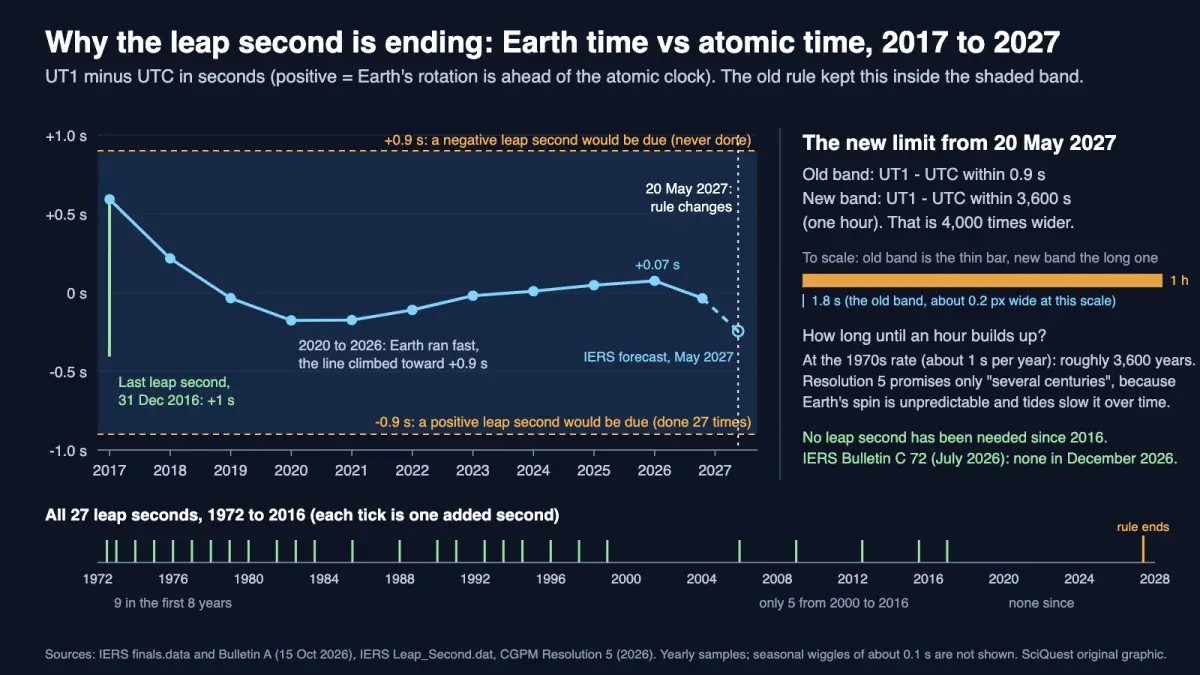
Resolution 5 (2026), adopted at the 28th CGPM in Versailles, lets Earth-rotation time and atomic time drift apart by up to 3,600 seconds instead of 0.9 s, a change pulled forward from 2035 after a workshop put the chance of a never-tried negative leap second at 30 percent.
Official announcement · A decision by metrology delegates, not a scientific discovery · No vote tally published
The leap second is finished. On 15 October 2026 the General Conference on Weights and Measures (CGPM), meeting in Versailles, adopted Resolution 5, which makes Coordinated Universal Time (UTC) continuous from 20 May 2027. Instead of adding a second whenever Earth’s rotation drifts 0.9 s from atomic time, timekeepers will let the gap grow to a full hour, a limit the resolution says will hold for several centuries. The change was brought forward from 2035 because Earth has been spinning slightly fast, and a negative leap second, never tried, had an estimated 30 percent chance of being needed by 2035. Scientific American reported that the resolution passed by majority vote. No tally has been published.
What you need to know
- Finding: From 20 May 2027 (World Metrology Day) UTC runs without leap seconds, and the allowed difference between UT1 (Earth-rotation time) and UTC rises from 0.9 s to 3,600 s, which is one hour.
- Method: A resolution of the CGPM, the treaty body of the Metre Convention, drafted by the Consultative Committee for Time and Frequency (CCTF) after a March 2025 workshop with the International Earth Rotation and Reference Systems Service (IERS) on Earth-rotation forecasts.
- Source: CGPM Resolution 5 (2026), “On the technical actions needed to ensure the continuity of UTC”, BIPM, DOI 10.59161/CGPM2026RES5E.
- Why it matters: Leap seconds have crashed software at Reddit and Cloudflare, and a negative one had never been tested. Removing them trades a one-second nuisance for a one-hour drift that the resolution expects to take at least several centuries to build.
- Limitation: The “several centuries” of continuity is an estimate that depends on Earth’s unpredictable spin, and the resolution does not say what happens when the hour is reached. Radio time signals may keep the old format until 2035, or 2040 at the latest.
Evidence at a glance
| Item | Assessment |
|---|---|
| Evidence status | Official announcement: a resolution adopted by the 28th CGPM on 15 October 2026. The French text is the official version. The underlying risk estimate (30 percent by 2035) comes from a CCTF and IERS expert workshop, not a peer-reviewed paper. |
| Primary source | Resolution 5 (2026), BIPM, with the statement by CCTF President Noël Dimarcq (15 October 2026) and Resolution 4 (2022), which set the earlier 2035 deadline. |
| Evidence strength | Strong for the decision itself, which is published in full by the BIPM. Moderate for the forecasts around it: the 30 percent risk and the “several centuries” of continuity are expert estimates of an unpredictable quantity, Earth’s rotation rate. |
| Principal limitation | The timing of any future one-hour correction is a projection. The resolution says “several centuries”; the CCTF president’s statement says “several millennia”. Both depend on how fast the Moon’s tides and Earth’s core change the length of the day. |
| Coverage at a glance | 4 distinct credible publishers with their own post-vote reports read by SciQuest (Scientific American, The Conversation, timeanddate.com, Keystone-SDA via bluewin.ch) as of 16 October 2026, 06:20 UTC, plus 3 pre-vote previews (ABC Science, Science Media Centre Spain, CNN; the CNN page could not be opened from our location). Excluded: an unbylined Geo.tv rewrite and aggregator copies. The count says nothing about whether the decision is right. |
Sources: BIPM Resolution 5 (2026) and the CCTF president’s statement; IERS Bulletins A and C; a SciQuest search of coverage on 16 October 2026.
Is this a big deal?
For timekeeping, yes: it is the biggest change to civil time since leap seconds began in 1972, and it ends a debate the CCTF president dates back 30 years. For your daily life, no. Clocks, phones and calendars keep working exactly as before. The real beneficiaries are the engineers who run data centres, power grids and telecom networks, and who have dreaded a second that runs backwards. The cost is a slow, deliberate loosening of the tie between the clock and the Sun.
What was decided
UTC is built from atomic clocks. The BIPM combines data from about 450 clocks in roughly 85 laboratories into International Atomic Time (TAI), a scale that never pauses or jumps. UTC ticks at exactly the same rate as TAI but sits a whole number of seconds behind it, currently 37 s: the 10 s offset chosen in 1972 plus the 27 leap seconds inserted since, each added so that UTC stayed within 0.9 s of UT1, the time scale defined by the angle Earth has actually turned through.
Resolution 5 keeps the integer-second relationship to TAI but changes the tolerance. From 20 May 2027 the maximum value of |UT1−UTC| becomes 3,600 s. The resolution says this ensures “the long term continuity for UTC for several centuries”. Once the hour is used up, a future conference would have to decide what to do, which is why some coverage talks of a “leap hour”. The resolution itself never uses that phrase.
The text also asks the BIPM to keep monitoring UT1−UTC with the IERS and to report on it regularly. Radio time stations get a transition: ITU-R Resolution 655 allows the old UT1−UTC code to persist until 2035, and until 2040 where equipment cannot be replaced earlier.
How timekeepers got here
Picture a quartz kitchen clock and a sundial. The clock keeps a steady beat; the sundial follows the Sun, which drifts because the planet’s spin is uneven. For 54 years, the fix was to nudge the clock by a whole second whenever it strayed 0.9 s from the sundial. The resolution’s answer is to stop nudging and accept that the sundial will wander, by up to an hour. The analogy has limits: UTC’s beat is atomic, not quartz, and UT1 comes not from a sundial but from radio telescopes timing signals from distant quasars, a technique called VLBI that Harald Schuh and colleagues describe as “a unique capability to directly access the rotation phase of the Earth”.
The IERS record shows how the problem changed shape. Nine leap seconds were needed between July 1972 and January 1980, almost one a year. Only five were needed from 2000 to the end of 2016. Then Earth began to run fast. According to IERS Bulletin A data, UT1−UTC fell from +0.591 s just after the last leap second on 31 December 2016 to −0.177 s at the start of 2020, the normal direction of drift. It then climbed every year, reaching +0.074 s on 1 January 2026. Had that climb continued to +0.9 s, the rule would have demanded the first negative leap second: clocks jumping from 23:59:58 straight to 00:00:00.
In 2022 the 27th CGPM had already decided, in Resolution 4, that the tolerance would be widened “in, or before, 2035”. The March 2025 workshop changed the urgency. Its experts estimated that the chance of a negative leap second “will increase rapidly in the near future, reaching a 30 % probability by 2035”, according to the resolution’s preamble. Patrizia Tavella, director of the BIPM Time Department, told Scientific American in July that when users were asked whether that was acceptable the answer was “No, even 10 percent risk is too much.” The CCTF proposed moving the date forward, and the conference agreed.
Why Earth’s spin is unpredictable
A day is 86,400 SI seconds only on average. The actual rotation period wanders by milliseconds, for three sets of reasons on three timescales.
Over a year, the atmosphere dominates. Richard Gross, a geophysicist at NASA’s Jet Propulsion Laboratory, has explained that seasonal shifts in the winds, especially the jet stream, mean “the length of the day changes about a millisecond over the course of a year”. Over decades, the liquid outer core takes over: flows in the molten iron exchange angular momentum with the mantle above, a process also written into Earth’s changing magnetic field. (For more on the core, see what would happen if Earth’s core stopped spinning.) Over millennia, the Moon wins. Its tides raise bulges that Earth’s spin carries ahead of the Moon, and the Moon’s pull on those bulges slows the rotation while pushing the Moon outward by about 3.8 cm a year, a figure measured by bouncing lasers off Apollo retroreflectors.
The recent speed-up is mostly the core. In a 2024 paper in Nature, Duncan Agnew of the Scripps Institution of Oceanography found that, once the effect of melting polar ice is removed, the core has been slowing at a steady rate since 1972, which makes the rest of the planet turn faster. Melting ice in Greenland and Antarctica works the other way: water moving from the poles toward the equator slows the spin, like a skater extending her arms. Agnew calculated that without the recent acceleration in ice loss the negative leap second would have been due about three years sooner, and concluded that “UTC as now defined will require a negative discontinuity by 2029”.
There is a twist in the latest numbers. IERS Bulletin A for 15 October 2026 puts UT1−UTC at −0.037 s and forecasts about −0.245 s by mid-May 2027. Earth has eased off again this year. The negative leap second was never a certainty, which is exactly why the delegates were working from a probability rather than a date.
Why engineers feared a second that runs backwards
A positive leap second gives the clock a 61st second, written 23:59:60. Most software has no idea what to do with it. On 1 January 2017, Cloudflare’s DNS software measured a response time by subtracting one timestamp from another; the leap second made the result negative, a random-number function received the negative value and crashed, and about 0.2 percent of DNS queries failed at the peak until a fix reached every data centre at 06:45 UTC. Meta’s engineers have listed a 2012 Reddit outage of 30 to 40 minutes from the same cause.
Big platforms responded by “smearing”: Google stretches the extra second across 24 hours, Meta across 17. The resolution notes that these workarounds mean different systems disagree with each other and run at rates that “do not conform to the SI unit”. A negative leap second would be worse, because it has never happened. As Darryl Veitch of the University of Technology Sydney told ABC Science, “It’s never happened before, and therefore the software for that has never been tested.” The resolution compares the cost of preparing for it to the millennium bug, and warns that some organisations might abandon UTC for satellite-system time if the risk persisted.
Why it matters to you
Nothing on your phone changes on 20 May 2027. Time zones and daylight-saving shifts already move civil clocks an hour or more from local solar time, a point the resolution makes itself. The benefit is invisible: fewer midnight outages in the systems that move your money, route your calls and balance the grid. The cost is for astronomers and anyone pointing a telescope, who already apply the UT1−UTC correction and will simply apply a bigger one. The 23:59:60 display on a synced clock is now history.
What the decision does not settle
It does not fix a date for a leap hour, or even commit to one. Christian Bizouard of the IERS, who issues the leap-second bulletins, told timeanddate.com: “It postpones the decision,” adding, “A future generation will decide if they want to apply a leap hour, or maybe they won’t. We don’t know.”
The “several centuries” figure is a floor, not a forecast. At the 1970s rate of about a second a year, an hour would take roughly 3,600 years to accumulate. The drift will speed up as tidal braking lengthens the day, which is why the resolution is cautious, and why the CCTF president’s statement uses the looser “several millennia”. The vote count is also unpublished: Scientific American reported a majority, timeanddate.com says the BIPM has 69 member states, and the BIPM’s own pages give no breakdown.
How this fits what we already knew
Leap seconds were a compromise from the start: atomic clocks defined the second, but astronomers wanted civil time tied to the sky, and the 1972 system gave both sides something. The 2018 CGPM formally defined UTC as a scale with the same rate as TAI, offset by an integer, and the 2022 conference set the 2035 deadline. Resolution 5 completes that sequence, nine years early.
Independent perspective
Michelle Bastian, a senior lecturer at the University of Edinburgh who studies the culture of time, argued in The Conversation that the outcome favours big technology companies, placing computing needs above sectors such as astronomy and asking who should decide what a shared clock is for. Lucia McCallum, a geodesist at the University of Tasmania, told ABC Science that the measurement side cannot be allowed to lapse: “What we still have to maintain is measuring Earth’s rotation.” Nick Stamatakos, who heads the Earth Orientation Department at the US Naval Observatory, told Scientific American that avoiding negative leap seconds was “a very big driver to open the window” between UTC and UT1. SciQuest has not yet interviewed an independent expert.
How other headlines framed it
- Scientific American framed it as scientists redefining how the world keeps time, quoting CCTF president Noël Dimarcq: “After 30 years of debates, we are ready.”
- The Conversation led with the politics, arguing the outcome favours big tech.
- timeanddate.com stressed the long horizon, reporting that no adjustment should be needed for a few thousand years.
- Keystone-SDA, via bluewin.ch, gave the plain facts: 27 insertions since 1972, the last in 2016, and stability as the goal.
- Before the vote, ABC Science asked whether a negative leap second would really break anything, and Science Media Centre Spain quoted Spain’s delegation head, Dolores del Campo, calling the measure “necessary and timely”.
None of the four post-vote reports mentioned that the IERS forecast now has Earth drifting the ordinary way again through 2027.
What happens next
The IERS has committed to changing how it announces leap seconds, and Bulletin C 72 already confirms there will be none at the end of December 2026. The BIPM must report regularly on UT1−UTC, and the ITU is updating the code radio stations use to broadcast the growing difference. The same conference also asked for a roadmap to redefine the second itself using optical clocks, with a proposal expected at the 29th CGPM in 2030 (our report on the thorium nuclear clock explains why the race to better clocks matters). SciQuest will report the first IERS bulletin issued under the new rules.
In one sentence
Metrology delegates voted on 15 October 2026 to stop inserting leap seconds from 20 May 2027 and to let atomic time drift up to an hour from Earth’s rotation, a gap expected to take centuries or longer to open.
Why it matters to you: your clocks will not change, but the systems behind your payments, calls and electricity lose a rare, dangerous glitch.
Quick check: did it click?
- How far can UT1 and UTC drift apart from 20 May 2027? Up to 3,600 s, one hour, instead of 0.9 s.
- Why was the change pulled forward from 2035? Earth’s spin sped up, and a workshop put the chance of a never-tried negative leap second at 30 percent by 2035.
- How many leap seconds have there been, and when was the last? 27, the last at the end of 31 December 2016.
Read next
- How does an atomic clock work? The caesium beat behind TAI and UTC, and why GPS depends on it.
- What would happen if we didn’t have a Moon? On the tides.
- Thorium nuclear clock runs for a day, but still trails atomic clocks: the next generation of timekeepers, and how far it still has to go.
Sources and disclosure
- CGPM. “Resolution 5 of the 28th CGPM (2026): On the technical actions needed to ensure the continuity of UTC.” BIPM, 15 October 2026. doi:10.59161/CGPM2026RES5E
- Dimarcq N. “Statement by the CCTF President.” 28th CGPM, Versailles, 15 October 2026. BIPM (PDF)
- CGPM. “Resolution 4 of the 27th CGPM (2022): On the use and future development of UTC.” BIPM
- IERS. Leap second history (Leap_Second.dat), Observatoire de Paris; Bulletin C 72, 6 July 2026; Bulletin A, 15 October 2026, and the finals.data UT1−UTC series.
- BIPM. “Circular T updates”, 23 February 2024 (about 85 laboratories, about 450 clocks). BIPM
- Agnew DC. “A global timekeeping problem postponed by global warming.” Nature 628, 333–336 (2024). doi:10.1038/s41586-024-07170-0
- Schuh H, Boehm J, Englich S, Nothnagel A. “Determination of UT1 by VLBI.” Highlights of Astronomy 15 (2010). doi:10.1017/S1743921310008859
- NASA JPL. “All days are not created equal” (2002) and “The Apollo experiment that keeps on giving” (2019).
- Cloudflare. “How and why the leap second affected Cloudflare DNS”, 1 January 2017. Meta Engineering. “It’s time to leave the leap second in the past”, 25 July 2022. Google. “Leap smear”.
- Gometz E. “Scientists vote to end leap seconds”, Scientific American, 15 October 2026, and the 8 July 2026 preview; timeanddate.com, ABC Science, The Conversation and Science Media Centre Spain as linked above.
Disclosure: This article was drafted with AI assistance and checked against the sources above. The UT1−UTC values in the graphic are IERS Bulletin A final values read from the IERS finals.data file; the “4,000 times wider” and “roughly 3,600 years” figures are SciQuest calculations (3,600 ÷ 0.9; 3,600 s at about 1 s per year). Quotes are verbatim from the resolution, the CCTF statement, the Schuh paper, the Agnew abstract, and the named outlets. The graphic is a SciQuest original. SciQuest has no conflicts of interest. Spotted an error? See our corrections policy.
Discover more from SciQuest
Subscribe to get the latest posts sent to your email.
Leave a comment