

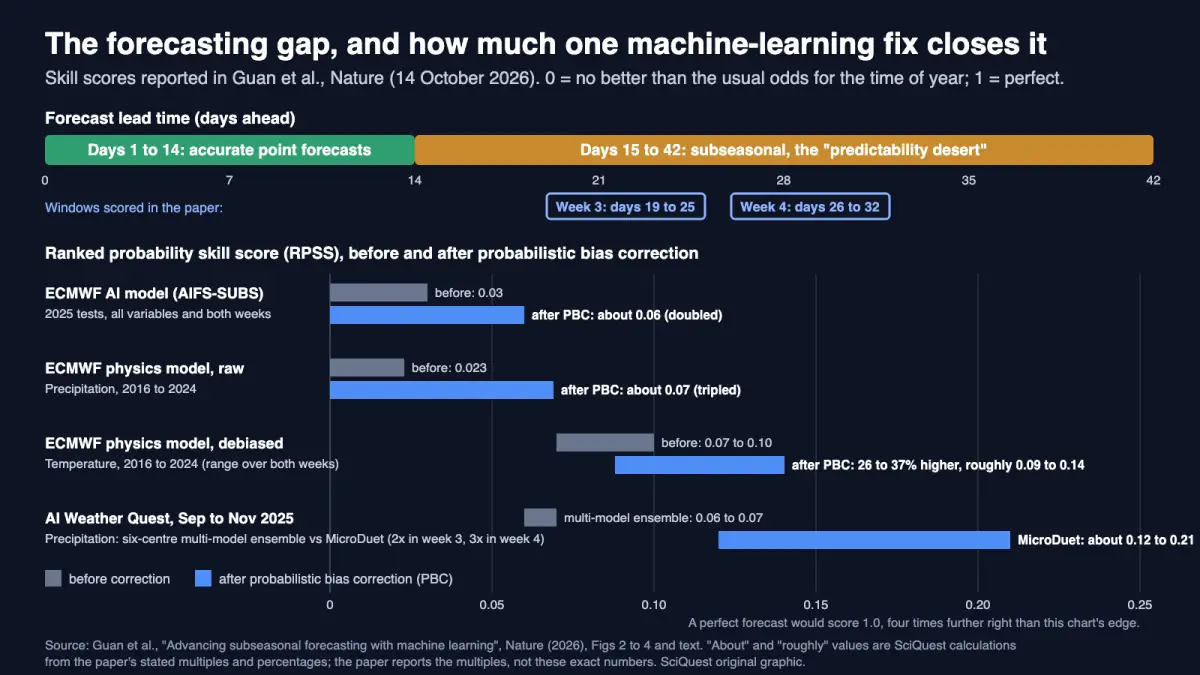
Applied to ECMWF’s AI subseasonal model, the method lifted its average ranked probability skill score from 0.03 to about 0.06 in 2025 tests, on a scale where 0 means no better than the usual odds for the time of year and 1 would be a perfect forecast.
Peer reviewed · Hindcast evaluation plus one real-time competition year · Microsoft-led team
A machine-learning add-on that learns a weather model’s habitual mistakes has doubled the skill of ECMWF’s AI model at forecasting three and four weeks ahead, and improved the centre’s operationally corrected physics model for 91% of pressure, 92% of temperature and 98% of precipitation targets. The method, probabilistic bias correction, comes from a team led by Microsoft Research with colleagues at MIT and ECMWF, in Nature on 14 October 2026. It also topped ECMWF’s 2025 real-time forecasting competition. The catch: the skill being doubled starts close to zero, and every number so far comes from the team’s own evaluation.
What you need to know
- Finding: Probabilistic bias correction (PBC) doubled the mean week 3 and week 4 skill of ECMWF’s AI model (from 0.03 RPSS) in 2025, tripled the raw ECMWF physics model’s precipitation skill (from 0.023) over 2016 to 2024, and beat ECMWF’s own operational correction on 89 to 98% of global grid cells.
- Method: Two lightweight machine-learning corrections learn a model’s systematic errors from its past probabilistic forecasts and from observed weather (the ERA5 reanalysis), then adjust the forecast probabilities for each location, date and quantile bin.
- Source: Guan, Mouatadid, Orenstein, Cohen and colleagues, “Advancing subseasonal forecasting with machine learning”, Nature, 14 October 2026 (open access).
- Why it matters: Weeks 3 to 6 are the gap where weather forecasts have faded but seasonal outlooks are too vague, and where farmers, utilities and emergency planners most want a usable signal. PBC is cheap to run and is released as open-source code.
- Limitation: A doubled skill of 0.06 is still small; the results depend on ECMWF hindcasts and one competition year, and 7 of the 13 authors own Microsoft stock, so independent replication has yet to happen.
Evidence at a glance
| Item | Assessment |
|---|---|
| Evidence status | Peer reviewed, Nature. Retrospective evaluation on 2016 to 2025 forecasts plus one year of real-time competition results. Preprint posted on arXiv on 17 April 2026. |
| Primary source | “Advancing subseasonal forecasting with machine learning”, Nature, published 14 October 2026, DOI 10.1038/s41586-026-11126-x. Open access (CC BY-NC-ND). Code at github.com/mouatadid/pbc. |
| Evidence strength | Moderate. The gains are consistent across variables, years, seasons and three different input models, and were tested in a real-time competition the authors did not control. They are relative gains on a very low baseline, and no group outside the author team has yet reproduced them. |
| Principal limitation | “Doubling” refers to a skill score going from about 0.03 to about 0.06, where 1 is perfect. Forecasts for weeks 3 and 4 remain only slightly better than the climatological odds, and the improvements rest on ECMWF’s hindcast archive and the evaluation periods chosen. |
| Coverage at a glance | 2 distinct credible publishers with their own reporting (Gizmodo, Meteored) plus two institutional releases (MIT News, Microsoft Research) as of 16 October 2026, 06:05 UTC. Excluded: Phys.org, which republished the MIT release; Unite.AI, whose piece is labelled AI-generated; and TokenPost, a summary of the preprint. MIT News also cites write-ups in The Verge and Popular Science that SciQuest could not open. |
Sources: the Nature paper (Results, Methods, Competing interests), the arXiv record, and a SciQuest search of news coverage.
Is this a big deal?
A solid step, not a leap. Nothing here lets a forecaster tell you whether it will rain on a given day a month out, and the authors say so: PBC “should be viewed as an effective post-processing tool rather than a replacement for input model improvement.” What is new is a cheap, general correction that reliably moves week 3 and week 4 forecasts from “no better than the usual odds” to “a little better”, across temperature, rain and pressure, and that held up in a public competition. In a field that calls this range the “predictability desert”, a little, done consistently, is worth having.
What scientists found
Subseasonal forecasts cover roughly 2 to 6 weeks ahead. Day-to-day forecasts are now accurate for about two weeks, after which tiny errors in the starting conditions grow until a single forecast is no better than a guess. Seasonal outlooks, months ahead, lean on slow drivers such as ocean temperatures. The weeks in between are the hard part, so the paper works in probabilities: for each place and week, the models give the odds that temperature, rainfall or sea-level pressure lands in each of five equal bins of the historical record.
Skill is measured with the ranked probability skill score (RPSS), defined in the paper against a climatological baseline that gives each bin a 20% chance. A score of 0 means the forecast’s probability errors are no smaller than that baseline’s; negative is worse; 1 would be perfect every time. The paper scores week 3 (days 19 to 25) and week 4 (days 26 to 32) on a global 1.5-degree grid, with temperature and rain counted over land only.
On that scale the gains are consistent but small. Over 2016 to 2024, ECMWF’s raw physics ensemble scored 0.023 on precipitation, and PBC tripled it; its raw temperature and pressure forecasts scored below zero, and PBC pushed them above. Against ECMWF’s own operational debiasing, PBC raised temperature skill by 26 to 37% from a baseline of 0.07 to 0.10, and pressure skill by 16 to 32% from 0.06 to 0.11. The 98%, 92% and 91% figures are the shares of grid cells where PBC beat the debiased model for rain, temperature and pressure. For ECMWF’s AI model, AIFS-SUBS, PBC doubled an average 2025 skill of 0.03.
How they found it
Lester Mackey of Microsoft Research New England and Judah Cohen, a research scientist at MIT, showed in 2023 that machine learning could correct the average error of a subseasonal model. The new work, led by Hannah Guan (then a Microsoft Research intern from Harvard) and Soukayna Mouatadid of the University of Toronto, corrects whole probability distributions instead of single numbers, so it can fix a model’s spread and shape as well as its centre.
Think of a friend who is always about ten minutes late. After a few months you stop trusting their stated arrival time and quietly add ten minutes. PBC does that for a weather model, but for probabilities, place by place and date by date. One component, Debias++, compares a model’s past forecast probabilities for a location and time of year with what actually happened and subtracts the average gap. The other, Persistence++, blends the forecast with the weather of the past few weeks and the 20-year climatology, since recent conditions carry some memory. The two outputs are nudged into valid probability curves and averaged. The analogy breaks where the lateness is random: PBC removes only the habitual part of a model’s error, and the paper is explicit that chaotic error remains.
The team tested the method the way a forecaster would have to use it. For every forecast date from 2016 onwards, PBC was retrained using only data available on that day, with ECMWF’s hindcast archive and the ERA5 reanalysis as the record of what really happened. The inputs were ECMWF’s physics ensemble, its AIFS-SUBS deep-learning model, and POET, an ECMWF hybrid that already post-processes the physics ensemble with neural networks. PBC improved all three. Cohen, in the MIT release: “We used it with the ECMWF’s dynamical model because that was considered the best, but it can be used with any model.”
The strongest test came from outside the lab. In 2025 ECMWF launched the AI Weather Quest, a weekly real-time competition for week 3 and week 4 forecasts scored with the same RPSS. The team’s entry, MicroDuet, combined PBC on ECMWF’s ensemble with PBC on POET. In the September to November 2025 season it scored highest for every variable and both lead times, ahead of the corrected models of six operational centres (ECMWF, NOAA, ECCC, HMCR, KMA and JMA), their combined ensemble, three versions of AIFS-SUBS and 34 other teams. For precipitation, all six operational models scored below zero; the combined ensemble reached 0.06 to 0.07, and MicroDuet about two to three times that.
Why it matters to you
If you are planning a holiday five weeks out, this will not tell you whether to pack an umbrella. A forecast with an RPSS of 0.06 offers odds that are about 6% less wrong, on average, than assuming the usual mix of weather for the time of year. That is a SciQuest reading of the score’s definition: the forecast’s probability error is 94% of the baseline’s instead of 97%. It helps a utility deciding how much gas to store, or a farmer weighing when to plant, where small shifts in odds across many decisions add up. For one weekend, the climatological odds remain the honest answer.
There is one place the gain could matter sooner. When PBC was trained to target the most extreme 5% of outcomes, the paper reports, its skill at predicting floods catalogued by the Global Disaster Alert and Coordination System rose 76 to 92% over the raw ECMWF forecast, while ECMWF’s standard correction drove that skill to near zero. The baseline was a Brier skill score of only 0.04 to 0.06, so the same caveat applies. Cohen, in the MIT release: “It’s really important to predict both, but extreme events might be the most impactful part of this for society.”
What the evidence does not show
It does not show that week 3 and week 4 forecasts are now reliable. Every corrected score in the paper sits below 0.25, and most below 0.10. The paper’s own phrase for what it doubled is “modest subseasonal skill”, and that word is doing honest work.
It does not show how the method behaves outside the periods tested: 2016 to 2024 for the physics model, 2024 for POET, 2025 alone for AIFS-SUBS, and one competition year. Whether the gains survive a strong El Niño or a model upgrade is untested, although the authors note that PBC can be retrained when input models change.
It is one group’s method, evaluated by that group, and the group has a commercial interest. The competing-interests statement says seven authors own Microsoft stock and five are Microsoft employees; two work at ECMWF, which runs the competition and built the input models. ECMWF scored the competition, which is a partial independent check, but no outside group has yet re-run PBC. The code is public, so that can happen.
One claim in the MIT release goes further than the paper. The release says the approach was the first to beat climatological averages at this range. The paper itself reports positive, if small, skill for ECMWF’s debiased temperature and pressure forecasts, and cites an earlier AI model, FuXi-S2S, that already beat ECMWF at subseasonal leads. The stronger claim fits precipitation, where all six operational centres’ corrected models scored below climatology in the competition.
How this fits what we already knew
Forecasting centres already correct subseasonal forecasts, usually by comparing each prediction with the model’s own hindcast climatology rather than with observations. The paper’s “debiased ECMWF” baseline is that operational protocol, so PBC’s gains are measured against current practice, not against an uncorrected model only.
Machine learning has been chipping at this gap for several years. FuXi-S2S, published in Nature Communications in 2024, outperformed ECMWF’s ensemble at subseasonal leads; the new paper reports that PBC applied to ECMWF beat FuXi-S2S on 96 to 100% of grid cells over 2017 to 2021. ECMWF’s own AIFS-SUBS, described in a 2026 preprint, is more skilful than the debiased physics model for rain. PBC does not compete with these models; it sits on top of them. For how far AI has and has not moved past human judgement elsewhere, see can AI outperform human intelligence?
Outside view
SciQuest found no published comment from a forecaster outside the author team or ECMWF by 06:05 UTC on 16 October 2026, and has not yet interviewed one. ECMWF’s science blog on the competition, written in March 2026 by staff including two of the paper’s co-authors, reported that MicroDuet consistently led the leaderboard across both scored periods, and concluded that fully data-driven systems still need development before they reliably beat physics models. In the Microsoft Research story, Lester Mackey described the tool plainly: “Our new pipeline (PBC) takes your favorite model as input and learns in what ways it tends to make errors.”
How other headlines framed it
- MIT News (republished by Phys.org) opened with the February 2021 Texas winter storms and at least 246 deaths, and framed the result as doubling predictive power two to six weeks out.
- Gizmodo led with extreme-weather warnings and the flood numbers, noting the method’s low cost for poorer forecasting services; its caveats were about the forecasting problem rather than the tool.
- Meteored asked whether forecasts could finally go beyond two weeks and reported new interview comments from Cohen, without discussing limitations.
- Microsoft Research, the lead institution, added two US winter storms that MicroDuet flagged 19 to 26 days ahead and a pilot with Kenya’s meteorological service.
None of the four gave the size of the skill scores being doubled.
What happens next
The AI Weather Quest continues through 2026, so MicroDuet’s record will keep being tested in public against new entrants. Microsoft Research says Genevieve Flaspohler of Rhiza Research, a co-author, is helping the Kenya Meteorological Service Authority pilot PBC during the current rainy season. The code is on GitHub and Zenodo, and the paper argues that meteorological services with small budgets could apply it to their existing products. The real test is whether an independent group reports the same gains on a model and period the authors did not choose.
In one sentence
A cheap machine-learning correction consistently makes week 3 and week 4 weather forecasts a little better than the climatological odds, roughly doubling a skill score that was close to zero, and that is both the achievement and the limit.
Why it matters to you: it will not change your holiday packing, but it may sharpen the odds that utilities, farmers and flood planners work with a month ahead, if other groups confirm the gains.
Quick check: did it click?
- What does an RPSS of 0 mean? The forecast’s probability errors are no smaller than you would get by assuming the usual 20% odds for each of five weather bins.
- What did PBC double? The average week 3 and 4 skill of ECMWF’s AI model, from about 0.03 to about 0.06, where 1 is perfect.
- Why can’t PBC fix all the error? It learns a model’s habitual mistakes; the chaotic, unpredictable part of the error remains.
Read next
- What are winter storms, and how do you prepare for one? The kind of event the Texas 2021 example in the MIT release describes.
- Scientists mutated nearly every DNA letter in a virus, and AI missed many effects: another case where machine learning helps but has clear limits.
- Can AI outperform human intelligence? For the wider question behind AI weather models.
Sources and disclosure
- Guan H, Mouatadid S, Orenstein P, Cohen J, Dong H, Ni Z, Berman J, Flaspohler G, Lu A, Schloer J, Talib J, Weyn JA, Mackey L. “Advancing subseasonal forecasting with machine learning.” Nature (2026), published 14 October 2026. doi:10.1038/s41586-026-11126-x. Full text and Methods read from the open-access HTML version.
- Same paper, preprint: arXiv:2604.16238, submitted 17 April 2026, version 3 posted 4 September 2026.
- Winn Z. “Researchers improve weather forecasts looking two to six weeks out.” MIT News, 14 October 2026 (source of the Cohen quotes).
- Microsoft Research. “New AI framework bridges a critical gap in mid-range weather forecasts.” Microsoft Research story, October 2026 (source of the Mackey quote and the Kenya pilot).
- Talib J, Loegel O, Vitart F, Hoffmann J, Schloer J. “The AI Weather Quest: spotlighting the best of machine learning sub-seasonal prediction.” ECMWF Science Blog, 13 March 2026.
- Mouatadid S et al. “Adaptive bias correction for improved subseasonal forecasting.” Nature Communications (2023). doi:10.1038/s41467-023-38874-y.
- Chen L et al. “A machine learning model that outperforms conventional global subseasonal forecast models.” Nature Communications 15, 6425 (2024). doi:10.1038/s41467-024-50714-1.
Disclosure: This article was drafted with AI assistance and checked against the sources above, including the full open-access paper, its Methods and its competing-interests statement. The “about 0.06”, “about 0.07”, “0.09 to 0.14” and “0.12 to 0.21” values in the graphic and text are SciQuest calculations from the multiples and percentages the paper states (0.03 × 2; 0.023 × 3; 0.07 × 1.26 to 0.10 × 1.37; 0.06 × 2 to 0.07 × 3), and the “6% less wrong” line follows from the paper’s RPSS definition. Quotes are verbatim from the MIT News release and the Microsoft Research story. SciQuest has no financial relationship with Microsoft, ECMWF or the authors. Spotted an error? See our corrections policy.
Discover more from SciQuest
Subscribe to get the latest posts sent to your email.
Leave a comment