

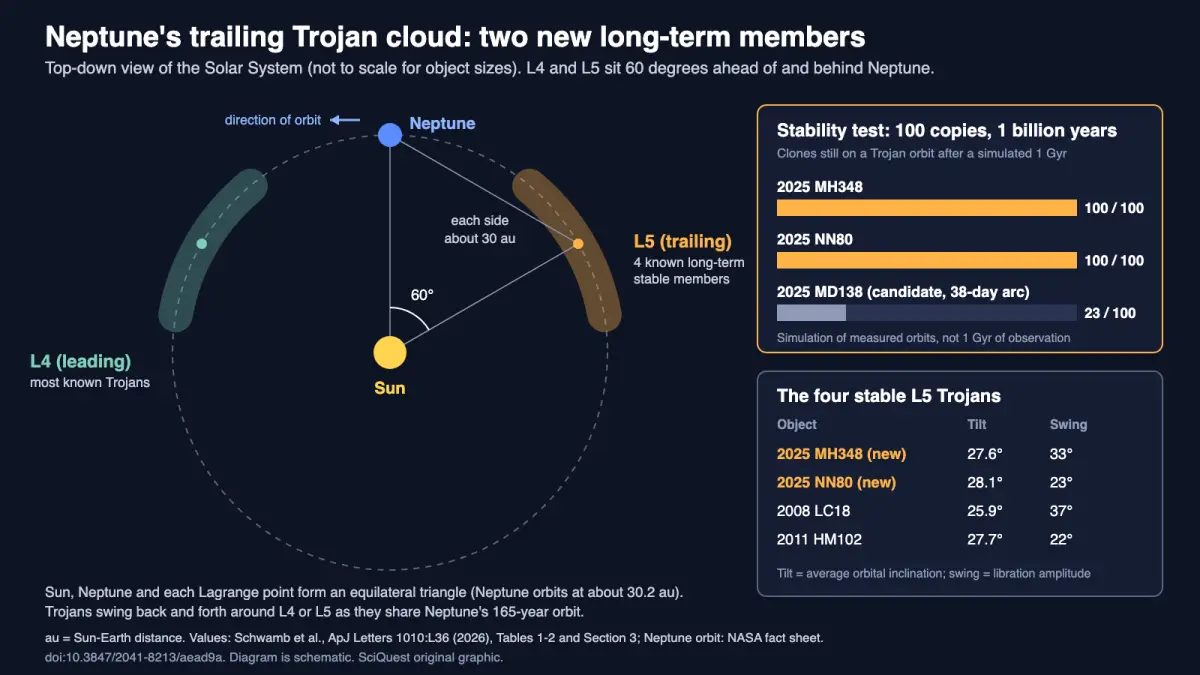
Simulations of 100 slightly varied copies of each orbit keep every copy of 2025 MH348 and 2025 NN80 locked in step with Neptune for 1 billion years, but the two objects are only the third and fourth such members ever confirmed in the trailing cloud.
Peer reviewed · New observations · Computer simulations of orbits
Two small icy bodies that trail Neptune by about 60 degrees have been confirmed as long-term members of its L5 Trojan cloud, doubling the known stable population there from two to four. A team led by Megan Schwamb of Queen’s University Belfast found 2025 MH348 and 2025 NN80 in the NSF-DOE Vera C. Rubin Observatory’s first weeks of test observations and reported them in The Astrophysical Journal Letters on 15 October 2026. The “stable for a billion years” verdict comes from computer simulations of their measured orbits, not from watching them that long.
What you need to know
- Finding: Rubin found two new Neptune Trojans in the trailing L5 cloud whose orbits stay stable for at least 1 billion years in simulations, plus a third, 2025 MD138, that remains only a candidate.
- Method: Rubin’s moving-object software linked detections from nightly 30-second exposures taken from 20 June 2025; older Pan-STARRS1 images extended the orbits, and the team ran 100 cloned orbits per object forward 1 billion years.
- Source: Schwamb, Bernardinelli, Volk and 12 co-authors, The Astrophysical Journal Letters 1010:L36 (open access, CC BY 4.0).
- Why it matters: For more than 15 years the L5 cloud sat in front of the crowded Milky Way, so almost everything known about Neptune’s Trojans came from the leading L4 cloud; this is the first real look at the other side.
- Limitation: Four objects is a tiny sample, and because Rubin’s detection efficiency has not yet been published, the team made no estimate of how many L5 Trojans exist.
Evidence at a glance
| Item | Assessment |
|---|---|
| Evidence status | Peer reviewed. New telescope observations (positions and brightness reported to the Minor Planet Center), plus computer simulations of the orbits. |
| Primary source | Schwamb et al., “NSF-DOE Vera C. Rubin Observatory’s First View of the Neptune Trojan L5 (Trailing) Cloud: Two New Long-term Stable Trojans”, The Astrophysical Journal Letters 1010:L36, published online 15 October 2026, doi:10.3847/2041-8213/aead9a. Analysis notebooks are on Zenodo. |
| Evidence strength | Strong that 2025 MH348 and 2025 NN80 are long-lived L5 Trojans: their orbits rest on observation arcs of 2,595 and 1,547 days, and all 100 clones of each stay in resonance for 1 billion years. Limited for their surfaces: each colour rests on 2 to 12 measurements per filter. |
| Principal limitation | “Long-term stable” is a simulation result built on today’s best orbit fits. The sample is four objects, and the candidate 2025 MD138 has only a 38-day arc, with 23 of its 100 clones surviving. |
| Coverage at a glance | 0 distinct credible publishers with their own write-up found as of 18 October 2026, 08:27 UTC. Counted: news outlets, observatory or university releases with original text. Searched: web search, Rubin Observatory news, NSF NOIRLab news, Queen’s University Belfast and University of Washington newsrooms. Not counted: the paper’s Zenodo code record and Wikipedia list entries. |
Sources: the paper (Sections 1 to 5, Tables 1 to 3), the Zenodo record, and a SciQuest search of news coverage.
Is this a big deal?
A solid, modest step. Two objects will not rewrite the history of the outer Solar System, but they double a population that had stood at two for more than a decade and give the first fair comparison between Neptune’s two Trojan clouds. The bigger news is what the paper tests: it is the first characterisation of objects found by Rubin’s own moving-object pipelines in a survey-like rhythm, which the authors call “a blueprint for LSST-era analyses.”
What scientists found
A Trojan is a small body that shares a planet’s orbit while staying near one of two balance points, called Lagrange points, that sit 60 degrees ahead of the planet (L4) and 60 degrees behind it (L5). The Sun, the planet and each point form an equilateral triangle, so the L5 cloud is about as far from Neptune, roughly 30 astronomical units (au, the Sun-Earth distance), as Neptune is from the Sun. Sunlight takes about 4 hours to cover that distance.
The two new objects fit the picture neatly. 2025 MH348 has an orbital eccentricity of 0.051 and a tilt (inclination) of 28.7 degrees; 2025 NN80 has 0.078 and 29.7 degrees. Their perihelia of 28.6 au and 27.8 au, combined with those eccentricities, put their average distances at about 30.2 au and 30.1 au (a SciQuest calculation from the paper’s Table 1), right on Neptune’s track. Over a simulated 10 million years they swing around L5 by about 33 degrees and 23 degrees.
All four stable L5 Trojans now known have tilts above 25 degrees. Earlier models found that Trojan orbits are most stable near 30 degrees and below 10 degrees, so the four may sit on one “island” of stability. The candidate 2025 MD138 is the interesting exception: its tilt is only 6 degrees.
How they found it
The L5 cloud spent more than 15 years projected against the centre of the Milky Way, where the sky is so thick with stars that a faint moving dot is easy to lose. By 2025 part of the cloud had drifted clear. Rubin, on Cerro Pachón in Chile, began its Science Validation survey on 20 June 2025, imaging a band of sky within about 10 degrees of the ecliptic every night with 30-second exposures that reach magnitude 24 in the red band. That survey was not built to hunt Trojans. It caught them anyway: 2025 MH348 and 2025 MD138 showed up on 21 June, one day into the survey, and 2025 NN80 on 7 July.
Software did the finding. Rubin’s Solar System Processing system compared sources night to night, dropped those that stayed put, and linked the movers with two codes, HelioLinC and pointdexter, a newer code tuned for distant objects. The detections reached the Minor Planet Center in February 2026, and older Pan-STARRS1 images later stretched the two confirmed orbits across several years.
To test stability, the team took each orbit fit from NASA JPL’s Small-Body Database, made 100 clones that span its uncertainties, and integrated them with the Sun and the four giant planets: first 10 million years at high resolution, then 1 billion years. Every clone of 2025 MH348 and 2025 NN80 stayed in Neptune’s 1:1 resonance. For 2025 MD138, only 23 clones were still Trojans at the end.
A useful way to picture this is a runner on a circular track who keeps pace with a leader while staying about a sixth of a lap behind, drifting a little closer and then falling a little back, but never catching up or dropping away. The analogy breaks down in one place: no runner is choosing the pace. The combined pull of the Sun and Neptune keeps the Trojan in its slot.
Why it matters to you
This changes nothing in daily life. Neptune’s Trojans are icy leftovers whose orbits, the paper notes, barely change on billion-year timescales, so they keep a record of how Neptune moved through the early Solar System and what material it swept up. Each new one is a sample from that time. If you have seen the Rubin Observatory’s first images in the news, this is the slower, careful science those images were built for.
What the evidence does not show
“Long-term stable” does not mean anyone has watched these objects for a billion years. It means that, given today’s orbit fits and the gravity of the Sun and four giant planets, simulated copies stay locked to Neptune. The authors follow earlier work in reading such stability as a sign that the objects are primordial, trapped early rather than captured recently. That is an interpretation, though a well-supported one.
The paper gives no sizes. It reports an absolute magnitude for 2025 NN80 of 7.71 in the red band (how bright it would look fully lit, 1 au from both the Sun and the observer), but the share of sunlight its surface reflects is unknown, and size depends on it.
Show the maths: a rough size range for 2025 NN80 (SciQuest estimate, not in the paper)
The standard relation is D = 1329 km ÷ √p × 10−H/5, where p is the albedo and H the absolute magnitude. With H = 7.71 and an assumed albedo of 0.10, D ≈ 121 km; with 0.05, D ≈ 171 km. The relation expects a visual-band H, and a visual value is likely a little fainter than the red one, which would shave roughly a tenth off. So “very roughly 110 to 170 km across” is a fair range, and it could be wrong if the albedo falls outside the assumed values.
The colours are suggestive, not conclusive. The three objects are a little bluer than the two earlier L5 Trojans as measured in a 2023 study, though close to an older measurement of one of them, and a statistical model reconstructs their spectra as most like the “water-type” group common among Neptune Trojans. The authors warn that this reconstruction from optical colours alone “should not be overinterpreted.”
How this fits what we already knew
Scott Sheppard and Chad Trujillo reported the first L5 Neptune Trojan, 2008 LC18, in Science in 2010, and 2011 HM102 followed. More than 30 Neptune Trojans are known in total, most of them at L4. That number is small next to Jupiter’s: the Minor Planet Center lists about 450 Jupiter Trojans for every Neptune one, yet surveys estimate that Neptune’s population is 4 to 10 times larger. Neptune’s are simply far fainter. For the scale of the trip out there, see how long it takes to get to each planet.
The new colours, combined with the two older L5 objects, match the L4 cloud, which the authors read as support for both clouds coming from one parent population. Whether a migrating Neptune captured them or they formed in place remains open.
One source of confusion is worth clearing up. Public lists such as Wikipedia’s show seven objects at L5. The paper’s “doubling” refers only to those with orbits stable for billions of years; other entries include objects thought to be temporary captures, such as 2004 KV18, and the unconfirmed candidate.
Independent perspective
SciQuest found no published comment from an astronomer outside the 15-person team as of 08:27 UTC on 18 October 2026, and has not interviewed one. The paper’s analysis notebooks are public on Zenodo, so other groups can rerun the stability tests.
How other headlines framed it
As of 08:27 UTC on 18 October 2026, SciQuest found no news coverage or institutional press release for this paper, so there are no headlines to compare. Earlier Rubin solar system coverage, such as Rubin’s April 2026 release on more than 11,000 new asteroids, did not single out Neptune Trojans. We will update this section if coverage appears.
What happens next
Rubin’s 10-year Legacy Survey of Space and Time (LSST) began at the end of June 2026, then paused in mid-July after heavy rain and snow on Cerro Pachón; the paper says science operations should resume in early southern spring after a planned engineering shutdown. The survey’s footprint covers nearly all of the sky where L5 Trojans should be. A 2026 forecast by Joseph Murtagh and colleagues in The Astronomical Journal predicts a median of about 130 to 300 Neptune Trojan discoveries, roughly twice as many in L5 as in L4, with most found in the first two years. Follow-up images of 2025 MD138 should show within a few years whether it is the first low-tilt stable L5 Trojan.
In one sentence
Rubin’s test survey caught Neptune’s trailing Trojan cloud just as it left the crowded Milky Way and added two members whose simulated orbits hold for a billion years, the first of what should be dozens to hundreds.
Quick check: did it click?
- Where is Neptune’s L5 point? 60 degrees behind Neptune on its orbit, forming an equilateral triangle with Neptune and the Sun, about 30 au from each.
- Why were L5 Trojans so hard to find? For more than 15 years the cloud sat in front of the Milky Way’s crowded centre, where faint moving objects are lost among stars.
- Does “long-term stable” mean they were watched for a billion years? No. It means 100 simulated copies of each measured orbit stayed locked to Neptune for 1 billion years.
Read next
- Gravity on other planets: surface gravity of planets and major moons
- How strong is gravity on Jupiter? The planet with the biggest known Trojan swarms.
- How long would it take to travel one light-year?
Sources and disclosure
- Schwamb, M. E., Bernardinelli, P. H., Volk, K., et al. (2026). NSF-DOE Vera C. Rubin Observatory’s First View of the Neptune Trojan L5 (Trailing) Cloud: Two New Long-term Stable Trojans. The Astrophysical Journal Letters, 1010, L36. doi:10.3847/2041-8213/aead9a
- Schwamb, M. E., et al. (2026). Reproducibility code for the paper above. Zenodo. doi:10.5281/zenodo.22967949
- Murtagh, J., et al. (2026). Predictions of the LSST Solar System Yield: Neptune Trojans. The Astronomical Journal. doi:10.3847/1538-3881/ae27bd (arXiv:2512.03892)
- Sheppard, S. S., & Trujillo, C. A. (2010). Detection of a Trailing (L5) Neptune Trojan. Science. doi:10.1126/science.1189666
- NASA Goddard Space Flight Center. Neptune Fact Sheet (semimajor axis 4,514.953 million km, sidereal period 60,189 days).
Disclosure: This article was drafted with AI assistance and checked against the sources above. The average distances, the 4-hour light time and the size range for 2025 NN80 are SciQuest calculations from the paper’s Table 1 and Table 3 and NASA’s Neptune data, and the graphic is an original diagram from those values. Spotted an error? See our corrections policy.
Discover more from SciQuest
Subscribe to get the latest posts sent to your email.
Leave a comment