

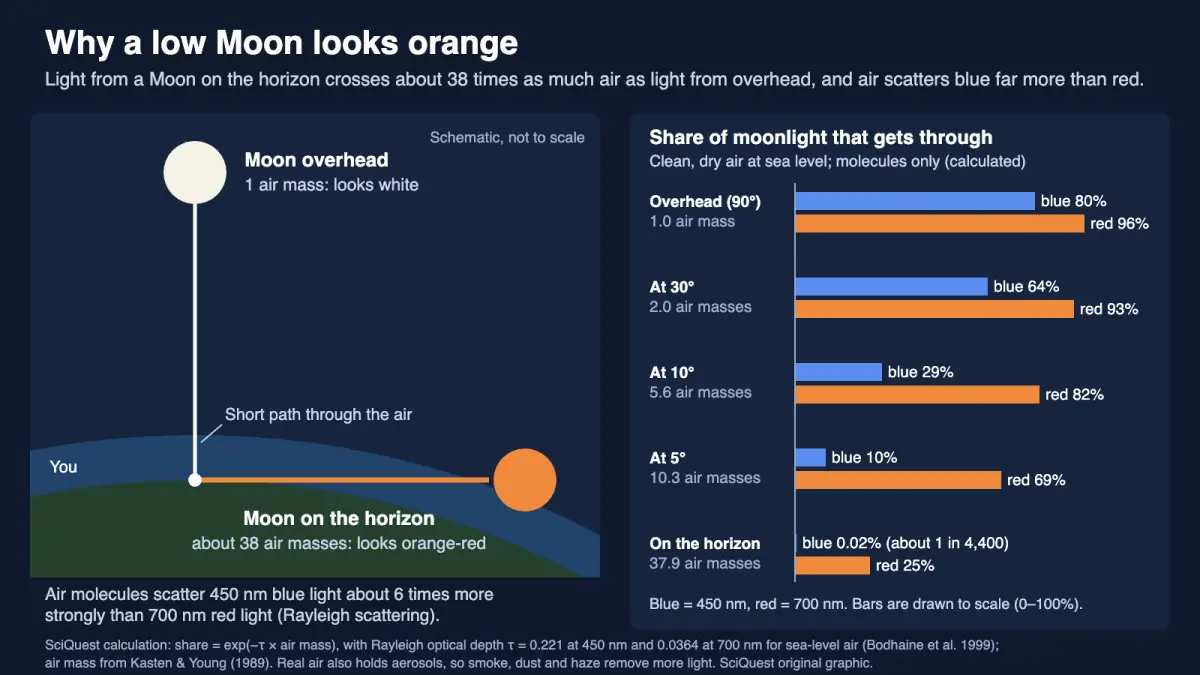
A Moon near the horizon is seen through about 38 times as much air as a Moon overhead, and in clean air that long path lets through roughly one in four red photons but only about one in 4,400 blue ones.
The Moon looks orange tonight most likely because it is low in the sky. Its light has to cross far more of Earth’s atmosphere to reach you, and air molecules scatter blue light out of the beam much more strongly than red, so the light that arrives is mostly yellow, orange and red. Overhead, moonlight passes through one “air mass” of atmosphere. On the horizon it passes through about 38.
Smoke, dust and pollution can deepen the colour, and can turn even a high Moon orange. A deep red Moon high in the sky is a different event: a total lunar eclipse, when the Moon sits in Earth’s shadow and is lit only by sunlight filtered through our atmosphere.
Explain it like I’m busy:
- A low Moon looks orange because its light crosses up to about 38 times more air, which strips out blue light.
- Smoke, dust and haze remove even more blue, so the colour gets deeper and can last higher in the sky.
- A blood-red Moon high overhead during a full Moon is a total lunar eclipse, not tonight’s everyday orange.
Key facts about the orange Moon
- Path length: the relative air mass is 1 looking straight up and about 38 at the horizon at sea level (Andrew T. Young, San Diego State University).
- Scattering: Rayleigh scattering by air molecules is inversely proportional to the fourth power of the wavelength (Embry-Riddle Aeronautical University), so 450 nm blue is scattered about 6 times more strongly than 700 nm red.
- NASA’s explanation: near the horizon the Moon “tends to have a more yellow or orange hue,” because its light travels farther through the atmosphere and more of the bluer wavelengths are scattered away.
- Particles: NASA notes that dust or pollution can deepen the reddish colour; smoke and dust are the main sources of the larger-particle scattering called Mie scattering (Embry-Riddle).
- Eclipses differ: during a total lunar eclipse “it’s as if all the world’s sunrises and sunsets are projected onto the Moon” (NASA). The next total lunar eclipse is on 31 December 2028, according to NASA’s eclipse catalogue.
| Moon’s height above horizon | Air mass (overhead = 1) | Blue light (450 nm) getting through | Red light (700 nm) getting through | Red compared with blue |
|---|---|---|---|---|
| 90° (overhead) | 1.0 | 80% | 96% | 1.2× |
| 30° | 2.0 | 64% | 93% | 1.4× |
| 20° | 2.9 | 53% | 90% | 1.7× |
| 10° | 5.6 | 29% | 82% | 2.8× |
| 5° | 10.3 | 10% | 69% | 6.7× |
| 2° | 19.4 | 1.4% | 49% | 36× |
| 0° (on the horizon) | 37.9 | 0.02% (about 1 in 4,400) | 25% | about 1,100× |
Source: SciQuest calculation. Share getting through = e−τ × air mass (Bouguer’s law, as written by Bodhaine et al. 1999), using their Rayleigh optical depths for sea-level air: τ = 0.2211 at 450 nm and 0.03642 at 700 nm. Air mass from the Kasten and Young (1989) formula. Molecules only: real air also holds aerosols, water vapour and ozone, so actual values are lower, especially near the horizon.
What 38 air masses means
Think of each air mass as one sheet of very faintly tinted glass that blocks a little more blue than red. With the Moon overhead you look through one sheet, and the tint is too weak to notice. Near the horizon you look through a stack of about 38, and the tint adds up to a strong orange.
The table puts numbers on that. Overhead, clean air passes 80% of 450 nm blue light and 96% of 700 nm red, close enough that the Moon looks white. At 10° above the horizon, red light is already 2.8 times as plentiful as blue in relative terms. On the horizon, roughly a quarter of the red survives while blue drops to about 1 photon in 4,400.
The glass comparison has a limit. Tinted glass absorbs light, but air mostly redirects it. The blue light knocked out of your moonbeam is not destroyed; it is scattered sideways into other directions.
How scientists know: scattering and path length
Why air removes blue first
Lord Rayleigh described in the 1870s how particles much smaller than a light wave scatter it, the US National Weather Service notes. Nitrogen and oxygen molecules fit that description, and the strength of the effect goes as 1 ÷ wavelength4.
Worked calculation (our wavelengths: 450 nm for blue, 700 nm for red):
- Ratio of wavelengths: 700 ÷ 450 = 1.556.
- Fourth power: 1.5564 = 5.86.
- So air molecules scatter this blue light about 5.9 times as strongly as this red light.
A more complete calculation gives a slightly bigger gap. Barry Bodhaine and colleagues at NOAA’s Climate Monitoring and Diagnostics Laboratory tabulated the Rayleigh optical depth of the whole atmosphere above sea level, a measure of how much light the air column scatters. Their values are 0.2211 at 450 nm and 0.03642 at 700 nm, a ratio of 6.07. The extra few percent comes from the way air’s refractive index and the shape of its molecules vary with wavelength.
Why the horizon path is so long
Air mass is the amount of air along your line of sight compared with the amount straight up. Andrew T. Young of San Diego State University, co-author of the air-mass formula used below, gives it as about 38 at the horizon for sea level. A simple flat-Earth formula would make it infinite; Earth’s curvature and the thinning of air with height keep it finite.
For heights between overhead and the horizon, we used the formula Fritz Kasten and Young published in Applied Optics in 1989. It gives 2.0 air masses at 30°, 5.6 at 10° and 37.9 at the horizon.
Putting the two together
The share of light that gets through is e−τ × air mass, where τ is the optical depth. For blue light on the horizon: 0.2211 × 37.9 = 8.38, and e−8.38 = 0.00023, about 1 in 4,400. For red: 0.03642 × 37.9 = 1.38, and e−1.38 = 0.25. Dividing one by the other, red light ends up about 1,100 times as plentiful as blue, relative to what left the Moon.
What changes the answer
How high the Moon is. The colour changes fastest in the last 10° above the horizon. Between 30° and overhead the table barely moves, which is why a high Moon in clear air looks white.
Smoke, dust and pollution. The table counts air molecules only. Particles add more scattering: Embry-Riddle’s meteorology tutorial says that as smoke and dust increase, more violet and blue light is scattered away and only the longer orange and red light stays visible. NASA’s Moon illusion explainer notes that dust or pollution can deepen the low Moon’s reddish colour. In July 2026, NASA’s Astronomy Picture of the Day showed the Sun glowing red through wildfire smoke over British Columbia, because smoke particles block and scatter bluer light. The same filtering applies to moonlight, which is why a smoky night can turn the Moon orange even well above the horizon.
Haze and humidity near the ground. Young notes that water vapour and aerosols can make the horizon air mass much larger than 38. Real horizon Moons are often dimmer and redder than the clean-air figures suggest.
Your altitude. Less air sits above a mountain observatory. Bodhaine’s table for Mauna Loa Observatory, at 3,400 m and 680 mb, gives a Rayleigh optical depth at 450 nm of 0.1488, about two-thirds of the sea-level value, so the reddening there is weaker.
The Moon itself does not change. Moonlight is reflected sunlight, NASA explains, and the orange tint is added on the way through our air. Two people watching the same Moon, one with it near the horizon and one with it high up, see different colours at the same moment.
Orange Moon or blood Moon: how to tell them apart
An everyday orange Moon and a lunar eclipse both owe their colour to Earth’s atmosphere filtering out blue light. The difference is where the filtering happens.
- Everyday orange Moon: moonlight is filtered on its way from the Moon to you. It happens at any phase, mostly when the Moon is low, and the colour fades as the Moon climbs.
- Total lunar eclipse: sunlight is filtered on its way to the Moon. The Moon enters the umbra, the inner part of Earth’s shadow, and is lit only by sunlight that has passed through Earth’s atmosphere. NASA says that “the more dust or clouds in Earth’s atmosphere during the eclipse, the redder the Moon appears.” It happens only at full Moon, and the Moon looks coppery even high in the sky.
Eclipses are much rarer than orange moonrises. NASA’s catalogue lists a partial lunar eclipse on 28 August 2026 and no further total lunar eclipse until 31 December 2028. Our guide to how often the red Moon occurs covers eclipse seasons, and our September 2025 blood Moon report describes the last eclipse many readers saw.
Harvest Moon and Hunter’s Moon: why autumn full Moons look orange
A full Moon rises around sunset and sets around sunrise, NASA’s Moon phases guide explains. That puts it low in the east in the early evening, when many people are outside to notice it, and low Moons are orange Moons.
NASA defines the Harvest Moon as the full Moon nearest the autumnal equinox; in 2026 it rose on 26 September. The Royal Museums Greenwich describes the Hunter’s Moon as the full Moon that follows it. NASA’s October 2026 sky guide lists that full Moon on 25 October (US dates). The names come from farming and hunting traditions. Neither Moon is orange because of its name: like any full Moon, each looks orange while it is close to the horizon and pales as it rises.
Why it matters to you
An orange Moon is a free reading of the air between you and the sky. A low orange Moon in clear weather is normal physics. A Moon that stays orange or red when it is high up suggests smoke, dust or haze aloft, and if wildfire smoke is the cause, check an official air-quality source such as AirNow or your local environment agency for conditions near the ground. The same filtering explains why the sky turns orange, red and yellow at sunset.
“But wait…”
The low Moon also looks bigger. Is the air magnifying it? No. That is a separate effect, called the Moon illusion. NASA’s “We Asked a NASA Scientist” series puts it plainly: “The atmosphere isn’t magnifying the Moon.” The same episode adds that refraction, if anything, squashes it slightly, and that a Moon on the horizon is about 1.5 percent farther from you than one overhead, because you see it from the side of the planet rather than from directly beneath it. Photographs show the Moon is the same width at the horizon as high in the sky, NASA’s Moon illusion explainer says, and there is still no settled explanation for why our brains see it as larger. Hold up a fingernail at arm’s length and it covers the Moon in both positions.
Related questions
Why is the Moon red tonight? Usually because it is very close to the horizon, where the clean-air calculation already makes red light about 1,100 times as plentiful as blue relative to what left the Moon, or because smoke or dust is in the air. If the Moon is red while high in the sky during a full Moon, check whether a lunar eclipse is under way.
Why is the Moon so big tonight? It is most likely the Moon illusion, which makes a Moon near the horizon look larger even though photographs show it is the same width. For the Moon’s real size, see how big the Moon is compared with other moons.
Why is the Moon yellow? A Moon partway up the sky, say 10° to 20°, has lost some blue but kept most of its green, yellow and red light, so it tends to look yellow before turning white higher up.
Why does the low Moon look dimmer? The same long path removes some of every colour. In the clean-air calculation only about a quarter of the red light and 2.5% of the 550 nm green light survive on the horizon. Our explainer on how far the human eye can see explains why the horizon itself sits only a few kilometres away on flat ground.
In one sentence
The Moon looks orange tonight because its light, when the Moon is low, crosses up to about 38 times as much air as when it is overhead, and that air scatters blue light away far more than red, with smoke, dust and haze deepening the colour and only a total lunar eclipse turning a high Moon blood red.
Quick check: did it click?
- About how many times more air does moonlight cross on the horizon than from overhead? About 38 times at sea level.
- Roughly how much more strongly do air molecules scatter 450 nm blue than 700 nm red light? About 6 times, from the 1 ÷ wavelength4 rule.
- The Moon is deep red, high in the sky, at full Moon. Is that the same thing as an orange moonrise? No. That is probably a total lunar eclipse, where sunlight is filtered on its way to the Moon.
Read next
- Why is the sky orange? Red, yellow and pink skies explained
- How often does the red Moon occur?
- How big is the Moon compared with other moons in the solar system?
Disclosure: This article was drafted with AI assistance and checked against the sources below. The scattering ratio, air-mass values, transmission table and graphic are SciQuest calculations from the cited NOAA optical depths and the Kasten and Young formula; they assume clean, dry air at sea level and are illustrations, not measurements of any particular night. Spotted an error? See our corrections policy.
Sources
- NASA Science, The Moon Illusion: Why Does the Moon Look So Big Sometimes? (low Moon “more yellow or orange hue”; longer path through the atmosphere; dust or pollution deepen the colour; same width in photographs; no settled explanation; fingernail test)
- NASA, Why Does the Moon Look Larger at the Horizon? We Asked a NASA Scientist, Episode 50 (atmosphere not magnifying; refraction squashes; about 1.5 percent farther; Ponzo illusion idea, no consensus)
- A. T. Young, San Diego State University, Airmass (definition; about 38 at the horizon at sea level; aerosols and water vapour can raise it)
- F. Kasten and A. T. Young (1989), Revised optical air mass tables and approximation formula, Applied Optics 28, 4735 (air-mass formula used for the table)
- B. A. Bodhaine, N. B. Wood, E. G. Dutton and J. R. Slusser (1999), On Rayleigh Optical Depth Calculations, Journal of Atmospheric and Oceanic Technology 16, 1854 to 1861 (Table 3 optical depths at sea level and Mauna Loa; Bouguer’s law)
- Embry-Riddle Aeronautical University, Scattering tutorial (inverse fourth-power law; smoke and dust as main sources of Mie scattering)
- US National Weather Service, Flagstaff, Why is the sky blue? (Rayleigh’s 1870s description; long paths redirect blue and violet)
- NASA Science, Eclipses and the Moon (umbra; “all the world’s sunrises and sunsets”; dust and clouds make the eclipsed Moon redder)
- NASA Goddard, Lunar eclipses: 2021 to 2030 (partial eclipse 28 August 2026; total eclipse 31 December 2028)
- NASA Science, Moon Phases (full Moon rises around sunset; moonlight is reflected sunlight)
- NASA Science, Harvest Moon (full Moon nearest the autumnal equinox) and What’s Up: September 2026 (Harvest Moon on 26 September 2026); What’s Up: October 2026 (full Moon 25 October)
- Royal Museums Greenwich, What are the names of full moons throughout the year? (Harvest Moon and Hunter’s Moon)
- NASA Astronomy Picture of the Day, Red Sun through Wildfire Smoke, 30 July 2026 (smoke particles block and scatter bluer light)
Discover more from SciQuest
Subscribe to get the latest posts sent to your email.
Leave a comment